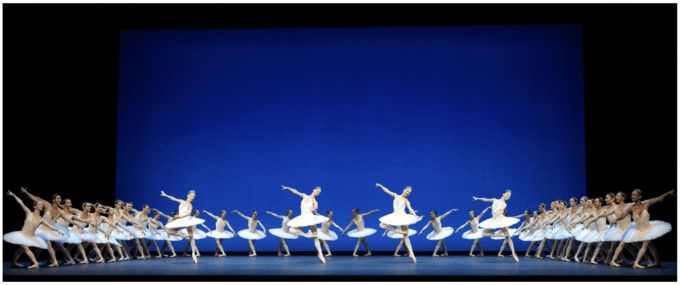
Ensemble of the Staatsballett Berlin in George Balanchine’s choreography of Georges Bizet’s Symphony in C. Photo: Carlos Quezada.
With a first name that advertises its kinship with marauding Nordic forbears and sporting a rakish diacritic at the start of the patronymic that follows, the pianist Vikingur Ólafsson got a head start on his brand right from the get-go—perhaps at the baptismal font soon after his birth in February of 1984.
That brand now belongs to one of Iceland’s biggest musical exports, though Ólafsson is not exactly right up there with Björk, the wraith-like pop star and actor who has tallied some 40 million global record sales. The pianist’s 2019 album with the lapidary title, Johann Sebastian Bach, has pushed into six-figure territory for CDs and LPs; more impressive still, the total number of streams is reported to be beyond a billion. Ólafsson’s Goldberg Variations followed in 2022 and approached the 100 million mark.
These Bachian offerings take their place in a diverse discography that runs from the baroque past to the minimalist present, from Jean-Philippe Rameau (a couple of years older than Bach) to Philip Glass (at nearly 90, still composing—and thumbing his nose at Donald Trump).
These smartly conceived and scrupulously executed albums are issued on classical music’s most prestigious label, Deutsche Grammophon. Go to that venerable company’s website and you will be treated to a masterclass in hyper-curation. There, the algal-green of Ólafsson’s velvet suit counterpoints with the splendid species of Icelandic moss on which he lies. His collar has been turned up so as to protect his pale neck from the sub-Arctic wind, even though not the slightest breeze appears to ruffle his meticulously coiffed brown hair, as lush as the Nature’s pillow that it touches. Turned onto his shoulder and towards the visitor, he makes bedroom eyes through round, professorial spectacles that want to, but won’t let themselves, glint in the northern-latitude light.
Troll further through the groves and gullies of the Deutsche Grammophon ecosystem and into its upscale habitations and you can eavesdrop and ogle as Ólafsson plays dreamy Schubert, Beethoven, and Bach in remote modernist villas of concrete and glass, their super-stylish interiors accoutered with furniture and objets by the latest Nordic designers. Near a polished black Steinway, the flames in a high-efficiency wood stove dance to the music he exquisitely makes. Among Ólafsson’s many artistic achievements, the most lasting is to have elevated Bach’s music to a lifestyle choice.
I don’t know if the pianist blew into Berlin from his home in Reykjavik for the weekend’s run of three concerts with the Berlin Philharmonic that included his flawless, if somewhat circumspect, performance of Beethoven’s Piano Concerto No. 5—nicknamed “The Emperor”—under the direction of guest conductor Semyon Bychkov. The sobriquet derives from the grandly heroic themes and the work’s rousing mix of contest and cooperation with the orchestral forces. The concert stage becomes both a temple of oratory and a battlefield, and Ólafsson, wearing a bow tie and black velvet jacket highlighted by the trademark colorful kerchief in his breast pocket, imbues the Emperor’s main theme with commanding authority and sallied through the swashbuckling arpeggios, galloping octaves, and dashing double trills with unerring resolve. After completing these various maneuvers—a veritable keyboard decathlon—he would throw up his hands in grand arcs and toss back his head (and with it his excellent hair) in gestures more balletic than martial.
Having impressed, if not exactly conquered, in the three flats of the opening E-flat-major Allegro, Ólafsson drew the packed audience in for an intimate fireside chat in four sharps for the B-major second movement, the piano’s reverie accompanied by muted strings. The key is simultaneously close by yet impossibly far away from that of the outer movements, and Ólafsson would have been happy to stay at its glowing hearth for much longer. But that inevitable half-step slide from a B-natural to a B-flat by the bassoon broke the spell. The finale’s romp was fast, but not furious, more exercise than ecstatic celebration. A solo encore was demanded and delivered—a transcription of Bach’s Air on the G String. This freeze-dried chestnut flaked and crumbled as it was warmed under Ólafsson’s ginger touch. Never has cliché been so fragile.
After the intermission, a far more harrowing heroism followed with Shostakovich’s Fifth Symphony. Whereas Bychkov seemed to be a rather dutiful field officer in the concerto and in Beethoven’s blood-curdling Coriolan Overture that had opened the concert, he rose to, and beyond, the physical and emotional challenges of his older compatriot’s forty-five-minute epic. Premiered in Leningrad in 1937, Shostakovich’s Fifth Symphony marked the composer’s return, if temporarily, to official favor after he had run afoul of state authorities with his notorious opera, Lady Macbeth of the Mtsensk District, three years earlier.
Bychkov fled the Soviet Union in 1974 and emigrated to the United States the next year at the age of twenty-two, but he never left the Russian masterpieces. Conducting from memory, he proved that the European symphonic tradition courses through his veins and through this work, in which Mahler is quoted, Bach-like canons are brandished, Beethoven’s ghost continually appears, and ultimately triumphs in the dauntless fourth-movement finale.
I sat in the benches just behind the orchestra in this hall-in-the-round. From there, Bychkov’s face was front and center, and I could see it contorting and grimacing against Shostakovich’s shifting harmonies, searing dissonances, and blasting brass. Bychkov was wide-eyed at the outbreaks of mischief (as in the third-movement scherzo), stern against the military snap of the snare drum, and mournful in the repose—or is it despair?—at the end of the Largo, before setting his jaw for the concluding call to arms.
The ultimate victory is proclaimed by a mighty gong that had been silent for nearly three-quarters of an hour. Cymbals crashed and the timpani barrage buffeted the massed tutti. Was this fortissimo bombardment a statement of moral principle, artistic aggression, or a strategic calculation according to which the best offense is a good defense? Maybe a musical masterpiece such as this can be all these things at once.
In the immediate aftermath of the Shostakovich storm, silence reigned, but not calm. Red-faced and sweat-drenched, his hands frozen in front of him as if clinging to the vanishing echo of an entire symphony, Bychkov stood, stooped and motionless, ready to expire at the moment of demobilization. But then, after an epic, unwritten fermata obeyed in unison by audience and orchestra, the conductor breathed again and the applause exploded. The septuagenarian maestro mustered a resigned smile and began the ritual acknowledgment of applause and the meting out of honors to the soloists and sections and to the whole orchestral regiment.
After these hyper-heroics on Friday in the Philharmonie, Saturday night brought beauty and transgression from the Staatsballett in a performance at the State Opera House of a canonical work by George Balanchine (another Russian emigrant to the United States), followed by the premiere of a piece by the Berlin company’s artistic director, Christian Spuck.
Prompted by his friend Igor Stravinsky, Balanchine chose Georges Bizet’s four-movement Symphony in C for his authoritative exhibition of ensemble synchronization, inventive and assured partnering, and kaleidoscopic solo virtuosity in which athleticism is transformed into an aesthetic act. The teenage Bizet’s emulation of the Viennese greats of the previous century (Mozart and Haydn) served as the perfect vehicle for Balanchine’s comprehensive neoclassical choreography. The balanced phrasing, profiled succession of motives, larger architectural structures, and facile craftsmanship of Bizet’s essay in emulation allowed Balanchine to put his famous dictum—“See the music, hear the dance”—into dazzling practice when the work debuted in Paris in 1947.
The stringent yet supple style he imposed on his female dancers was no longer to be hidden behind flowing diaphanous garments that extended even below the knee. So, Balanchine, working with his costume designer Barbara Karinska, developed the “powder-puff” tutu that pressed and layered the diaphanous, cloud-like skirt of yore into a sharp vertical axis that horizontally bisected the ballerina’s body, accentuating her torso and exposing the entire length of her legs to full view. The precise movements of the limbs could now be admired by the audience and policed by the imperious ballet genius: regimentation as exaltation. It fell to Sandra Jennings to teach the company this half-hour tour de force and monument of the repertoire. The brilliant revival renounced every trace of ironic distance, even when a crisp chorus line of Balanchine ballerinas bobbed on pointe to Bizet’s coyly retrospective capers.
A foil to such imposing yet appealing formalism came after the intermission in Christian Spuck’s confrontation with American composer John Adams’s orchestral work Fearful Symmetries of 1988. That title had been adopted for the evening’s entire program, but it also spoke to the daunting prospect facing any contemporary choreographer brave or foolish enough to go head-to-head with the great Balanchine.
In contrast to the starched white women’s costumes of Symphony in C, the dancers of Fearful Symmetries wore purples, browns, grays, dark greens and darker reds. These hip-hop hues and the dancers who donned them alternated with a Queen and three courtiers (Jester, Lover, Alchemist) in black. The contemporary was in ever-shifting conversation and sometimes conflict with this quartet, conjured as if from the Elizabethan era. The sovereign’s Renaissance wig of pyramid curls could almost have been a reference to the powder-puff tutu or to the Euclidean angles of Balanchine’s kinetic art. The dialogue staged by Spuck between shifting groups of two and three dancers alternated with solos and still fuller formations and fluxes. The strict angularity of Balanchine’s symphonic structures was reshaped into fluid contours and connections, as Adams’s orchestra chugged along like a 1940s swing band on autopilot, occasionally relaxing into reverie before being wound up and set in motion again. The royal quartet could have represented not only the ancien régime but also the autocrat Balanchine. At the end (of the evening and, apparently, an era encapsulated in just twenty-five minutes), the queen and her entourage were banished from the stage and from history, but the up-to-date dancers kept moving even after the music had ground to a halt and the curtain fell. Maybe they’re dancing still, provocatively asymmetrical, but occasionally in line with an ever-present past.