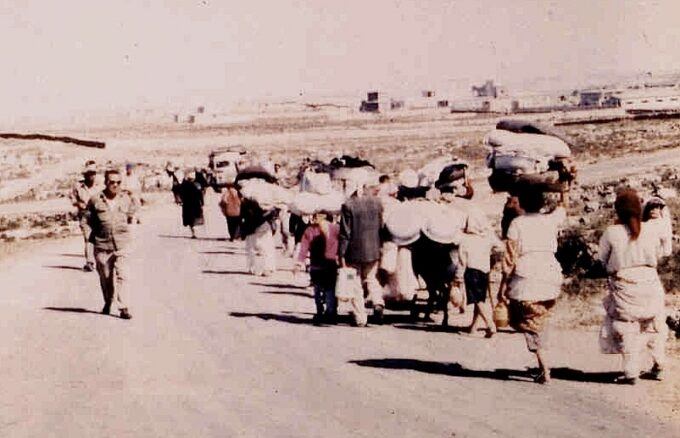
Israeli soldiers expelling the residents of Imwas – Public Domain
On June 5, 1967, over six days, some three hundred thousand Palestinians were driven from the West Bank, East Jerusalem, and Gaza. For roughly half of them it was a second expulsion in under twenty years. The official account calls it a war Israel had no choice but to fight. Menachem Begin admitted otherwise: the Egyptian troop movements, he said, “do not prove that Nasser was really about to attack us,” and Israel chose to strike first. What the war secured was the territory Israel still occupies today. Palestinians called that June the Naksa, the setback. Fifty-nine years later, it is not something we look back on but something we still live inside — what Mahmoud Darwish called an extended present.
We write as Palestinian mental health professionals, in Palestine and in the shatāt. We know from our work that dispossession is never only a matter of borders and demography. It is a wound to the psyche, to a person’s sense of who they are and where they belong. Forced displacement does not end when the trucks stop. It lives on in the body, in the family, and in the children of the people it first uprooted.
And the harm is deliberate. What the Zionist entity pursues is not only land but the murder of the Palestinian soul, the slow unmaking of a people’s inner life. In the prisons, the United Nations Secretary-General’s report on conflict-related sexual violence verified rape and genital violence against Palestinian men, women, and children in Israeli custody, and for the first time listed Israel’s forces among those credibly suspected of such crimes. Inside the lands taken in 1948, Palestinian citizens of Israel face the same logic: Bedouin homes demolished by the thousand in the Naqab, people arrested over a post or a protest, grief and solidarity treated as offenses. To live through all of this and then be told your suffering cannot even be spoken is an injury in itself. Our profession has no right to watch it in silence.
The setback that has not ended
This week the clearest case is Lebanon. Israel signed a ceasefire and then used it as cover for war. After thousands of violations of the November 2024 truce, it opened a new assault in late February that has killed more than three thousand four hundred people and emptied cities across the south. Its forces have crossed the Litani, taken Beaufort Castle, and pushed north, and the bombing continues as we write. Many of those under the bombs are the refugees of 1948 and 1967 living in the camps of the south, displaced once more from the very places they had fled to. One of our sister networks works there, under fire.
Inside Palestine, the displacement of 1967 is happening again, in plain sight.
In the West Bank, 2026 has brought the highest rate of demolition-driven displacement in the seventeen years of UN records, alongside settler violence the UN calls unprecedented: roughly six attacks a day, hundreds injured, mosques and olive groves burned. The settlers do not act alone. The UN has found Israeli forces directing, joining, and shielding the attacks, until state and settler violence can no longer be told apart. In May, more than a hundred and thirty Bedouin villagers, most of them children, were driven from Jiljiliya, refugees expelled all over again, while B’Tselem records whole communities emptied off their land at a rate not seen in decades.
None of this is hidden; it is announced. Since early 2025, Israeli forces have emptied the refugee camps of the north, Jenin and Tulkarem, driving out some forty thousand people in the largest forced displacement the West Bank has seen in nearly sixty years. Israel’s finance minister, Bezalel Smotrich, who also governs the settlements, has called for annexing most of the West Bank and for “encouraging the migration” of its Palestinians; the stated aim is as much land and as few Palestinians as possible. This April, at the rebuilding of a settlement evacuated two decades ago, he declared that Israel was “abolishing the disgrace of expulsion, killing the idea of the Palestinian state.” His government is now advancing the E1 plan, a settlement bloc east of Jerusalem meant to split the West Bank in two and seal off East Jerusalem, and has ordered the expulsion of the Bedouin village of Khan al-Ahmar to clear its path. The word for all of it is the same word we used in 1967.
In Gaza, the ceasefire announced in October 2025 held only on paper. Its first six months brought more than two thousand four hundred violations, with hundreds more killed since. The territory is now split by a “yellow line” behind which Israel holds close to two-thirds of Gaza, having pushed it steadily west of the truce terms; Palestinians who cross that line, or only stray near a boundary often left unmarked, are shot on sight. The dead exceed seventy-two thousand,more than twenty-one thousand of them children, and tens of thousands more have been maimed. Famine has been confirmed, and most of those who have starved to death are children. These are not statistics to us. They are the patients, parents, and children we are supposed to be able to help.
In the prisons, more than nine thousand six hundred Palestinians are held: some three hundred and fifty of them children, more than three thousand five hundred without charge or trial. Over a hundred have died in custody since October 2023 under torture, starvation, and medical neglect; the bodies of dozens are withheld, and others have been disappeared. Israel’s parliament has now passed legislation toward executing prisoners. None of this is the system breaking down. It is the system working.
What the world’s institutions have already found
The naming has already been done, at the highest levels of law. In September 2025 the UN Commission of Inquiry concluded that Israel has committed genocide, finding four of the five genocidal acts and placing intent at the top of the Israeli government. The International Court of Justice has ruled the occupation unlawful and found Israel responsible for apartheid, and in the case brought by South Africa it found genocide plausible and ordered Israel to prevent it. Israel ignored those orders. The International Criminal Court has issued arrest warrants for Israel’s prime minister and former defense minister. Amnesty International and Human Rights Watchhave each found genocide, apartheid, extermination, and persecution. None of this is contested by the institutions built to judge it. The only open question is whether it may be said aloud.
The silence is not neutral
The crimes of the Zionist entity are now plain for everyone to see; they cannot be hidden in the open anymore. So the work of erasure has shifted onto the institutions, onto what the bodies that shape knowledge and conscience are allowed to say. The killing is one form of violence; forbidding it to be named is another, and the second protects the first. We see this in the institutions closest to us. The American Psychological Association moved to censor a lecture by Dr. Mansoor Malik. Springer Nature retracted a chapter by Samah Jabr, Sarah Mohr, and Elizabeth Berger on genocide and Palestinian collective trauma. A special issue of Psychoanalytic Inquiry appeared while refusing the word genocide. The International Psychoanalytic Association condemned Russia’s war within days, yet across two years and tens of thousands of deaths it has named no crime in Gaza and called for no ceasefire, pleading legal constraints it never found when the war was in Europe. Its silence was not neutral. An IPA committee cast the assault as a fight of “light against darkness,” and its president could bring herself to acknowledge only the suffering of “non-terrorist Palestinians,” as if a Palestinian had to prove she was not the enemy before she was worth mourning.
Once the highest courts have named the crime, refusing to name it is not neutrality. It is a way of controlling what people are allowed to know — what scholars call academic denialism: careful, administrative language that lets a genocide be filed as a “conflict.” The same move drives the demand for “balance.” One clinician describes trying to name the trauma of Palestinian children and being told instead to keep “balance and objectivity,” the appeal to evenhandedness arriving exactly where a child’s pain was about to be spoken. This is the kind of harm we are trained to recognize: a person seen, counted, and documented, and left unprotected all the same, while accountability never comes and the killing goes on.
So we ask our colleagues in mental health, wherever they work, to keep naming it: the genocide, the apartheid, the torture, and the silence that shelters them. Naming costs us something. Refusing to name costs the people we are meant to serve far more.
Why we speak, and whom we thank
We refuse this erasure by naming what it hides. A people cannot mourn what it is not allowed to name, and without mourning there can be no repair.
Our gratitude goes, above all, to our sister networks — in Abya Yala, Argentina, Australia, Chile, Cyprus, Egypt, France, Germany, Greece, Indonesia, Iraq, Ireland, Italy, Jordan, Lebanon, the Netherlands, Palestine, South Africa, Spain, Sweden, Tunisia, the United Kingdom, and the United States — who have not abandoned us. And to the psychoanalysts who resigned from the International Psychoanalytic Association rather than lend their names to its silence, and who let their names be known: the founders of the Germany–Palestine Mental Health Network, Ferisde Eksi, Michals Kaiser-Livne, Iris Hefets, and Shirin Atili; Mary Adams and Denise Cullington in the United Kingdom; and Avgi Saketopoulou, Molly Merson, and Danny Gellersen in the United States. They resigned at real professional cost. What they did was harder than private disapproval: they withdrew, and they carried into their institutions the same thing we hold to in the consulting room, a refusal to become instruments of harm against the person in front of us.
Fifty-nine years on, we mark the Naksa not to lay it to rest but to insist that it has never ended. We will keep saying what is being done, and who is doing it, and we will not stop until saying so no longer takes courage.