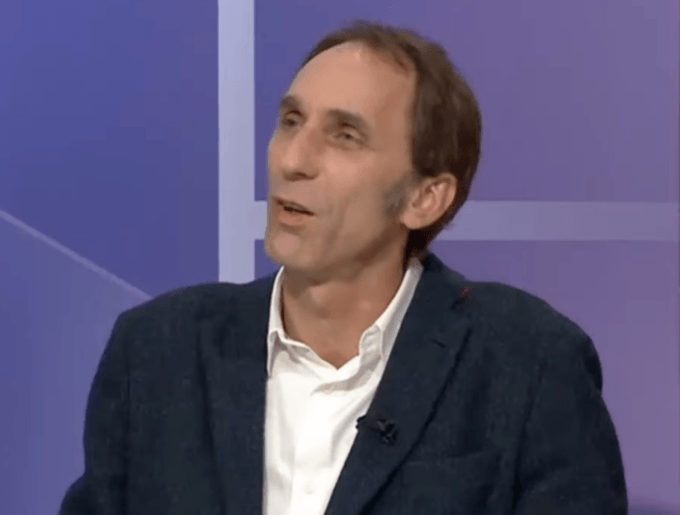
Will Self on Question Time. (Screegrab.)
I hadn’t realised how much I’d missed hearing Will Self until he reappeared. While I was sorry to learn he had been unwell, I found myself unexpectedly delighted by two recent TV appearances: first in an interview filmed at his south London home, the window open for health reasons; then on a Sunday morning broadcast, where his independent trains of thought darted about like sticklebacks through the mossy rocks of everyone else’s Sunday consensus. I remembered why I liked him.
I recalled seeing him on a train once with his children. We were travelling back to London. I was with the artist and our own children, and although he may never have noticed us—we were at the far end of a long carriage—I clocked him at once. Coming from Broadstairs, it felt Dickensian. Yet what stayed was the kind of father he was. Not having really known my own, I have always been curious about how other men inhabit the role, and what I saw that day was a man wholly engaged in it.
I had still not read much of his fiction, though I did enjoy Great Apes. The idea alone of a writer called Will Self had always been appealing, and not just to me. Before I had seen a photograph of him, I had half-suspected he might be fictitious. Then I felt certain I had, in fact, seen him before I left for America: tall, in a rain-darkened overcoat, somewhere near the French House on Dean Street, moving through Soho like a figure from a memory in the making. Or was it in a shadowy squat in Kings Cross?
Then, when I returned to Britain five years later, curious to see how the culture had changed, Will Self seemed to function as a cultural barometer, registering every shift in atmospheric pressure. A few years later he was fired from a job after another journalist, writing for the Express, reported that he had been snorting heroin in the lavatory of John Major’s election campaign jet, Self having decided that with so much security around he should probably vanish his drugs. While I found—and still find—the other journalist’s behaviour unforgivable, I watched Self thereafter become unacceptably stigmatised for his addiction. That stayed with me.
Then, on my second trip to Lashkar Gah in Helmand, I found myself among a group of British officers that included a former commanding officer of 22 SAS. What did this have to do with Will Self? Quite a lot, as it turned out. Back in London, one of the officers—by then retired—told me he had been meeting regularly with Self, who was researching a novel.
I was impressed the writer should be seeking out someone who knew the spikier end of Britain’s questionable war in Afghanistan. Of course, any resulting character in the book would be a creature of the novel rather than a portrait of the man supplying the raw material, and I wondered if he realised that.
In the meantime, the artist went to hear Will Self speaking in support of another artist at a small chapel here in London. She told me Self left immediately after speaking—a detail which, rightly or wrongly, I associated with the habits of sobriety.
The next time Will Self crashed into everyone’s social media feeds—as well as onto the pages of our not-so-noble press—was during a period of domestic unhappiness for him which I will not go into here. Suffice to say, it belonged to a distinctly English tradition of public dissection masquerading as moral concern. Once again, Self was treated less as a person than as material.
After distancing himself from the television culture that had helped make him famous, which he had come to regard as fundamentally trivialising, he openly insisted he no longer wished to function as a “professional controversialist.” It is not difficult to understand the frustrations behind such a judgment. English culture has its closed shops, and fresh air does not always find an easy way in.
Having Will Self back—and long may he persist—is rather like climbing a mountain and suddenly seeing someone half-remembered emerge from the nearest cliff face, climbing irons dangling from his waist like pans. One reason he feels so welcome is that so much British media now appears beholden to interests it rarely acknowledges.
If Self had retreated from some forms of public life, it was not from public reflections on health. In essays and interviews alike, he became increasingly preoccupied with mortality, bodily decline and, not least, sobriety.
Discussing his blood cancer recently—polycythaemia vera progressing towards myelofibrosis—Self reflected on the 2024 Russian cyberattack on London’s blood-testing services. This assault on NHS pathology systems had, he explained, affected him personally.
Cyberwarfare, he took the opportunity to argue, was no longer an abstract geopolitical threat but a force already shaping everyday British life. Once again, Self was acting as a kind of cultural barometer, registering a change in atmospheric pressure before much of the country had even noticed it.
His latest bête noire is the smartphone: “So, phone addict, don’t confuse connectivity with understanding,” he writes.
I once read or heard that he returned to using his mother’s electric Olivetti typewriter, partly in protest over the frictionless creative lanes down which most writers are expected to travel on their personal computers these days. This independence I not only admired but deeply envied.
Will Self’s SitRep blog has, for me, rapidly become required reading. There he continues to publish criticism and long-form journalism. Most recently he recalled the laughter of his late publisher Liz Calder at Bloomsbury after reading his novel Cock about a dissatisfied housewife who mysteriously grows a penis: “I sometimes wonder whether she would laugh in quite the same way now. Not because the book has changed, but because the ecology around literature has changed almost beyond recognition.” The observation strikes me as characteristic.
Thankfully, whether writing about literature or war, Self remains unusually alert to the environments in which people think and behave. Of Ukraine he wrote lately: “Civilians witness fires and hear drones overhead, and their reactions become part of the feedback loop. The war is everywhere and nowhere, continuous and yet never conclusive.”
Today, watching Will Self rub his eyes or scratch his wrists on TV while discussing his new novel, The Quantity Theory of Morality, I am newly aware that what appears effortless cannot always be so.
I doff my crumpled hat to him.