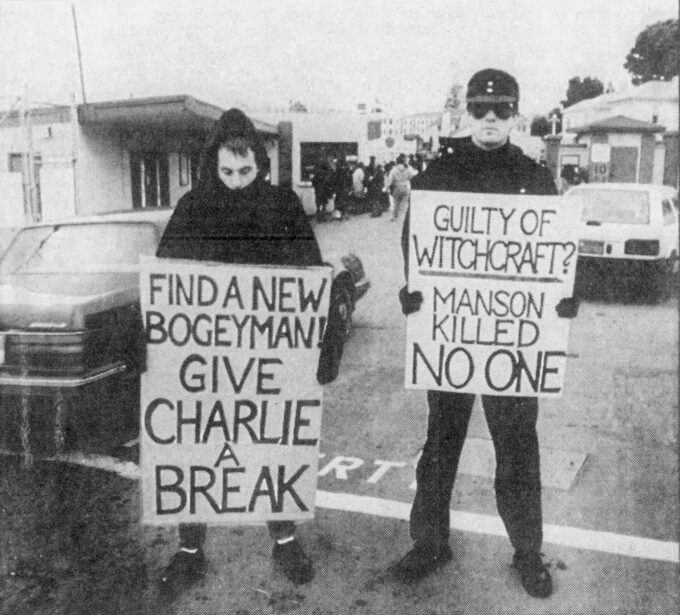
Boyd Rice (right) and a man who only identified himself as “White” protesting for Charles Manson after he was denied parole – Public Domain
Charles Manson was an archetypal American in a manner similar to Donald Trump. Both men convince(d) others to do things against their better sense, moral training and counter to their own interests. The particular charisma Manson and Trump project is one that is based in the amplification of people’s fears while creating an illusion of their difference. Charles Manson was considered above conventional morality and something of a demigod by his followers and supporters; Donald Trump is placed above the law by his followers, with some genuinely believing he is a prophet and spiritual figure placed in the White House for godly purposes. More to the point, both men are sociopaths with minimal regard for the rest of humanity. Although Manson seemed to consider money only as a means to an end, Trump’s obsession with money borders on worship. Both enjoy(ed) and manipulate(d) power.
In a new book titled Love and Terror: The Helter-Skelter History of the Manson Murders, the author Claudia Verhoeven expands the above comparison to Trump to include much of the entire culture of the United States. Indeed, she makes a convincing argument that Manson is the USA, just like Nixon, Trump, rock and roll, and Hollywood are; not all of its culture, but as much a part of it as influenced by it. Ignorant and brash, insightful and confused, religious and blasphemous. It’s a bold statement that has more than a kernel of truth in it. After all, Manson was not the first or the last US resident to use the nation’s foundation in white supremacy to further his vision and Donald Trump will most likely not be the last.
The book itself is a critical exploration of the so-called Helter-Skelter history of the Manson family murders in Los Angeles in 1969, the formation of the family and the aftermath of those murders. For those who are either unfamiliar with the story or have forgotten it, here’s a quick review. In August 1969 a group of young people killed several people in the city of Los Angeles. The first people murdered were alleged to have somehow ripped off or offended Charles Manson, while the others were either members of the film community or extremely wealthy—some were both. Within days of the latter two sets of killings, the US national media had already begun to sensationalize the deaths and the victims. Like many crimes of this type—seemingly random and without motive—it took awhile before the police narrowed their investigation. Indeed, if the members of the Manson family had not been involved in car theft and other illegal activities, it may have taken the police considerably longer. If Manson follower Susan Atkins had not bragged about her involvement in the murders of Sharon Tate and her friends while in jail after being arrested for theft, the family could possibly have made a getaway to a hideout being prepared by them in the desert east of Los Angeles, making the investigators’ work even more difficult. In the meantime, the local and national media were having a field day speculating about the murders, especially those in the house rented by Sharon Tate.
Verhoeven goes over the murders, sparing the reader the particularly gruesome details while framing them in the zeitgeist of the time; the war in Vietnam, the Woodstock festival, Nixon’s intensification of the police state apparatus against the New Left, the counterculture, the antiwar movement and the Black liberation movement. In her telling of the history, which ranges from intimate details to general reminders of the state of the US nation, Verhoeven considers the nature of Manson’s beliefs, the process of gathering his followers, his social connections in the often-weird world of LA, and his personal history from Kentucky to Spahn Ranch and numerous prison facilities in between. Her discussion of what she calls the Helter-Skelter history takes on prosecutor Vincent Bugliosi’s presentation at the trial and in his book Helter-Skelter; not because it wasn’t relevant to Manson’s vision, but because her study found Bugliosi’s presentation to have left out some important interviews and other evidence in order to portray Manson’s concept of race war and a postwar ruled by him as more coherent and logical than it actually was.
I remember various writers in the underground and liberal press making the case that the massacre perpetrated by Manson’s followers was more similar than different than the US Army’s massacre of hundreds of Vietnamese in the village of My Lai. The comparison was probably made because the slaughter in MyLai became public knowledge in November 1969, three months after the Tate-LaBianca murders and the growing hysteria around those murders. A main point of the comparison was that if Manson and his followers had been soldiers in a US war, the murders would have probably gone unpunished, if not completely ignored. In addition, Manson—like most of the Army officers who covered up My Lai—would probably not have been charged. The My Lai atrocity was but one such incident in a war not only filled with similar atrocities, but an atrocity in and of itself. Somewhat ironically, the first verdicts in the Manson trials came down the same day as Lt. Calley was convicted for his role in the My Lai massacres.
Author Verhoeven notes that Manson is, as she says, a “slippery” subject. He seemed to pride himself on this characteristic, while this text proves the difficulty of pinning down exactly what his motives were and how they should be considered. With every attempt to answer a question regarding Manson, his followers and their motivations, more questions are raised. Love and Terror’s discussion of the Manson family, the murders, and the aftermath immediate and long term is both captivating and worthwhile; as a true crime piece, a study in US whiteness and an in-depth consideration of a society that creates phenomena like the Manson family.