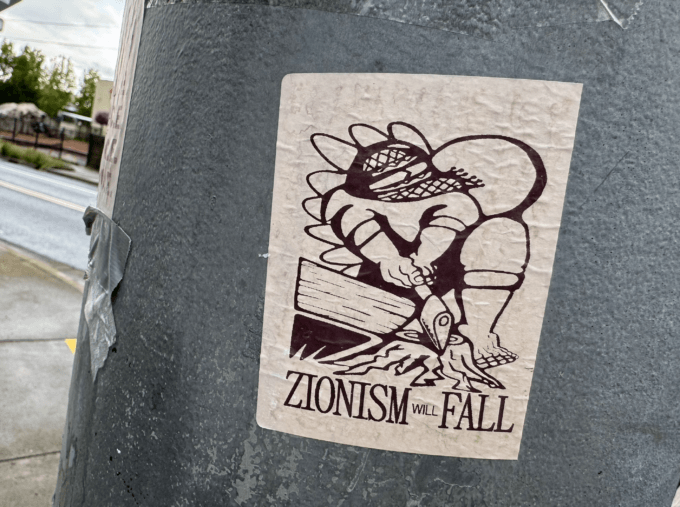
Photograph by Nathaniel St. Clair
The images that have emerged from Gaza reveal the anatomy of a desolate landscape that defies human comprehension. Nothing can prepare the conscience for the sheer suffocating scale of a seemingly endless treeless terrain overwhelmed with millions of tons of concrete and rebar.
There is a distinct agonizing geometry to the destruction of buildings folded upon themselves. The angles, lines and shapes of neighborhoods have been completely warped, creating a jarring unnatural landscape of ruins, where once familiar streets, blocks and landmarks are now unrecognizable. The steel and mortar that once housed generations of families, communal memories, bustling markets, and schools full of children eager to learn, have been leveled into a desolate sea of gray.
The human spirit cannot comprehend the reality of tens of thousands of Palestinians entombed beneath mountains of pulverized concrete. The very air of Gaza carries the heavy toxic dust of war and of extinguished lives.
To gaze upon the ruins, is to confront not only its physical erasure, but the malign systematic campaign of the Israeli regime to wholly erase Palestinian ethnic, cultural and national identity—the very definition of genocide.
Systematic and indiscriminate aerial campaigns have decimated entire family units across multiple generations, erasing entire family lineages. These attacks not only erase collective histories, they inflict profound trauma and deep psychological scars upon survivors.
The level of death, destruction and scale of human suffering is unparalleled in modern history. Survivors of this holocaust must navigate a daily visceral reality. Each day is a battle for survival against Israeli atrocities, extreme spatial restrictions and the distress of living among the collapsed skeletons of their destroyed homes and memories.
Because the oppressive realities of daily life rarely break through the filter of the legacy media, the public remains largely insulated from the true scale of the catastrophe. They are shielded from knowing, for example, that the widespread destruction of municipal water and sanitation infrastructure has resulted in raw untreated sewage flooding makeshift tents and displacement camps across Gaza. And that sweltering heat, piles of uncollected trash, and disease spread by rodents and insects have led to a public health crisis; made worse by Israel’s blockage of crucial medical supplies and other crucial aid.
Tel Aviv’s aim is to make life completely unlivable, to create unbearable conditions that do not allow for survival and dignity. Israeli defense minister, Israel Katz, said as much when he unveiled Israel’s plan for the mass expulsion of Palestinians from Gaza; a forced deportation ethnic cleansing scheme he described, in true Orwellian manner, as “voluntary migration.”
Since the so-called October 2025 ceasefire, violated by Israel 2,400 times, Gazans have been forced into an ever-shrinking sliver of their enclave. As Israel seeks to completely occupy Gaza, it has unilaterally expanded its concocted “yellow demarcation line,” effectively bringing some 64 percent under its control.
Earthen barriers and military bases constructed along the shifting yellow line, have walled off Palestinians from accessing their land and most of the strip. Those Gazans who come near the Israeli designated “no-go” zones are killed.
Israel continues to push deeper into Gaza, corralling two million Palestinians into 56 square miles of makeshift camps along the coast. Recently, Israeli prime minister and war criminal, Benjamin Netanyahu, ordered the military to seize 70 percent of Gaza, with 100 percent as the final objective.
Faced with a ruined landscape and realities that defy comprehension, Palestinians continue to demonstrate a spirit of defiance and unwavering hope. Proving that the human spirit cannot be crushed, they are actively trying to rebuild their lives.
Although Israel has tightly restricted the entry of essential construction material and heavy equipment, Gazans are repurposing rubble, crushing concrete and scrap metal to clear routes and to pave areas for tents and community kitchens. They use whatever they can find (iron, window and door frames) to make partially damaged structures habitable.
While agencies such as the United Nations Development Program estimate that clearing the debris will take years, true reconstruction must also address the monumental task of rebuilding the human spirit.
However, extolling Palestinian strength in coping with incredible hardships should not overshadow the cruelty of the conditions Israel has forced them to navigate and the horrendous injustice of their circumstances. Exhausted and terrified, they have no other choice but to live through and resist Israeli violence. Endurance—the very act of surviving—becomes an act of fierce resistance.
To comprehend the enormity of this 21st century tragedy, it is important to look beyond today’s stark ruins to the rich enduring legacy of Gaza’s more than 5,000 year history.
Since antiquity, Gaza has been a vital Mediterranean coastal hub, a rich oasis and crucial political crossroads connecting Africa and West Asia. This historical crossroads of civilization, positioned squarely on ancient trade routes, was repeatedly conquered and reshaped by successive empires, from the Romans, Persians to the Ottomans. To this day, it remains the key to war and peace in the region.
Gaza became part of the British empire, under the Mandate of Palestine, following World War I. Its administration passed to Egypt at the end of the Arab-Israel War in 1948.
Israel gained control over the strip as a result of the 1967 Arab-Israeli War, establishing civilian “settlements” in the territory. After 38 years of occupation, it ended its physical presence, evacuating settlements and withdrawing its military in 2005. However, by maintaining dominance over Gaza’s airspace, coastline and borders, Tel Aviv continued de facto control. In 2021, the barrier, dubbed the “iron wall,” constructed to surround Gaza, was officially completed, converting the strip into an “open-air prison.”
Since declaring statehood in 1948, Israel has waged 15 wars against the Palestinians in Gaza. The current unprecedented bombardment and siege is by far the longest and deadliest.
In addition, for more than three months, Tel Aviv and Washington have been engaged in a war to silence the Islamic Republic of Iran, a nation that has consistently answered the Palestinian call for justice, freedom and self-determination.
Israel’s prolonged, relentless war on Gaza is a testament to the moral failure of the international community, and an indictment of the American-led global order.
Recovery transcends physical reconstruction. It insists upon restoring human agency, guaranteeing fundamental rights, and honoring the inherent dignity of the Palestinian people.