Photo courtesy of Ken Jones.
There is nothing like walking quietly with a group of committed people through the hot Arizona desert to bring home the deadly reality faced by migrants coming to the U.S. through its southern border.
Thousands of migrants have made this journey over the years. Forced into the Sonoran desert by the inhumane U.S. Prevention Through Deterrence policy and hunted by Customs and Border Patrol (CBP), they have endured blazing heat and scarcity of water and shade as they have desperately sought asylum and a better life. Some have made it through, but many have not. Over 8000 migrant deaths have been recorded over the past 30 years. And there are many more whose bodies have not been found.
Twenty-three years ago, a small group of activists in the Tucson area got together and initiated the Migrant Trail Walk. At the time, they thought they could put an end to this murderous policy by raising public awareness about it. That hope faded, but the walk has continued every year as a way of bearing witness to the suffering and loss of life that have ensued.
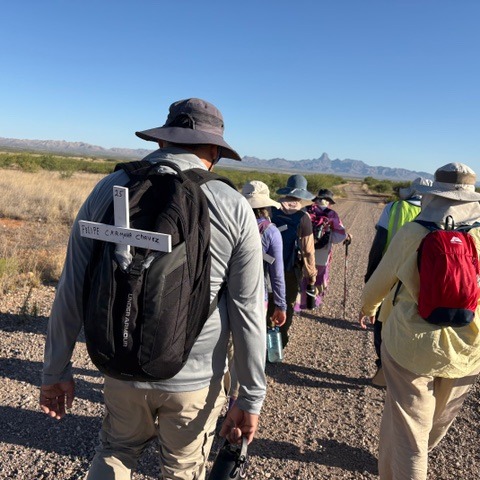
This year, in late May, I joined 40+ activists on this week-long 75-mile walk. What I experienced was a physical challenge, but still only a solidarity gesture towards the migrants. We had support vehicles that carried water and food, shade canopies, port-o-potties, and medical assistance, along with air conditioned cars for people to get into when the walk in the heat proved too much. We camped out together, kept each other safe, and were well organized with radio communications, planned rest stops, and allies who visited and were on call.
Most of all, we were not being hunted down by Border Patrol, with its ceaseless patrol cars, check points, drones, planes, blimps, surveillance towers, motion detectors, and god knows what else.
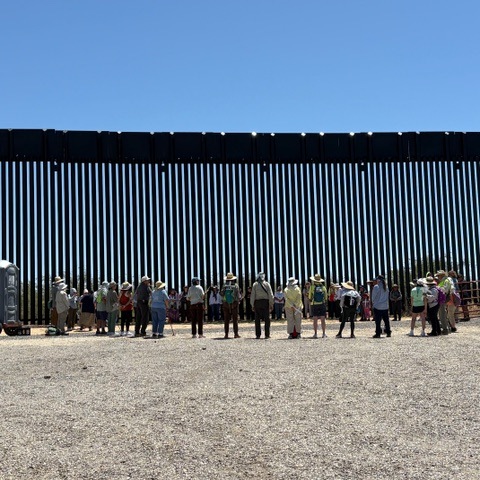
Photo courtesy of Ken Jones.
But the walk was also much more than just a physical thing. It was a spiritual journey focused explicitly and continuously on the migrants for whom we were walking. Our purpose was to honor and accompany them, whether they have passed away or are still here.
Our intention in the walk was kept front and center in many ways. For example, we all wore or carried crosses with the names of migrants who had died in the desert. Actually, most of us had Desconocido (Unknown) on our cross, as some 80% of dead bodies found in the desert have not been identified.
On every other 1.5 mile leg of the walk, we walked in silence, absorbing the presence of the desert and contemplating the hardships of those migrating. As we arrived at our rest stop, we each, in turn, would call out the name on our cross and the entire group would respond by raising crosses and calling out, “¡Presente!” It was a very grounding and moving ritual.
I think of this walk, and other peace walks, as political actions. If holding a sign on a corner or bridge is political, so is walking with an intention and presence that expose the realities of government-inflicted killings.
To what end, you might ask? Why put yourself through a trying experience like this when it likely won’t change a thing? To me, it’s just about showing up for justice.
Dan Berrigan once advised activists to “Know where you stand and stand there.” As I understand this, he was not pointing to any strategy that might lead to a positive effect in the world, but just emphasizing the importance of showing up to manifest our beliefs and values. Showing up as a public witness to injustice can be enough. None of us is apt to do something that might change the world. What we do as we stand, or walk, with the intention to highlight and resist injustice, is –as A. J. Muste once said–acting so that the world doesn’t change us.
I am sometimes asked where I find hope in this tragic world. And my answer is that I find it in activism, even if that means just showing up, or standing up, or walking – with intention. Being with other like-minded and like-hearted people is comforting and uplifting. And feels like the right thing to do. And like the right person to be.
Doing this Migrant Trail Walk, challenging as it was, and with no apparent political effect, gave me a sense of well-being and affirmed purpose. It felt like I belonged there, like I was in the right place at the right time.
And who knows? Maybe some hearts were moved by our walk. Maybe some of those migrating out there in the desert felt accompanied, knowing that they are not alone. Maybe some spirits of those who have died in the desert could feel our presence. I know I felt theirs.
Looking up at the stunning nighttime sky in the desert, listening to the coyotes, I felt blessed to be present in that vivid desert among the migrants. The accompaniment was a two-way thing. Then and from now on, I am present for them and they are present in me. ¡Presente!, indeed.