Gaza Catastrophe is a highly-researched analytical document of the ongoing Israel’s Genocide of Gaza that had begun on October 2023. It is a timely publication by Gilbert Achcar. He argues that not only is the current Genocide exceeding the 1948 catastrophe—Nakba for Palestinians who lost their homeland. But the Genocide also represents the conclusion of Israel’s far-right systemic policies against Gaza over the last few decades. The intense brutality of the neofascist/neo-Nazi coalition government of Israel and the scope of the onslaught have been implemented with US participation and the full support of several European countries—the UK, France, Germany, and Italy—and some non-European countries—India.
This review seeks to clarify Achcar’s goals, critique, and reflections. He explores three goals: analyzing Israel’s assaults on Gaza since 2007, when Hamas won the parliamentary elections to rule the Strip; putting the Genocide in historical perspective; and reflecting on and fleshing out the various strands of the tragedy locally, regionally, and globally. The goals also include critique of: Hamas’ Islamically inspired struggle; Israel’s shift to the far-right; and Western liberalism and its failure.
The Organizational Plan
Gaza Catastrophe comprises 3 parts. Part I, “Reflections on the Gaza Genocide and its World-Historical Significance” introduces the book. Part II, “Background to the Catastrophe,” contextualizes the Hamas attack on Israel after the highly-secured border between Israel and Gaza was breached by Hamas fighters. It is a collection of essays regarding the Genocide that the author penned since 1994. Part III, “Gaza, Nakba, Genocide,” collects articles written by the author from October 7, 2023, through the first year of the Genocide. The book concludes with an Epilogue, titled, “Enter Trump,” written in February 2025. An Appendix, a “Statement on Antisemitism and the Question of Palestine,” is a letter-statement initiated and drafted by Achcar with Raef Zreik. Titled “Palestinian Rights and the IHRA Definition of Antisemitism,” the letter is signed by 122 signatories, which was first published in The Guardian on November 29, 2020.
Discussion
Achcar does not mince words as he narrates the three parts of the book. He describes the Israeli far-right as neo-fascist and the current Israeli coalition government as neo-Nazi. He rightly affirms that at inception, as stated by the father of political Zionism Theodor Herzl, there was an inherent contradiction between the claim of establishing an egalitarian state for Jews in Palestine on a land already inhabited by Palestinians. The spuriousness of that claim became more apparent when David Ben-Gurion, the founding father of Israel, declared the establishment of the “Jewish State,” on May 14, 1948, a state that would presumably “ensure complete equality of social and political rights to all its inhabitants irrespective of religion, race or sex.” While ensuring the Ingathering of the [Jewish] exiles, Ben Gurion forbade the return of the displaced Palestinians—about 750,000 people— to their homeland (85). Next, Achcar rightly links the US global hegemony and Israel’s so-called security vis-à-vis Iran with the policies of the G. W. Bush administration, after September 11, 2001. The success of the election of Hamas was perceived as a slap in the face, especially that the rivalry between Hamas and the Palestine Authority (PA), who towed the line of the Israel-US dictate, divided the Palestinians, isolating Hamas. The Gaza Strip has been separated from the West Bank since 1991, suffering an intense blockade by Israel since 2007. 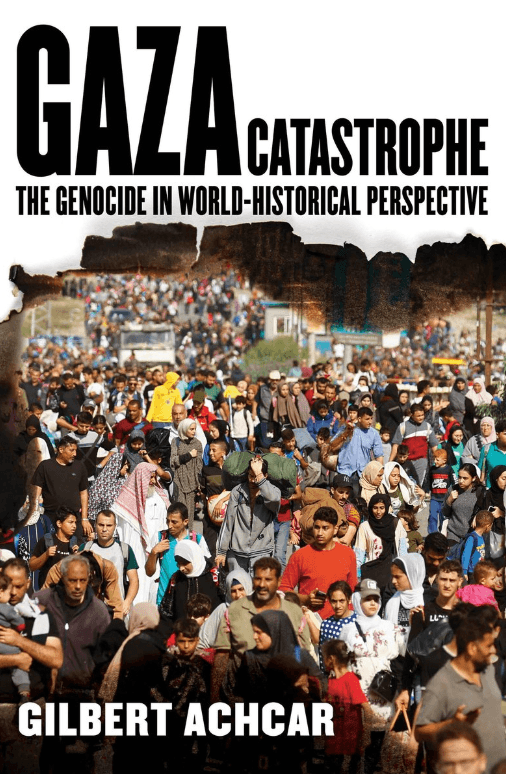
Achkar’s critique is insightful regarding the US policy in the Middle East, role of the US-Israel “special relations,” and the ideology of western liberalism. The Genocide, he suggests, lays bare the demise of what he dubs “the Atlanticist liberalism” (1)[2]. Since its inception, Israel’s goal has been to ethnically cleanse Palestinians, Achcar asserts. In 2009, he predicted that a new Nakba is looming with the coalition of the right-wing Likud with ultraright extremists Itamar Ben-Gvir and Bezalel Smotrich, one that “will inevitably be much worse in terms of killing and destruction than the first, the 1948 Nakba” (19). More than a decade later, we are live-streaming a Genocide that demonstrates the fulfillment of Achcar’s predictions.
Equally on target is the author’s critique of the so-called “peace process.” Achcar reveals that the peace process was not only a tactical strategy to derail Palestinian resistance. In reality, it was also a trap into which the PA fell, under Yasser Arafat, when he “publicly and shamefully declar[ed], ‘We totally and absolutely renounce all forms of terrorism’ in order to meet Washington’s condition for that purpose” (15). The peace process culminated in the signing of the Oslo Accords in 1993, which nominally recognized Arafat as the representative of the Palestinian people, but it did not mention Palestinian self-determination or the right of return of refugees. Thus, Oslo was an agreement between governments, underscoring the victor’s conditions (103).
Although presented as the most “spectacular event,” only a few critics were well aware that the Accords were “an updated version of the Allon Plan” (90-94). Devised by Yigal Allon, in July 1967, the Allon Plan was thus a “plan of colonization and partial annexation,…” (92). After Israel occupied the remaining land of Palestine—the Palestinian Occupied Territories (OPT), Achcar exposes Israel’s obsession with Iran when he suggests that Israeli attacks on Iran’s proxies, Hamas and Hezbollah, are mere pretexts (133). The current US-Israel war on Iran proves Achcar’s insight to be viable.
We also learn about the rift between Fatah and Hamas, and the Israeli subjugation of the PA under Mahmoud Abbas. Achcar does not shy away from chiding the Arab Gulf states for normalizing relations with Israel by signing the Abraham Accords in 2020, nor does he refrain from deriding Jordan for promoting sentiments toward the possibility of regaining the OPT. Likewise, Achcar’s predictions about the consequences of Israeli attacks on Gaza are on target, should Hamas continue shooting rockets at Israel, which it did.
Limitation of Achcar’s Critique
One of Achcar’s critiques did not sit well with this reviewer. And that is the critique of Hamas’ religious faith, against the back drop of “Weber’s ‘ethic of conviction’ in which practical rationality is usurped by faith” (21). Although the author grants Hamas the sincerity of religious beliefs claiming that he is not being condescending, he, nonetheless, asserts that the attack reflects an impractical, irrational mystical vision. Why impose western theory on Palestinian experience and on what’s happening on the ground? Who says acts of resistance are rational? And why focus the argument on the theatrics and religiosity? Had Achcar focused on Hamas’ actions as resistance to occupation, blockade, colonialization, racism, and dehumanization, his argument would have been more empathetic regarding this desperate act against violence and power. The Palestinian condition should not be governed by theoretical dogma, let alone western one, but by the facts on the ground and their ramifications.
Conclusion
Gaza Catastrophe is a valuable documentary about the ongoing Genocide of Gaza. It narrates the various stages of the political developments of the Palestine-Israel conflict, traces the conflict between, and within, the two polities of Palestine and Israel, and considers the regional and Global domains. It would be useful to politicians, scholars, and students of Middle East history, international politics, Palestine and war studies, and peace and conflict resolution studies.
NOTES
1. Gilbert Achcar, Gaza Catastrophe: The Genocide in World-Historical Perspective (University of California Press, 2025) ↑
2. Achcar proposes that the liberal mask of the Atlanticist ideology, which had claimed liberal ideology against fascism and genocide after 1945 and that was the basis of the United Nations Charter, has fallen. As we observe the collusion of the West with Israel, we are live-streaming the Genocide and abuse of Palestinians on the ground in the West Bank and those in Israeli prisons. See Gilbert Achcar, “Anti-Fascism and the Fall of Atlanticist Liberalism,” August 8, 2024, https://gilbert-achcar.net/anti-fascism-and-atlanticist-liberalism.↑