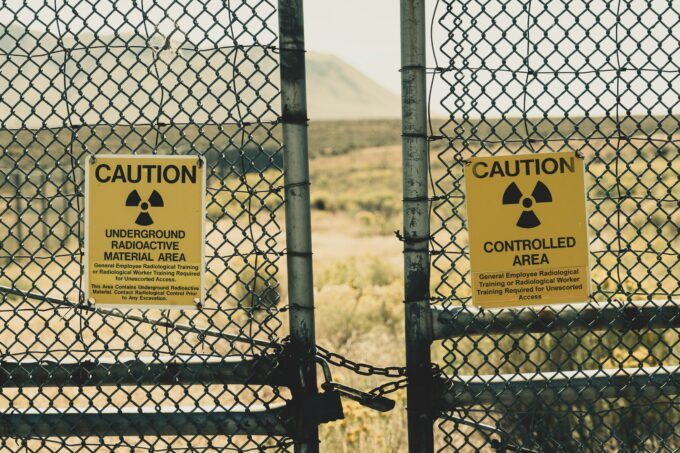
Image by Dan Meyers.
Among the hundreds of Trump White House executive orders (EO), No. 14300 directs the Nuclear Regulatory Commission (NRC) to weaken its long-standing radiation exposure rule, “Standards for Protection Against Radiation.
Based on the EO, an upcoming NRC rule change calls for setting a radiation exposure “threshold” or level below which your exposure to ionizing radiation “would not count” or would be considered “never to have occurred.”
The proposed NRC exposure rules will be 5-100 times less protective than current law, and will likely be based on the archaic “Reference Man” standard, the grossly outdated radiation risk model. “Reference Man” represents a young adult male, and so the standard both ignores and denies the greater harm exposure to the fetus, to infants, to children, and to women, done by a given radiation exposure.
The EO would impact people in thousands of communities surrounding the 94 operating nuclear reactors in the United States by increasing exposure to radiation from routine offsite emissions: from reactors, nuclear weapons facilities, nuclear material transport systems, and nuclear waste sites.
Forty citizen organizations, including the national nonprofit Physicians for Social Responsibility, wrote to federal officials warning of public health consequences of Trump’s EO. The joint letter points out sharply disproportionate impacts on women and children from weakening existing radiation exposure standards and calls for strengthening them.
But vested interests in the nuclear industry want to save money by attacking the basis of NRC regulation, the “Linear No Threshold” or LNT risk model.
Decades of published peer-reviewed research support the LNT model, including the authoritative National Academy of Sciences report “Biological Effects of Ionizing Radiation, VII Phase 2” (BEIR VII), as well as many studies of nuclear industry and nuclear weapons production workers.
One industry-sponsored “Petition for Rule-making” appealed to the NRC in 2015 and it triggered a formal review of the ‘no threshold” model. The NRC then soundly rejected the petition in a 2021 decision. In fact, the NRC reaffirmed the scientific basis and global consensus that no radiation exposure is so small as to carry no risk of harmful effects. Well-documented findings show that even exposures so small that they cannot be measured may, sometimes, result in fatal cancer. Reducing the risk to zero requires zero radiation exposure.
A detailed analysis of the proposed rule change and its dire consequences was published by Princeton’s Frank von Hippel in the May 27 Bulletin of the Atomic Scientists. For more about sending comments to the NRC, see: www.nirs.org/radiation or www.radiationproject.org/online .
NRC rule changes, and its abandonment of the no-threshold model, are scheduled to be issued as a proposal on June 8, 2026, marking the start of a 30-day public comment period. We must oppose this dangerous deregulation and demand more, not less, protection against radiation.