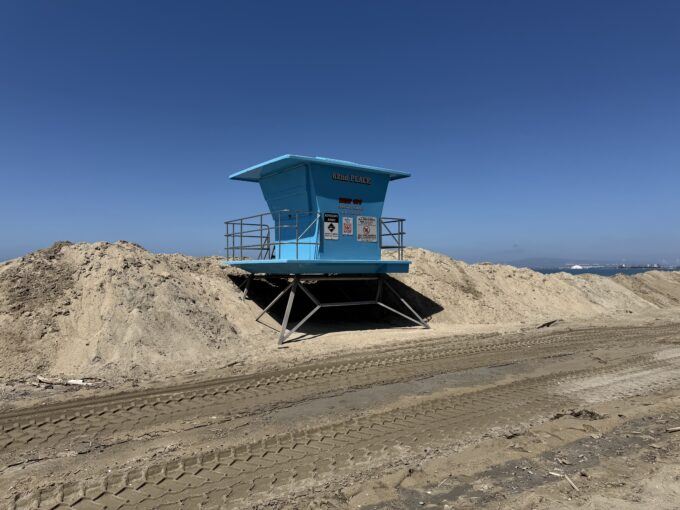
A coastline erodes as sea levels rise. Long Beach, California. Photo by Joshua Frank.
This week in the Anthropocene
The first major swell of the year pummeled Southern California this week, and onlookers flocked to Balboa Peninsula in ritzy Newport Beach to watch adrenaline junkies attack the Wedge – a mutant wave that ricochets off a rock jetty, forming a steep, heavy wall of water that accelerates and breaks chaotically. Only the bravest (craziest?) dare to face it down.
A wild storm system, nearly the size of the United States, took shape in the central South Pacific last week and hurled massive wave energy toward California and Baja, Mexico. It was the perfect setup to awaken the sleeping Wedge and the lore and danger that accompany the deadly break. As the big swell arrived on Tuesday, lifeguards were already rescuing daredevils from the rough waters.
However, amid all the excitement, er, stoke, as we surfers call it, lies a coastline that continues to be chewed up by high tides, large swells, and rising seas. The Wedge, for example, is slowly encroaching on multimillion-dollar beachfront property, forcing the City of Newport to bulldoze mounds of sand onto the beach in hopes of fending off erosion. It’s a relentless problem that is set to worsen in the years ahead as climate breakdown continues.
Of course, it’s not only this stretch of the Orange County coast that’s in danger of having its beaches swallowed by the ocean. In Long Beach, where I live, sand is continually brought in to protect pricey homes along the city’s peninsula from flooding as the ocean expands as the icebergs melt. It’s a conundrum plaguing much of California. 
Malibu, Dana Point, San Francisco, Seal Beach, and many other coastal cities are experiencing severe erosion, prompting them to adopt novel approaches, often trucking in sand as a stopgap to protect property. Taxpayers usually foot the bill to protect some of the country’s most expensive real estate from the wrath of climate change.
The California Coastal Commission has been sounding the alarm, but few are listening.
The agency that regulates coastal development reports that sea-level rise in the state “will affect almost every facet of our natural and built environments.” If greenhouse gas emissions continue at their current pace, we could see sea levels rise by up to 8 inches over the next eighty years, or, under the worst-case scenario, by up to 7 feet by 2100 and 13 feet by 2150. NOAA notes that high-tide flooding is now nearly 900% more frequent than it was just 50 years ago.
Much of this depends on the rate of ice shelf melting – and melting it is. As Robert Hunziker recently wrote in CounterPunch, the “Doomsday Glacier” in Antarctica is acting up.
That’s very, very bad news, not just for California’s 840-mile coast, but for the entire world.
In the best-case scenario, California will still be violently whalloped in the years to come. In the worst-case scenario, two-thirds of Southern California’s beaches could be lost by 2100 unless there is significant, rapid intervention. The situation isn’t much better up north. The Public Policy Institute of California explains that what’s unfolded in the San Francisco Bay illustrates the peril we’re in. The Bay Area faces a $105 billion shortfall to fortify its vulnerable coastline.
In Los Angeles, it will cost $6.4 billion to adapt, $246 million in Long Beach, and up to $1 billion in San Diego. The only reasonable option is to relocate homes away from the coast, but the rich aren’t ready to budge.
This, as you are likely aware, is among the most expensive real estate in the world. Homes in Malibu average $5.9 million. Homes in Newport Beach? An average of $9 million. The closer you are to the water, the higher the price and the greater the risk that someday your lavish pad will be flooded by rising seas.
There’ll be no escaping climate chaos. Warmer oceans also mean stronger, more intense storm systems, like the one that brought huge waves to So Cal this week. Larger swells mean greater damage to this embattled coast. Combine all of this with increasing sea levels, and it’s a recipe for disaster.
Back in Long Beach, I grab lunch and head to the beach. As I unwrap my burrito, I watch large dump trucks pile up a hill of sand while a tractor moves and spreads it down the peninsula. Waves don’t batter this beach like they do at the Wedge down in Newport because a breakwater a mile and a half out blocks wave action here. Even with the seawall, a lack of natural sand movement and rising sea levels have made the area vulnerable to frequent flooding. Not if, but when the next 100-year flood hits this stretch of coast, at least 1,900 homes in Long Beach, worth over $1.3 billion, will be impacted. Many will be destroyed.
There may be no stopping the ocean from warming and the seas from rising, and I am not in the camp that believes taxpayers should continue paying to protect these elite coastal properties while people remain unhoused and rents continue to skyrocket. One day, the effort to protect these homes won’t be enough, and the water will win.
Mike Davis argued that we should let Malibu burn. Well, we should probably let the place flood, too.
+++
The UN released a report predicting that the rate of sea level rise will double over the next decade. The Trump administration isn’t worried and is ensuring that future revelations like this never see the light of day. The lunatics in Washington have dismantled the National Science Foundation’s $368 million deep-ocean observation system that tracks many things, including how the climate is impacting our oceans. This, as the government spends $12.6 billion on a new fleet of cruise missiles. We are a country in rapid decline.
Want to see the future our coasts face? Check out NOAA’s visualization tool before it’s gone.
Lastly, summer is here, and most of the United States is facing deadly heatwaves this week. We’ve been smashing temperature records all year, and this summer is sure to be the hottest ever. Miranda Green reports in Atmos that we are in the early stages of a full-blown crisis as drought and heat engulf the West.
+++
Okay, as always, a bit of good news. For the first time ever, Americans are now getting more of their energy from solar power than from coal. I like the sound of that, well, until I realize lots of that energy came at a cost as well, to places we ought to be fighting to protect, like the Mojave.
Light that up, and I’ll see you in a couple of weeks when I return from Montana.
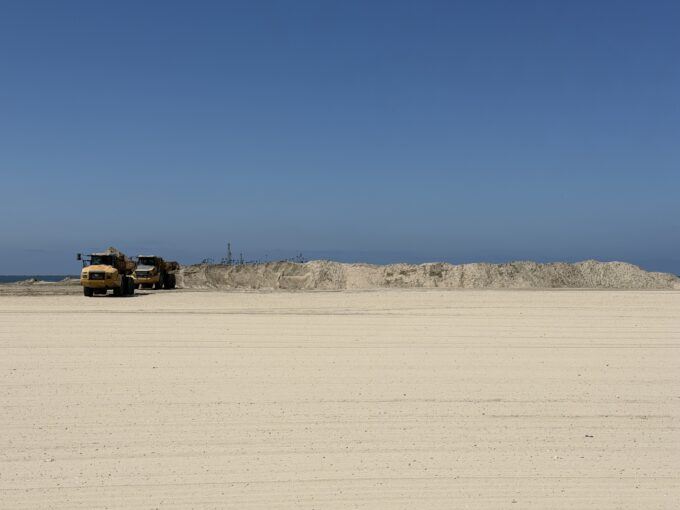
Sand movement to protect coastal property. Long Beach, California. Photo by Joshua Frank.