Image by Planet Volumes.
The US, with Donald Trump as president, has become a bizarre place. The country is at the moment in a sort of lull in a major war that Trump and his Israeli sidekick Benjamin Netanyahu launched against Iran over three months ago—not quite a cease-fire, but not full-blown war. Nearly $50 billion dollars spent on it, and the global economy is reeling from the shutdown of one-fifth of the world’s supply of oil and natural gas, and Trump still can’t explain why the war was necessary and how and when he’s going to end it….if he can.
Even weirder, Trump’s war was launched even as the US has left Venezuela in chaos in the wake of his Jan 3 “shock and awe” attack on that country’s capital, followed by a midnight raid by US Special Forces who killed 32 Cuban soldiers guarding Venezuela’s president Nicolás Maduro, whom they then kidnapped, spiriting him and his wife Celia Flores away to Manhattan. There, they face spurious drug smuggling charges in a US federal court.
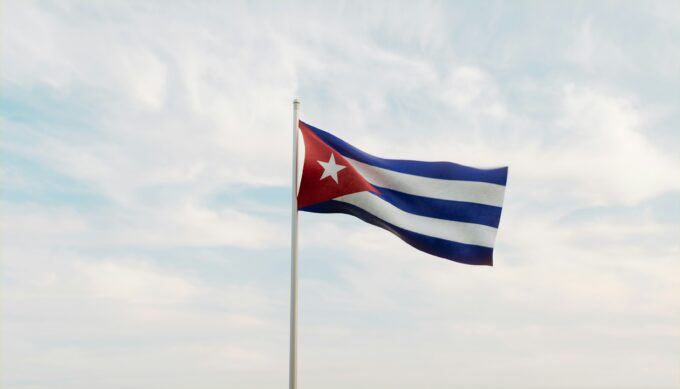
As if that weren’t enough, Trump is now threatening to “take over Cuba,” the island nation whose economy has collapsed because of Trump’s blockade of all oil shipments.
So is Trump, America’s least popular president in his second term since G.W.Bush, going to invade Cuba? With Trump, it’s hard to know, but his recent actions and threats are ominous. First, to provide a pretext for his threatened assault and kidnapping in Cuba, he has had his ever-compliant Department of “Justice” indict 94-year-old Raúl Castro, the frail and ailing younger brother of Cuban revolutionary leader Fidel. Raúl was the vice president in 2008 when Fidel stepped down as Cuba’s president for health reasons. Raúl became acting president and then president until stepping down in 2018.
The US indictment lodged against Raúl, who is no longer a Cuban leader, is based upon the dubious allegation that as Minister of Cuba’s armed forces he “gave the orders” to two Cuban Air Force MiG fighter jets to down several civilian US-registered Cessna aircraft alleged to be violating Cuban airspace,, killing all four men in the downed planes operated by an organization called “Brothers to the Rescue.”
A third plane piloted by José Basulto, a right-wing Cuban exile who founded “Brothers to the Rescue,” managed to escape the attack and fly back to the US. Basulto was known by Havana to have been secreted, as part of the Bay of Pigs invasion plan, into another part of Cuba, tasked with committing acts of sabotage so as to draw away Cuban defenders from the planned invasion landing area. (Later, in 1962, he took a speedboat to the island and fired a cannon at a beach hotel, the Paquita de Hornedo, known to be frequented by foreign technicians, mostly from the Soviet Union and some Warsaw Pact countries. He gave a press conference about his action on his return to the U.S.)
Following the shooting down of the two planes, then US President Bill Clinton blasted the Cuban government, saying the civilian planes were unarmed and were flying over international waters.
As the BBC report on the indictment notes, at this point the US has in the span of several months targeted three national leaders and former leaders of three countries with serious felony indictments, or simply killed them: One, Ali Khamenei, was targeted and deliberately killed (along with dozens of other political and military leaders) by the bombing of his office compound; a second one, Venezuela’s elected president Maduro, was kidnapped and is in a US prison awaiting a possible trial; and the third one, Raúl Castro, who has been out of government for ten years, has been charged with an alleged crime that dates back 30 years and is facing possible abduction by US Special Forces,
The Trump regime’s brief against Raúl Castro seems rather weak and hypocritical, given that Trump himself and his ‘War’ Secretary Pete Heseth have authorized the killing of over 200 civilians on speedboats in international waters off the coast of Venezuela (some by so-called “double taps” that hit survivors stuggling to avoid drowning after the initial attacks) claiming—on no evidence—that they were “invading” drug smugglers headed for the US.
As he grandiosely boasted to Washington journalists at the White House last month, “I think I can do anything I want with it [Cuba]. Whether I free it, take it…You want to know the truth? They’re a very weakened nation now.”
What could go wrong? Well, let’s see…
It’s true that Cuba’s economy is in a state of collapse, with malnutrition rampant, infant mortality soaring, hospitals unable to function, schools closed, and transportation difficult to impossible. But this collapse has nothing to do with the fact that Cuba is run largely as a socialist state as Trump and his toadying Cuban-American Secretary of State Marco Rubio claim, but rather because it is being literally destroyed by an almost total Trump-ordered US blockade of oil shipments, leaving the island nation almost completely without electricity, fuel, and medicines that require refrigeration, etc. (The island does contain some small deposits of mostly very heavy crude oil, and of natural gas deposits and has the ability to refine the former into useable oil and petroleum.)
There is, sad to say, not much global solidarity being shown for Cuba in this crisis, even by countries that have long been Cuban allies. Maduro had been sending Venezuelan oil to Cuba, but even before overthrowing and kidnapping him, the US had been blocking or taking over tankers to prevent them from delivering it. In Mexico, many people have been calling for their government oil company Pemex to start sending oil to Cuba, but the government and President Claudia Sheinbaum Pardo, not wanting to anger Trump, have balked. This may also explain why Brazil’s leftist President Lula hasn’t sent oil either.
China has been shipping solar power panels to Cuba but so far they are only a fraction of the need, It is unlikely that if China were to send a large tanker under its own flag through the Strait of Hormuz to pick up Iranian oil for Cuba, it would be blocked by the US Navy, especially if it were accompanied by a Chinese Navy frigate or destroyer, given Trump’s desire to have good trade Relations with China. That said, though, President Xi Jinping thus far has not had the courage to make that gamble.
Only Russia has done so, dispatching a relatively small Russian-flagged tanker loaded with Russian oil to the island. Trump, citing “humanitarian reasons,” allowed that vessel to reach Cuba, with what was said to be a 10-day supply for critical services across the island.
That said, Trump, an unapologetically ignorant leader who mocks science, doesn’t know Iceland from Greenland, thinks windmills cause cancer and knows virtually nothing about history, no doubt is unaware that Cuba and its long-suffering people, have struggled through and survived over 60 years of a crushing US embargo on not just oil, but also on tourism, medicines, food, car parts and trade with other nations.
Nor can he possibly imagine how Cubans over the decades have come together to help each other through crises, whether weather-caused or man-made.
As someone who as a young man dodged the US war on Vietnam by getting his family physician to claim he had “bone spurs” on his feet, Trump is also I’m sure, totally unaware that ordinary Cubans raced to the Bay of Pigs to support Cuban troops to defend their new socialist country when it was attacked by a CIA-organized group of right-wing Cuban mercenaries hoping to spark a rebellion to oust Fidel Castro and his fledgling Communist government. Trump cannot comprehend that kind of patriotic courage, any more than he could fathom thousands of young Iranians rushing out in the dead of night to stand on bridges and beside power plants he had just threatened to bomb if their theocratic regime (which many of those bold young patriots despise) wouldn’t agree to his terms for an end to his war.
The truth is that if Trump were to actually follow up on his threat and, as he did in Venezuela, and were to dispatch US Special Forces to Cuba to try and capture 94-year-old former Cuban President Raúl Castro, they’d likely find their task a great deal more bloody and unpredictable than was their surprise January 3 raid on the presidential compound of Venezuelan President Nicolás Maduro.
(Recall that the biggest battle US forces faced in President Ronald Reagan’s “heroic” [sic, ludicrous] 1983 invasion of the tiny Caribbean island nation of Grenada was against Cuban construction engineers working on expanding the island’s tiny airport to allow for larger airliners to boost Grenada’s tourist business. The workers, 24 of whom died, had picked up rifles and put up an unexpectedly stiff fight against 7600 US Marines, Army, Air Force and Navy Special Forces troops.)
Trump, his sycophantic MAGA cult backers in Congress and among the broader electorate probably are likewise unaware not only that has Cuba and its people fought off multiple US efforts to crush Cuba’s socialist experiment, but that the country was already once taken over by the US military.
That happened in December 1898, when the Spanish-American War ended with Spain’s defeat. With the departure of what was left of the defeated Spanish army and navy from the Caribbean, the island colonies of Cuba and Puerto Rico and their people were both left to the tender mercies of the victorious US Army and Marines.
If the US wanted to become a colonial power both in the Caribbean region and in the Pacific (as some in Congress and among the American public wanted after the Spanish-American War), that might have happened, and indeed did happen in the case of the Philippines in the Pacific, and with Puerto Rico in the Caribbean. But the local people, former colonial subjects of Spain’s surrendered colonies—particularly in Cuba and the Philippines, had other ideas.
So too did many US citizens who opposed the idea of the US becoming a colonial or imperial power. In Cuba, a popular independence movement, 40 years before the Spanish-American War, had fought a war for independence called the Ten Years War. It began in 1868, lasted a decade, and then broke out again in 1895 and significantly led to US intervention and its declaration of war against Spain. Cuba also had a number of popular revolutionary leaders in that period, prominently including José Martí, a nationalist writer, poet, philosopher and activist who became an independence martyr when he was killed in battle with Spanish troops in 1895.
The already advanced state of Cuba’s independence movement only grew with the end of four centuries of Spanish rule in 1898.
President William McKinley, meanwhile, was not a fan of colonialism, though many members of Congress were. But even if McKinley were feeling pressed to keep Cuba as a US possession (as he did with the much smaller island of Puerto Rico, which, despite a long-standing independence movement of its own, remains a US colony), I suspect the real reason he didn’t make Cuba a colony is because of the lesson he was getting in the Philippines.
There, the US faced a full-scale war of liberation with independence guerrillas, which erupted soon after an independent government was declared by independentistas in Manila, only to be shut down by the US military. That brutal war lasted three years from 1899 TO 1902, resulting, according to the Watson Institute on Costs of War military records, in the deaths of 4200 American troops, 20,000 Filipino fighters, and 250,000 civilians. That independence struggle smoldered on and only really ended with the 1942 invasion of the Philippines by Japan, which drove the US out. (By the time WWII ended, the colonial era was ending, and the US had no interest in colonies. Imperialism was fine, as long as America could have naval and air bases on an independent Philippines and in other vassal states.)
In any case, Cuba, after three years of US military rule, was permitted by the US to avoid the humiliating status of being a colony by becoming a “sovereign” republic, but with the US having a 100-year lease on 46 square miles, including Guantanamo Bay, for a major naval base, beginning in 1906. (While the lease term was up in 2006, Washington, instead of turning over the base to Cuba, has just kept paying the annual $4068 rent with a cheque from the US Treasury, which Cuba keeps and never cashes.)
With the new republic of Cuba a vassal state of the increasingly powerful US and with the US behind the scenes running the Cuban government in the early 1900s, US agriculture firms were able to buy up agricultural fincas from local Cuban landowners and small farmers and to develop the monoculture production of sugar cane. This consolidation trend happened, unfortunately for Cuba, after WWI, just as the US was adopting prohibition, first with states passing bans on alcohol and Congress then passing a Constitutional amendment banning the production, transport, sale or use of alcohol.
This development made smuggling of alcohol and the establishment of black-market speakeasies, which often included high-stakes illegal gambling, a huge industry. Not surprisingly, this illegal business combination supercharged the expansion of the Cosa Nostra, whose Mob capos and bosses had found a safe place to run their new business. Cuba, as an independent nation with few laws, and even less enforcement, offered easily bribed politicians and had plenty of sugar and local distillers able to turn it into rum. Best of all, in the days before radar and satellites, it was easy to smuggle the rum to the US, which is less than 90 miles away.
The result was not a narco-state, but something perhaps as bad or worse: a mob-run alcho-state fueled by gambling, rum-running, as well as organized prostitution.
This massively corrupt state of affairs continued until Fidel Alejandro Castro Ruz, a young nationalist Cuban lawyer, son of a wealthy farmer, came along. He led an unsuccessful 1953 uprising attempt to assault the Cuban Army’s Moncada barracks in Santiago de Cuba, which he optimistically misjudged would ignite a mass insurrection. Instead, it earned him a 15-year jail sentence.
Released after 19 months as part of a general amnesty, he traveled to Mexico. There, he met his brother Raúl and Ernesto “Che” Guevara, a radical young Argentine physician, and the trio founded the July 26th Movement (in honor of Fidel’s first failed uprising). This time the more attainable goal was to organize and build a guerrilla movement in the rugged Sierra Maestra mountains. Amazingly, the state of affairs in Cuba was so bad that this seemingly romantic movement worked! People from all walks of life, including deserting Cuban Army soldiers, made their way into the mountains to join the guerrillas, who then were able to take their struggle to all parts of the island.
After three years of fighting and of growing support for the rebels, the dictator Batista on Jan. 1, 1959 fled by plane (taking with him $300 million in bribes and stolen state assets). Learning of his admission of defeat, the victorious rebels, riding on jeeps, trucks and even tanks turned over to them by deserters or captured in battle, entered Cuba’s cities to claim their victory.
“Che” Guevara and Camilo Cienfuegos led their two columns of rebels into Havana, the nation’s capital, on Jan 2, 1959. Fidel Castro simultaneously led his victorious troops into Santiago, Cuba’s second largest city located at the opposite end of the Island on the same day, and then, after a victory caravan of nearly 600 miles, passing crowds of cheering Cubans, finally rode into Havana on a jeep at the head of a column of captured armored vehicles on January 8.
While many in the US found the Cuban revolution inspiring and admired the charismatic Fidel and his colorful and heroic comrades, the US government was upset at the new rebel government’s campaign of expropriation of foreign-owned properties. The US, being at that time right at the height of the 1950s Red Scare and its Cold War with China and the Soviet Union, there was concern that Fidel Castro, like his brother Raúl, was a Communist. Especially in the case of Latin America, which the US, since the days of President James Monroe, has considered “America’s back yard,” this was anathema, especially to the national security state the US had by then become.
On April 17, 1961, just two months into the presidency of John F. Kennedy, a force of 1500 right-wing Cuban mercenaries, organized, trained, funded, and armed over prior months by the CIA, landed at the Bay of Pigs, hoping to ignite a nationwide counter-revolutionary uprising.
Instead, the opposite happened, as Cuban troops, with local help from civilians, defeated the invaders over the course of three days, with most killed or captured.
President Kennedy reportedly was caught by surprise by the invasion plan and declined to authorize US air cover for the invaders, which they had been led to expect by their CIA handlers. That decision by Kennedy led to bad relations between the new president and the CIA (and possibly to his assassination), with new evidence that Kennedy reportedly contemplated downgrading the CIA from a secret independent agency to a part of the State Department, modeled on Britain’s MI6.
Since the country’s liberation from the yoke of US imperialism, Cubans have lived through decades of privation, not because of Communism, but because of brutal and illegal US sanctions, boycotts, terror attacks and even germ warfare, illegal blockades and countless failed attempts to assassinate Fidel.
If Trump thinks they, their children and even grandchildren, will forget or forgive that multi-generational suffering visited upon them by the US, just to be delivered into the hands of the man who has this year cut off their access to oil and electricity, he may be in for a big surprise.
Cubans, especially younger ones, may look covetously at the fancy cars, big houses, and state-of-the-art electronic equipment available to Americans, including many of the Cubans who have left for the US. But they also know, I’m sure, that Trump himself grew rich in the casino business, where it was impossible to succeed without working out some “arrangement” with the Mob. The same goes for successfully completing large real estate development projects in places like New York, New Jersey, Nevada, and Florida, where the Mafia runs some of the construction unions and owns things like cement suppliers.
The idea of Trump “running Cuba” as Trump, who sometimes even talks like a Mafia “don,” has said he wants to do, should horrify Cubans who’ve already been there. It is certainly true that, as Danny Shaw writes in a recent depressing Counterpunch posting, many long-suffering working-class Cubans are just too worn out and worn down from struggling to survive and keep their families alive through the economic assault on their island, which has been merciless for six decades and has only gotten worse under Trump.
At the same time, the downtrodden masses have put up incredibly heroic resistance. Think of the people of Leningrad under a Nazi siege, the people of Vietnam and the defeat of the UA imperium, the doomed resistance to the Nazis fought from inside the walls of the Jewish Ghetto in Warsaw, and the Palestinians in Gaza today.
Besides, Donald Trump is a uniquely odious and crude leader of the American Empire, even in the long history of imperial presidents, and if he does try to “take over and run” Cuba, his words and actions could well spark the same kind of mass resistance in Cuba that we’re seeing among the Iranian people in the current US/Israeli war on that country.
We’re already seeing just how odious the Trump regime can be: When Boss Trump wanted to shake down Cuba’s leaders a few weeks back, he sent as his gooombah the CIA Director John Ratcliffe, a Trump MAGA stalwart who told assembled Cuban legislators the US wanted to “seriously engage” with their government, but “only if it makes fundamental changes” to its Communist political system. His message couldn’t have been any clearer had Ratcliffe dropped a bloody, severed horse’s head on the conference table as he left.
As Ratcliffe was issuing his warning, CNN reported that the US has been stepping up intelligence flights near Cuba’s larger cities.
Ron Ridenour is a journalist friend and longtime colleague who spent eight years in Cuba (1987-96) working, among other jobs, at Editorial José Martí and then Prensa Latina. He also while there, became a global news item himself (and a Cuban hero) when he burned his US Passport outside the US Interest Section of the Swiss Embassy in Havana 1991, tossing the ashes over the wall before a bunch of international news reporters and videographers while renouncing his citizenship because of the US invasion of Iraq.
Now an expat living in Denmark, he says, “The current Cuban administration is showing weakness and, like a voracious animal smelling blood, Trump will pounce, seeing weakness. Trump only respects strength, and sitting down with the head of a US agency that tried to assassinate Fidel 638 times shows only weakness to him (and to me).”
He adds, “Fidel and his Director of Secret Services, Fabian Escalante, would never have sat down with one of the US Murder Inc. directors, especially not in their own country.