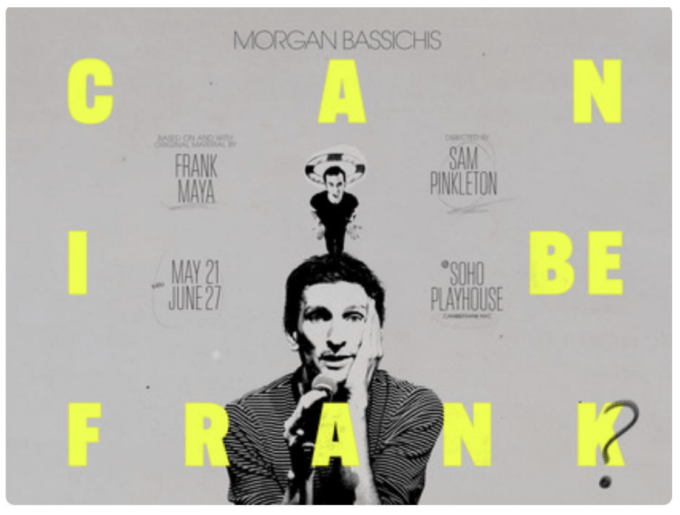
If I’d gone to see Morgan Bassichis’s show “Can I Be Frank?” when I meant to, when it premiered at La Mama in 2024, or even at the SoHo Playhouse last summer, when it won two Obie Awards, or even if I’d gone earlier this run – its third – back at the SoHo Playhouse, starting May 21,¹ I would have felt far less loss this year.
Morgan’s work brings back friends — ancestors, allies, friends, lost comrades — and re-populates the air with them. Elizabeth and I walked home through downtown streets thick with their beloved spirits. Can I tell you to get to the Playhouse before “Can I Be Frank?” ends on June 27th because it will make you feel better, and less alone? Yes. Go.
Morgan Bassichis wrote and performs “Can I Be Frank?” around the work of performance artist, comedian, and songwriter Frank Maya; work that was carefully archived and posted by one of Maya’s ex-lovers, the choreographer, Neil Greenberg. Thus, one act of loving remembering begets another, and Bassichis’s work begins.
Maya was among the first openly gay comedians on network television; the first to appear on MTV’s “Half-Hour Comedy Hour”, and the first to star in his own half-hour special on the Comedy Channel. He died of AIDS-related complications in August 1995 at age 45, at the edge of what Bassichis calls “mainstream fame”, and just months before the release of the protease inhibitors that would have kept him alive.
Funny, tender, relentless — Bassichis does whatever it takes to make their audience laugh from the moment the spotlight snaps on (including brilliant on-going gymnastics with his microphone cord). The New Yorker’s not wrong to call their work “fiercely hilarious,”² but hilarity doesn’t begin to cover what happens in that theater.
It gives us those times, and those people back, not as ghosts but as presences: the ones whom Reaganism vilified and money media ignored, whom neoliberalism tortured and AIDS killed; the ones whom capitalism (and hetero-patriarchy) have made it so easy to forget; the ones they’ve sold back to us as crass commodities or brands.
”Can I Be Frank?” earned those two Obies and will no doubt earn more awards. Surely Bassichis will be compared to George Carlin with a queer anti-capitalist thrust. Director Sam Pinkleton no doubt helps to keep the whole thing alive and kinetic. But this is Bassichis’s show, which they share with Frank Maya, and somehow, by the end, it belongs to all of us who lived those years — and to everyone who didn’t, and needs to know that they are inheriting a lineage that was nearly erased. That it’s ok to be funny in a crisis, and to know that people lived, and died, who were.
Bassichis’s problem now, is that so many people have seen the show twice, or – like my neighbor – three times – that they shout out punchlines. (“Do that again and I’ll kill you,” grins Morgan.) What Bassichis really wants us to do is pay homage, and not in a sit-down way. With sweat dripping off their wickedly angular smile, and laughter still hanging in the air, they amp up the delivery to a pointed litany of ways “we can honor those lost”. Those ways include saying the names and preserving the memories of those who’ve gone before, and by “doing everything we can to stop our government the next time it decides another population is utterly disposable.” Think AIDS, think Epstein, think anti-trans, and anti-art thought police, think ICE, think Gaza.
Bassichis is an active member and organizer with Jewish Voice For Peace (JVP).
Can Bassichis be Frank? It turns out to be a real question. Can we, more expansively, be what and who we need to be in this moment?
Go before June 27. Take someone you love. Walk home through the city afterwards and feel how many friends and allies you have, and how full the air is.