As Trump shreds the Constitution and continues to heap scorn on music with his devotion to the Village People and his treacly anointing of Chris Macchio as “Presidential Tenor,” let’s rewind to the beginning of our Republic and listen once again to the Founding Father of American Song.
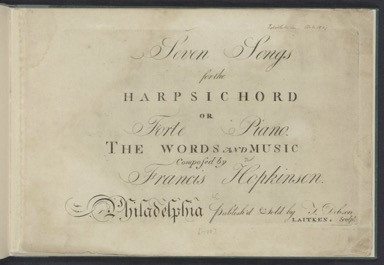
Less than a month before the first presidential election which began in December of 1788, Francis Hopkinson published his Seven Songs for the Harpsichord or Forte Piano, dedicating the set “To His Excellency George Washington, Esquire.” Hopkinson was a Philadelphia lawyer, signer of the Declaration of Independence and a delegate to the Constitutional Convention of 1787. Also an inventor, amateur musician and poet, Hopkinson had made fun of war during the Revolution with his satirical “Battle of the Kegs” (1778), and declared his devotion to the commander of the Continental Army with “A Toast” (1778). More ambitiously, he cobbled together an oratorio called The Temple of Minerva (1781), mostly from tunes lifted from George Frideric Handel, King George’s favorite composer. Hopkinson’s repurposing of rthis oyalist fare shows that music knows no borders and that the ongoing Anglo-American hostilities were a mere hiccup in the Special Relationship.
After peace came and the Constitution was ratified, Hopkinson wrote “The Raising: A Song for Federal Mechanics,” performed at the celebratory parade in Philadelphia on July 4, 1788.
Come, raise up the turret, our glory and pride:
In the centre it stands, o’er the whole to preside;
The sons of Columbia shall view with delight
Its pillars and arches, and towering height:
For our roof we will raise, and our song still shall be,
A Federal Head, o’er a people still free.
If Trump knew more history—if he knew any history at all—he might strew this sonic garland on his own Great Leader architectural designs.
Hopkinson’s 1788 volume of songs marries his meager talents for music and poetry in a series of disarming ditties—seven sentimental melodies ranging from the opening “mellow fruits” of “Fair Rosina” to the lilting and oxymoronically upbeat lament of the third song:
Beneath a weeping Willow’s shade,
She sat and sang alone,
Her Hand upon her Heart she laid
and plaintive was her moan.
For all its musical simplicity and concord, the seventh song strikes a dissonant note when we remember that it, like the others, is dedicated to a Virginian plantation master:
My gen’rous heart disdains
The slave of Love to be,
I scorn his servile chains
And boast my liberty.
Surprisingly, given Hopkinson’s limited compositional range, this song’s form can be heard to match its content, not only in articulating the narrator’s desire to be released from love’s bondage, but also as an unwitting representation of the Peculiar Institution enshrined in the Constitution that he had recently signed and was now musico-poetically supporting. Hopkinson sets the text as a rondo: like an enslaved person apprehended while running towards freedom, the tune and its galloping Alberti bass are perpetually dragged back to their starting point.
As befitting the optimism of the newly born nation, none of Hopkinson’s songs risks the gloom of a minor key.
The cloying tenderness of the texts and melodies might seem more appropriate for a harpsichord-playing girl than a hard-bitten general, soon to be elected president. Indeed, in his preface Hopkinson claims that his intent is to “please young Performers.”
Yet warrior kings have often been suckers for sentiment. Frederick the Great indulged in melancholic adagios on his flute even while he plunged Europe and the world into war in the middle of the eighteenth century, one of which (the Seven Years’ War, which did business on this continent as the French and Indian War) Washington fought in, defending the Virginia frontier against Native American raids.
A hundred years later, during America’s greatest crisis, Abraham Lincoln was besotted by pathetic ballads, occasionally performing songs such as “Mary’s Dream” himself:
When Mary laid her down to sleep
Her thoughts on Sandy far at sea,
When soft and low a voice was heard say:
‘Mary, weep no more for me.’
While bombing Cambodia and facing impeachment, Richard Nixon would distract himself with barbiturates and the mournful tones of his own Romantic piano noodlings in alternation with comforting renditions of the American popular songs of his youth. As a presidential candidate, Bill Clinton unsheathed his saxophone and squawked out Heartbreak Hotel on the Arsenio Hall Show in a staged attempt not to atone for, but rather to distract from, his having signed off as Governor of Arkansas on the execution of the mentally unfit African-American Ricky Ray Rector in January of 1992. The blues and prayer would see Clinton through future scandals.
At the start of his one-page dedication to Washington, Hopkinson claims “personal Friendship” to the great man and trumpets his own “Hope, that the same Wisdom and Virtue which has so successfully conducted the Arms of the United States in Times of Invasion, War, and Tumult, will prove also the successful Patron of Arts and Sciences in Times of national Peace and Prosperity; and that the Glory of America will rise conspicuous under a Government designated by the Will, and an Administration founded in the Hearts of THE PEOPLE.”
Eager that his music not be judged too harshly by connoisseurs, Hopkinson seeks refuge in his amateur status, boasting nonetheless that he “cannot be refused the Credit of being the first Native of the United States who has produced a Musical Composition.” So full of ideas was Hopkinson that he added an eighth song, “The Trav’ler Benighted and Lost,” after the title page to the collection had already been engraved. Thus, he can claim to be not only the first truly American composer, but also the inventor of the bonus track.
Brandishing the rhetorical tropes typical of prefaces from composers both high and low, Hopkinson concludes that “If this attempt should not be too severely treated, others may be encouraged to venture on a path yet untrodden in America, and the Arts in succession will take root and flourish among us.”
In his 1788 letter thanking Hopkinson for the volume and its dedication, Washington admitted that he could “neither sing one of the songs, nor raise a single note of any instrument.” But like his fellow Virginian Thomas Jefferson, Washington procured a sumptuous harpsichord from London for the women of his family. A replica of the instrument can be seen and sometimes heard at Mount Vernon, the original having been removed to one of those musical mausoleums known as a climate-controlled facility.
This is the 1793 Longman & Broderip two-manual harpsichord on which the Washingtons’ granddaughter Eleanor Park was forced to practice. According to her brother George Washington Parke Custis, “very long and very unwillingly … the poor girl would play and cry, and cry and play, for long hours, under the immediate eye of her grandmother [Martha], a rigid disciplinarian in all things.”
The vignette, rehearsed in various forms across ten or more subsequent generations of aspirational Americans trying to get their kids to learn the piano, brings to mind a short clip posted on London’s Daily Mail online edition in May of 2015 showing Ivanka Trump instructing her daughter Arabella at the keyboard. A finely manicured maternal finger, attached to Ivanka, showing a lot more naked arm than the Mother of Our Country ever dared to do in the parlor at Mount Vernon, points to a chart of the keys and notes on the music desk of the grand piano. The young girl, obedient and willing at least for the filmed moment, pokes out the notes with the index finger of her right hand and sings the names of the pitches. I’m not sure if it’s a touching moment or a chilling one—or both.
It remains to be seen whether these thirty seconds of family life document the first steps of a lifelong love of music or the inculcation of the more basic Trumpian family values of knowing exactly when the cameras are rolling. Judging by the videos that the proud mother continued to post, progress was slow. A couple of years ago Ivanka shared a video of Arabella’s younger brother Theo plunking away at the White House grand piano with the president looking on.
At the 2017 Chinese state visit, Arabella sang a song in Mandarin very beautifully at Mar-a-Lago for Xi Jinping and his wife. Now a teenager, Arabella did not sing or play at Xi’s most recent American sojourn.
Back in 1788, Hopkinson looked forward to a peaceful land where the Arts came first. His hope was as naïve as the music he wrote.
The year after the 1788 publication of the Seven Songs dedicated to the new nation’s first president, Washington appointed Hopkinson to the federal bench in Philadelphia.