
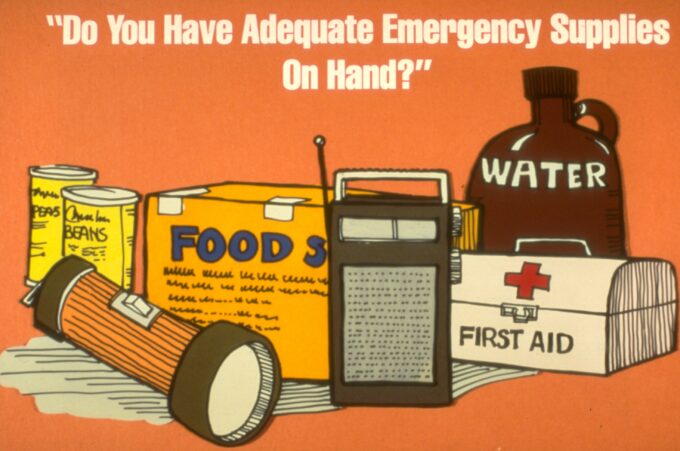
FEMA News Photo – Public Domain
The Federal Emergency Management Agency (FEMA) is back in the news again, with the administration pushing its goal of placing the burden of disaster recovery almost entirely on states. But with Trump and FEMA’s administrator sending very different messages about who gets federal aid and why, the situation will likely create more uncertainty.
Speaking to a closed session at the National Emergency Management Association’s (NEMA) annual conference, FEMA Administrator Cameron Hamilton told the audience that states should prepare to handle disasters with limited federal assistance. The announcement follows an internal memo on October 15 obtained by journalists that set four priorities for the agency, the first titled “Reduce Federal Government Dependency.” In the memo, Hamilton writes that the agency’s goal is to build local capacity so the overall number of disaster declarations will decrease. At the conference, he said that could start happening in as little as six months.
But a recent study of public-sector emergency management agencies nationwide, done in collaboration with FEMA and NEMA, found widespread staffing and funding issues as well as hurdles that make Hamilton’s timeline unrealistic. Highlights of the findings include:
+ Many emergency management agencies are small, with most relying on one permanent full-time employee and supplemented by part-time staff and volunteers. Directors also have dual responsibilities, limiting the time they can spend on disaster preparedness.
+ Agencies struggle with low pay, high turnover, and difficulty recruiting and retaining staff, largely due to burnout.
+ Not only do these agencies face funding and staffing challenges, but they also encounter obstacles in securing additional resources and setting clear goals.
+ Agencies spend most of their time preparing for response operations and far less on recovery, which is where localities usually rely on FEMA assistance.
These problems can’t be solved in six months. Now, if the goal of the administration is to increase funding for emergency management agencies to build local capacity, that is a much-needed move. Hamilton’s memo states that FEMA will “strengthen state and local emergency management capacity through responsible investment, sustainable staffing, operational capabilities, and ownership of disaster risk reduction.” The problem is that last part: “ownership of disaster risk reduction.” Some issues go beyond local capacity or cross state borders, requiring federal intervention. There is no one-size-fits-all model for disasters and disaster mitigation. So how does the federal government choose which communities to help?
Along these lines, Hamilton writes in the memo, “FEMA will prioritize hardening national infrastructure where federal investment provides clear national value.” How does the administration determine “national value”? Unfortunately, we already know what this looks like under Trump. Research by the Revolving Door Project shows Trump has been more likely to deny or delay disaster declarations from Democratic governors, states with two Democratic senators, and states that voted for Kamala Harris in 2024. And in a move that crosses ethical and possibly legal boundaries, the president and Vice President JD Vance have been promising disaster relief to states that vote Republican in the midterms. Trump even went as far as to promise to withhold aid if Democrat Roy Cooper is elected to the Senate in North Carolina.
FEMA should absolutely invest more in building local capacity and support states in disaster recovery. It should be a two-pronged approach. Solving the first problem reduces the chances of having to step in to help with the second, but there are times when disasters are going to exceed local capacity no matter what. Resiliency should be a national priority. Instead, the administration is going about it in a way that suits its needs, not communities across the US. Right now, “national value” equals cutting government spending, winning votes, and maintaining power, not helping Americans. If the administration wants to help, it should create a long-term plan to empower emergency management agencies and restore funding and staffing to crucial federal agencies that support that goal. Right now, that doesn’t appear to be the plan.
This first ran on CEPR.


