
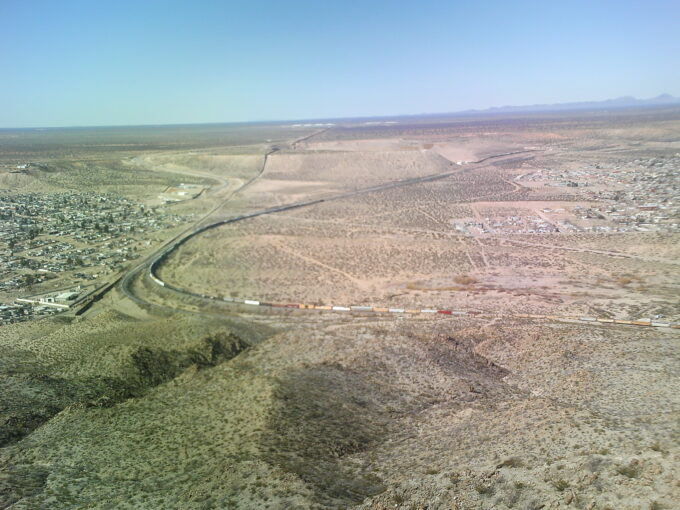
The start of the border fence in the state of New Mexico – just west of El Paso, Texas. Photograph Source: MJCdetroit – CC BY-SA 3.0
When I was presented with today’s topic, my first response to myself was, “What is the left anyway?” What the left is called upon to do is to imagine a world without borders. If we can’t do that, if we can’t even imagine it and fight for it, then we’re giving up and conceding defeat before the game begins. We are not in a fight only with the current regime, but we are in a fight against its opponents also. We are in an unrelenting fight against power, against domination, against all authority to build up any coercive apparatus like a border. There is no pro-border left. The left cannot consider immigration in isolation, because it is not one thing and it is not sealed off from a host of other factors within the social totality. Do we actually believe we could speak of these crises of refugees and mass movements without considering the war economy and aggressive wars of our government?
The mass-mobility of the modern age was thrust upon the popular masses of people by war and violent dispossession. Within this context, the immigration system has always been used to attack and undermine the truly bottom-up movements of ordinary people. It is used to weaken political radicalism just as it is used to structure the labor market, to determine the bargaining position of workers, to allocate social and economic vulnerability, and to distribute economic power and privilege. So borders are several coercive social systems, not one.
The focus on the physical boundaries of the country rather than its ethical boundaries is a profound value inversion and sign of moral sickness. Immigrants are not the ones gutting the country and stealing its wealth; that’s the global corporate conglomerates, with the very active partnership of the U.S. government. Immigrants are an easy target and scapegoat. I don’t think we should want an easy target. We should want the ruling class, whatever our political label or “identity” fetish. One of the most remarkable but little remarked on features of American politics is how little of the resentment is directed at the ruling class.
This is functionally quite useful to the ruling class and their ability to further concentrate power. From the standpoint of class power, anti-immigrant sentiments channel popular anger and resentment downwardly rather than upwardly, in the direction of the true sources of exploitation and economic and physical dislocation. The proponents of borders are the takers: they do not own every square inch of the country or the continent or the planet, but they assume to tell others whether they can welcome refugees and immigrants. Borders are social technologies for stealing what doesn’t belong to you and for dominating the bodies of other people. The way the mainstream discourse talks about borders—as mere lines on a map—is meant to obscure these glaring facts.
We have made the very fact of being an immigrant criminally suspect. The legal scholar Juliet Stumpf, who coined the term “crimmigration,” developed a theory of membership to help explain “the convergence of immigration and criminal law.” We should think carefully about what we consider ourselves members of and where our commitments are rooted and directed. I wonder if people really believe they’re in the same membership organization as those building up a hyper-militarized, AI-driven police state, and harassing and murdering innocent people who are trying to earn a living.
I disavow this membership organization: I disavow the state in its entirety. All of statism, the nation-state itself, wherever we find it, is imperialism. The state is always a military force occupying civil society, imposing its violence. It is always taking new areas of life and assuming new powers. One of the first things that came to mind for this talk was Harsha Walia’s influential book, Undoing Border Imperialism. Walia nailed so much of what is wrong with borders, why they’re there, what function they serve for the ruling class, and their practical mechanics. In the book, she discusses “border imperialism” as “the process by which the violence and precarities of displacement and migration are structurally created as well as maintained.” And in doing that she sets out,
four overlapping and concurrent structurings: first, the mass displacement of impoverished and colonized communities resulting from asymmetrical relations of global power, and the simultaneous securitization of the border against those migrants whom capitalism and empire have displaced; second, the criminalization of migration with severe punishment and discipline of those deemed ‘alien’ or ‘illegal’; third, the entrenchment of a racialized hierarchy of citizenship by arbitrating who legitimately constitutes the nation-state; and fourth, the state-mediated exploitation of migrant labor, akin to conditions of slavery and servitude, by capitalist interests.
Borders are not mere lines on a map, or a benign protector of the country, whatever the country might be. They are structures of violence that are always there; they are there even when ICE or border agents are not present. Walia’s idea of border imperialism underscores the fact that the border is a relationship of power that rests on and presupposes existing state domination. If massive-scale displacement of people is the result of war, colonial dispossession, enclosure and extractive “development,” then we have to seriously broaden the conversation about borders and immigration.
Imperialism must be at the center of this conversation; it gives the name to historically defined, interconnected and co-constituted phenomena of territorial domination, violent labor control, racial hierarchies, and capital accumulation through privilege. Borders and immigration as policy matters are far downstream of capitalism and colonialism. The system that displaces people through violence also criminalizes their movement through violence. Citizenship is itself a system of gradated, oppressive political technology. The border doesn’t stop at the border; it is very much a source of violence within the borders.
The anarchist writer Voltairine de Cleyre wrote: “Government is as unreal, as intangible, as unapproachable as God. Try it, if you don’t believe it. Seek through the legislative halls of America and find, if you can, the Government. In the end you will be doomed to confer with the agent, as before.” The state does not exist and borders do not exist. People can dress up in different costumes and patrol expanses of territory, but you will never find the state, and anyone who has visited a supposed border knows what one is. Borders are sites of human suffering, indignity, and indeed torture. Borders are historically a favorite tool of police states and authoritarian regimes, precisely because they seem to create a nebulous, lawless space, another “state of exception,” in Agamben’s terms.
Borders are another figment of the imagination by which some people grant themselves permission to violate and dominate other people. We have become so fixated on and enamored with these abstractions (the state, nations, borders) that we are willing to sacrifice actual human lives to propitiate their thirst for blood. The borders do not exist. The state and capital themselves tell us that borders do not exist. Capital moves with the ease of water, even easier, in fact, with the ease of switching 0s and 1s.
[The remarks that follow were presented originally as part of a talk, “Immigration and the Left,” for the Platypus Affiliated Society at Northwestern University in Evanston, Illinois on Monday, September 28, 2026.]


