
Photograph Source: Daniel Torok – Public Domain
With current polling suggesting that the Democrats will win the House and possibly the Senate in the upcoming midterms, the longer trajectory of American politics is brought into focus. With the US currently engaged in two wars and one genocide; the wholesale destruction of the institutions that make life livable in the US, and the economic empowerment of a predatory oligarch class, most of what Americans call politics isn’t on the ballot.
As has been the practice for more than a few decades, Donald Trump ran as a political outsider, threatening to blow the system up if elected. Ordinary DC chair warmers, as the collectors of political donations to support oligarchic control over the rest of us, represent the institutionally-mandated mode of ‘governing’ in the US. Trump came to the job with a list of long-discredited ideas that less intrepid souls would have understood to be both idiotic and self-destructive.
One possible way to consider this contest is as between the political parties. One party supports one flavor of policies and the other party favors another. As should be evident at this point in history, that system put in place a tiny group of oligarchs making really bad decisions for the rest of us. Crypto grifts and AI? This is what happens when a ‘heads, they win, tails we lose,’ power dynamic is in place. The good news for the few is bad news for the rest of us.
Should the pollsters have the election predictions right, the first order of business will be securing the results. Up through about Bush v. Gore this impulse would have been bipartisan. At the time the myth of American democracy had been well sold. That the US was founded as a Constitutional Republic explains quite a bit about why it is today an oligarchy. Giving power to those pursuing their own interests leads to power being used in pursuit of those interests.
That the representatives of both parties appear in public surrounded by ‘their’ oligarchs should provide a clue as to who wields power in the US. That the fortunes of these oligarchs came through inheritance and / or dubious business endeavors should provide a clue as well. One unifying factor has been CIA venture capital funding through In-Q-Tel. We, the people, have the CIA to thank for Oracle, Palantir, and a host of AI startups.
In 1925 US President Calvin Coolidge gave us “the chief business of the American people is business.” He was referring to the industry that built the heartland. While it is a mistake to romanticize the brutal labor relations of US industry, post-War prosperity made it possible to perceive a crude unity in a national interest. That war profiteering and the seizure of foreign economic resources became the point of US foreign policy required decades to re-instantiate.
‘Business’ hasn’t been the business of the American people for at least the last half a century. Just getting by has been. The question now is whether to blame politicians or economics for the shift? On the one hand, politicians make economic policies. On the other hand, the special circumstance of the US having the only intact industrial infrastructure following WWII was temporary. The ‘American Century’ was an artifact of history. That Americans were told that the advantage was permanent explains some fair portion of the political rage of today.
By the 1970s the writing was on the wall. The American infrastructure advantage began to wane. Imports from Japan were climbing the value chain from trinkets to consumer goods. American industrialists shifted from labor hoarding to searching abroad for poor, desperate workers who wouldn’t contest poverty wages with no benefits. The claim that brutal labor relations were the key to American prosperity led to the passage of NAFTA (1994) and the elevation of finance as a disciplining factor for labor.
The brutality towards labor emerges from the capitalist theory of capital accumulation. Capitalist economics posits that the social savings that fund capitalist investment produce a benefit for both capital and labor. But US economic evolution since the 1970s tells a different story. Capital understood that the post-War infrastructure advantage was over early on. The temporary truce between capital and labor was turned back into a zero-sum game where capital saw its future in treating labor as prey.
The wisdom of this move is a matter of perspective. The fast money crowd turned the US into a casino. Fortunes are made or lost making ‘bets’ on the direction of financial markets. That US markets have been openly manipulated since the 1987 stock market crash (‘Greenspan put’) is a matter of public record. That billionaires are minting their own currencies (‘crypto’) gives the power of the state to unaccountable individuals and institutions.
This shift of state power to oligarchs is why political resolution in the US won’t be found anytime soon. The likely 2028 candidates are differentiable in rhetoric but not in policy. The wars to be fought are the same. The genocides are the same. State violence against anti-genocide protesters began in 2023, not 2025. Within the current configuration of power, ‘give ‘em enough rope’ is the alternative to direct confrontation.
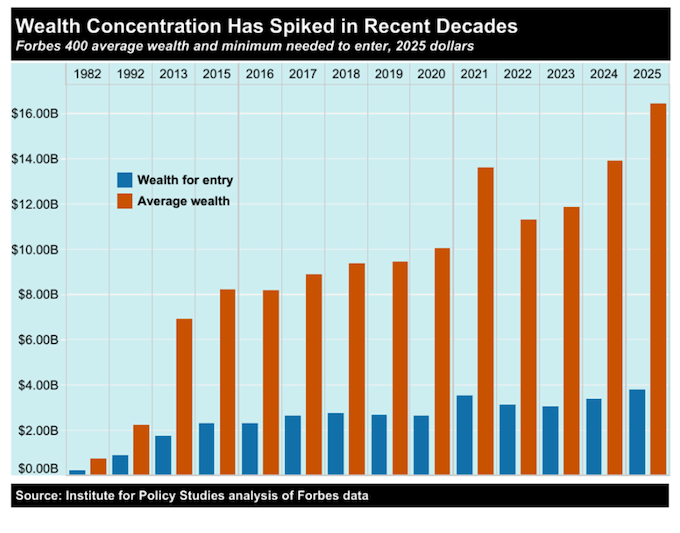
Graph: while readers are likely familiar with this graph, interpretation requires slight knowledge of statistics. Statistical averages (in orange) are prone to over-representing extreme concentrations (kurtosis) of wealth relative to what most people experience. In the graph this explains why the orange bars keep rising higher relative to the blue bars. Interpretation is that the concentration of wealth in the US has risen relative to what most people experience since the early 1980s. This is evidence that the US is an oligarchy. Source: inequality.org.
The current impediment to rebuilding a functioning economy is that China and other economic competitors have already built the ‘factories of the world.’ In order to compete the US needs a new entry point. The new factories that could have been located in the US and employed American workers were built by other nations. The ineffectiveness of recent US efforts to re-industrialize is a function of decades of underinvestment. As China learned decades ago, building roads that run from factories to export facilities is how they get built.
That the Americans perceived a ‘unipolar moment’ (1991) as the US economy was being systematically dismantled demonstrates the power of delusional thinking. Many of us at the time were incredulous that US military production was shifted to geopolitical rivals just as US belligerence and poorly considered militarism were rising. Surely, no one was so stupid as to expect that geopolitical rivals would export arms to the US as they were being attacked by it.
On this last point, I was wrong. Market ideology that had little to no explanatory power with respect to US economic success up to that point was put forward as uncontested fact. Having accepted a project in college where I traced the reach of the Western imperial powers into Africa, the neoliberal ‘free-market’ trade routes followed the old imperial trade routes quite closely. What this means is that US ‘free-market’ economics is imperialist dogma.
Donald Trump’s homicidal / suicidal resistance to regulating AI is a function of this ideology. Recall the neoliberal theory that corporate-friendly regulation is the secret to unleashing the animal spirits of capitalism? Today it means handing state-level destructive capacity to any psychopath with a computer that decides that s/he has had enough of this world. Why would would-be school shooters put themselves at risk when they can send AI agents to cut off the town’s water supply?
The US had the same opportunity as China and other economic competitors to invest and it chose to give the money to the oligarchs instead. While China was building an export-led economy the people running the US were arguing over the size of tax cuts for billionaires and how to ‘shrink the size of government.’ Lest this shock, this is the very same ‘abundance’ theory recently being touted by self-styled centrists in the US. That it is recycled Right-wing dogma from the 1980s locates it on the ideological spectrum.
That Reagan represented the hard-Right when he was in office but his policies are considered ‘the pragmatic center’ in the present illustrates the conundrum. Why would those of us who opposed these policies in the 1980s vote for them in 2026 unless we changed our minds about them? As both legacy parties bleed voters, the evidence has it that lots of people haven’t changed their minds. The question then is why self-styled centrists don’t just vote for the party that represents their politics? The answer back is that they do. It just doesn’t fit neatly into any coherent notion of a political center.
Graph: remarkably, nearly every name on this graph of billionaires whose wealth has ballooned in recent years is a recipient of Federal largesse, known colloquially as welfare. And ironically, almost every one of them claims to be a self-made person who thinks that welfare for the poor should be abolished. This absence of self-awareness would make them dangerous to the oligarchy if it didn’t define it. Source: inequality.org.
Part of what is perpetually odd about American politics is that we are constantly told what we care about but never asked. Iran having nuclear weapons? Israel is the state that never should have been allowed to have them. Iran is ruled by a rational government. Israel is populated by genocidal and apocalyptic religious zealots. To the ‘Israel controls the US crowd,’ Trump just forbade Netanyahu to attack Iran to save his (Netanyahu’s) election campaign. And the Israeli government then stepped in to prevent Netanyahu from doing so.
Regarding what Americans want from politicians and the state, this is always posed in terms of new costs rather than net benefit. Current ads claim that Medicare for All (an inadequate solution) would ‘cost taxpayers $400 billion’ when those who have looked into the matter offer that it would save $1 trillion per year. Equitable public schools would likely require Federal funding. But we would get in return an educated populace that possesses the tools needed to thrive in the world. And again, it is oligarchic welfare recipients upset that their looting might be hindered by public investment who object to these policies.
More broadly, Americans seem to expect absolutely nothing from the politicians that they vote for. This leaves us complaining about half-baked and wholly inadequate campaign promises that go unfulfilled instead of insisting that we get the policies that we need and have already paid for. The suggestion here is that a barely negotiable set of policies be proposed to get us out of this cycle of reacting to inadequate proposals
Education: state-funded pre-K through post-Doc for all comers. End the Charter schools and redistribute the money to public schools. And use Federal money to raise and equalize the quality of education through equalizing the funding.
Healthcare: a public system where healthcare is fully state funded for all humans living within the US. All healthcare will be free at the point of provision. End the health insurance industry and create jobs for the workers displaced.
Childcare: create a childcare authority to manage a national network of free at the point of service childcare facilities whose purpose is to free parents to work. Hire local workers at a living wage with benefits. Put child safety and wellbeing first.
National defense: end the network of 800+ US military bases handing the land back to the nations in which they are located. Dissolve the US standing army and cut the Pentagon budget by 85% – 95%. If a military emergency arises, draft people in order of their family wealth with the richest being drafted first. This isn’t punitive. It is to prevent the rich from starting wars from which they benefit economically.
The usual pushback at this stage is panic-mongering about the Federal budget deficit. How can ‘we’ possibly afford these luxuries when we have pointless and murderous wars to fight, banks and bankers to bail out, and tax cuts for billionaires to pay for?
What is missing in the budget hawk panic is that it was private debt that caused the GFC (Global Financial Crisis), not public (Federal). Non-financial private debt (to prevent double counting) is currently $45 trillion versus $40 trillion for the public debt. And the Federal government of the US issues its debt in USD which it can create at will. Private companies get charged with counterfeiting if they do this.
The tales of sovereign defaults under these conditions are far and few between. The best-known, Russia in 1998, involved a pegged currency. The point is that it was the peg that was the problem, not the debt. The US has a floating rate currency. It isn’t pegged and hasn’t been since the US left the Gold Standard under Nixon.
FWIW, my Democrat friends are motivated in the current election and my Republican friends aren’t. This jibes with news reports on early voting. More Democrats than Republicans are showing up at the polls. But Trump has already put down legal markers for contesting the election results. He had his chance to govern pretty much unimpeded and he made a mess of it. The problem of ICE at polling places so far hasn’t materialized to my knowledge. I voted without incident. The larger challenge at present will be to get past Trump’s legal impediments.
The immediate problem of an AI-induced financial crisis has been averted for now with the announcement that AI company Anthropic will IPO (Initial Public Offering) in late November. This should provide some breathing room until the next AI-induced crisis appears. If we can get Trump out of the way a tiny vacation from the existential dread that he has been causing may be possible. But recall that he is delivering 40,000 2,000lb bombs to Israel of the sort that flattened Gaza. This won’t be over until it is over.


