
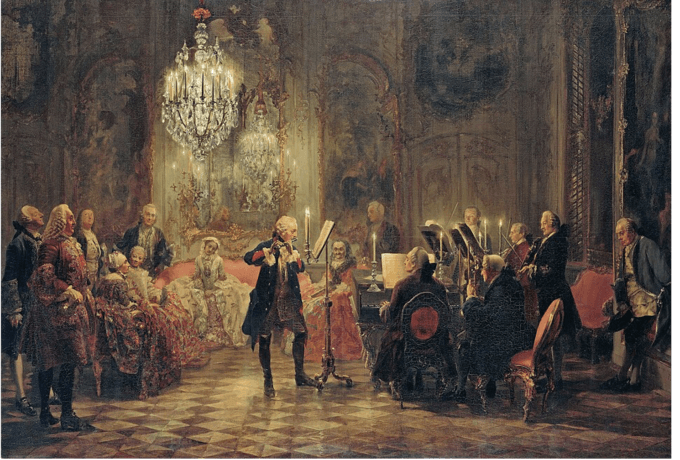
Adolph Menzel, Frederick the Great Paying the Flute at Sansoucci, 1853. Alte Nationalgerie, Berlin.
In the midst of near-continuous hostilities in eighteenth-century Europe, a decades-long window of peace opened up after the end of the Seven Years’ War in 1763. Grand Tourists from Britain poured onto the continent. In 1764, the English musician and writer Charles Burney deposited two of his four daughters at a school in Paris so they could perfect their French. Burney himself would have to wait until 1770 to undertake his own trip to France and then on to Italy.
Friend of Samuel Johnson, Joshua Reynolds (who painted his portrait), Edmund Burke and known to all the great and the good in Georgian London, the companionable Burney was not a man of means. He supported his large family in London as a harpsichord teacher, mostly of wealthy women. Unlike the dissolute young aristocrats who spent years abroad, ogling art, women and each other, Burney had just six months for his not-so-grand tour, funding the adventure with his own savings. Yet he was also speculating that the fruits of this journey undertaken to do research in European libraries and archives for his planned General History of Music would, when published, more than repay the considerable outlay. The first of that project’s four volumes came out in 1776, the last in 1789.
Soon after returning to England, Burney published a condensed and edited version of his extensive travel diaries as The Present State of Music in France and Italy.
The book sold well and was disseminated on the continent. The Germans believed they deserved a visit, and they invited him to undertake a northern tour. Not least because of the success of the French and Italian volume, Burney’s publisher granted him twice the number of pages, spread across two volumes, for the Present State of Music in Germany, the Netherlands, and United Provinces, which appeared in 1773.
On his travels, Burney saw and heard princes and processions, prodigies and potentates, scientists and savants, operas and plays, buskers and gondoliers, religious rituals and reenactments and mass tramplings. (This Parisian disaster occurred as a result of unplanned explosions in a fireworks display celebrating the wedding of Marie Antoinette and the future Louis XIV; Burney had just arrived in Paris, and his account of the catastrophe that left thousands dead is found in only the unpublished draft of his diaries now in the British Library).
On the continent, Burney met dozens of musical celebrities of the day, among them the aged opera singer Farinelli in his opulent mansion outside of Bologna, where Burney also encountered the young Mozart and his father; the gentle Baldassare Galuppi, just blown back by the north wind from three years in St. Petersburg to his native Venice, composing at his clavichord; the last of the Couperin dynasty holding forth at the family’s church of St. Gervais in Paris; the imperious, pock-marked Willibald Gluck at his residence in Vienna, accompanying himself at the keyboard and singing through his next, as yet unnotated opera; C. P. E. Bach at a larger, more powerful and expressive clavichord after dinner at his townhouse in Hamburg. Of this most famous Bach of the 18th century, whom Mozart praised as the “father and we the grandkids,” Burney wrote: “During this time, [Bach] grew so animated and possessed, that he not only played, but looked like one inspired. His eyes were fixed, his under lip fell, and drops of effervescence distilled from his countenance.” It was a painting in prose as artful and affecting as those his friend Samuel Johnson did in oil.
The Present State journals are most often read—and mined—today by Burney’s musicological heirs for these intimate, unforgettable portraits of the great musicians of his day.
Though an unwavering monarchist with many friends—both Whigs and Tories—in parliament, Burney pilloried the ossified musical culture of France, where music by dead composers enjoyed royal favor and was imposed on the populace in public concerts and commemorations. Italy was the engine of new ideas and musical products and the proving ground of performers, and the great exporter of fashionable sonic workers and wares cast in the international style known as the galant—the gentlemanly, refined, agreeable. “An old opera is as useless and neglected as an almanac of last year,” as he wrote in Present State. But Burney also harbored respect for the great works of the past, even editing a volume of the papal classics that he heard on his pilgrimage to the Sistine Chapel. In 1771, the same year as the first travel diaries appeared, Burney published his edition of some of these sacred selections, including Allegri’s Miserere, revered and transcribed by those other pilgrims, Mozart and Mendelssohn.
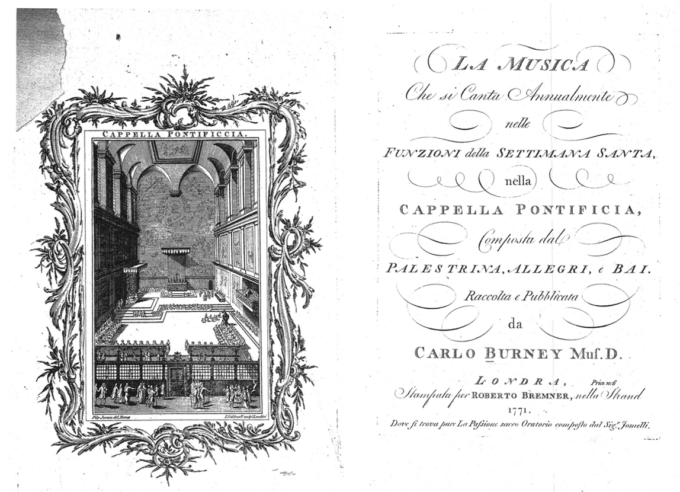
Frontispiece and title page, of Burney’s La musica che si canta annualmente nelle funzioni della Settimana Santa (London, 1771)
On the German trip of 1772, Burney was struck by the ubiquity of military bands, the size of the garrisons, and their effect on the urban soundscapes. The devastations of the recent Seven Years’ War were everywhere to be seen: buildings in ruins, the arts in retrenchment, once-comfortable musicians pitched into poverty, even despair.
Written in the aftermath of this first truly global conflict, the diaries are prescient, even portentous. Burney’s condemnation of French musical culture prefigures, even seems to predict, the fall of the ancien régime less than two decades later. Similarly, the ascent of Prussian militarism and the wars it pursued inevitably lead the modern reader to ponder the calamity of the 20th century. Music for Burney is the bellwether of a state’s moral character.
At the royal palace of Sanssouci in Potsdam outside Berlin, Burney eavesdropped through a closed door on Frederick the Great practicing his flute. The English visitor then attended the concert at which the monarch was the soloist every evening, as always culminating with a concerto by his top musical servant and teacher, the famed flutist Johann Joachim Quantz. That evening’s concerto had been composed thirty years before. However well-constructed, this music’s persistence was a sign of the stultifications of absolutist rule.
Disgusted by his rough treatment, including the censorious search for banned books at various customs posts on the borders of German-speaking lands and even cities, Burney slammed Prussia on his way north to Hamburg: “That music is truly stationary in this country [of Prussia], his majesty allowing no more liberty in that than he does in civil matters of government; not contented with being sole monarch of the lives, fortunes, and business of his subjects, he even prescribes rules to their most innocent pleasure.”
If Burney had undertaken a similar trip in 2026, he would have commented on all this autumn’s elections—those mass rituals of the present, conducted in most nations nowadays on Sunday—rather than a voter-unfriendly Tuesday.
Instead of royal fêtes and religious spectacles, Burney would also have encountered an endless succession of sporting events of massive scale: the Champions League finals; open-air World Cup screenings; the Tour de France; derby soccer duels from Milan to Munich. Had he ventured to the present-day North American colonies, to which his son James was dispatched as a naval officer in 1770, Burney would have decried the royalist music of Trump, dictating a defunct repertoire ranging from Puccini to the Village People.
Burney had much to say of sovereigns’ pursuits, remarking, with more than a touch of suspicion and even exaggeration, that in once-splendid Dresden, now wrecked by the war, the Saxon Elector’s “favorite amusement is dancing, and, to oblige him, his subjects and courtiers are dancing for ever.” The sight of Trump swaying and slow-fist-pumping to the sounds of “Y.M.C.A.” would have confirmed Burney’s diagnosis that rigor mortis has set into the American president’s body and into the American body politic.
Even if, according to Burney, the continent would never flourish musically, politically, commercially, or culturally under these autocratic regimes, it was for the time being at peace. As for the world’s “greatest democracy,” as Burney’s friend Edward Gibbon might have put it, after the rise there comes an inevitable “decline and fall”—the fate of empires tracing on the world stage the trajectory of a galant melody.


