
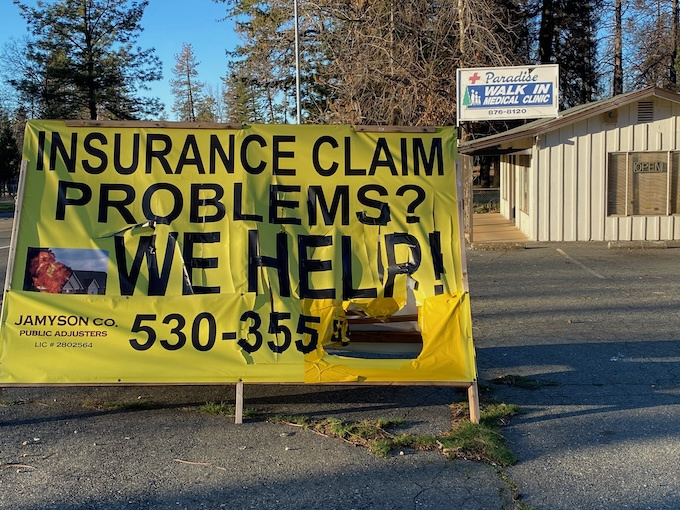
Insurance sign after the Camp Fire burned 14,000 houses in Paradise, California. Photo: Jeffrey St. Clair.
Donald Trump has repeatedly pronounced global warming to be a hoax, but his pronouncements have not prevented it from having a large effect on people’s pocketbooks. The price of homeowners’ insurance has far outpaced the overall CPI since the pandemic, and global warming is likely a major factor.1 As I noted a few months back, this could be a big part of the cost-of-living paradox that has been bothering economists the last couple of years.
The paradox is that indexes of consumer sentiment show terrible numbers; the University of Michigan Index of Consumer Sentiment is at an all-time low, even though the data on items like unemployment and income growth don’t look that bad.
It’s fair to say that no one has come up with a widely accepted explanation for the gap between sentiment and standard measures of economic well-being. I was looking at homeowners’ insurance as a possible explanation because it is not included in the Consumer Price Index. As I explained in my piece from July:
Since 1983, the Consumer Price Index (CPI) has used a rental equivalence measure for owner-occupied housing. This is supposed to measure the rent that could be charged if the home was rented. We can think of this as what the homeowner is paying to themselves.
It might seem a strange idea, but the prior method — measuring the increase in house prices as part of the CPI — effectively implied that homeowners were worse off if the price of their house rose by 20 percent. The logic of the rental equivalence measure is to treat owner-occupied housing as a consumption good rather than an investment good.
In keeping with this approach, the CPI excludes the cost of homeowners insurance. The logic is that the insurance is bought to protect the value of an investment good. It only includes renters’ insurance and the small portion of homeowners insurance that covers personal possessions, not the value of the structure. As a result, the weight of this insurance in the CPI is 0.29 percent, a bit less than for household cleaning products.
Excluding homeowners insurance from the CPI would not matter if rose roughly in step with the overall rate of inflation, but that has not been the case in recent years. It has risen far more rapidly. As I pointed out in my last post, since 2016 the cost of homeowners insurance has increased 110 percent, compared to an increase in the overall CPI of 37.4 percent over this period.
I was giving this a bit more thought, and I realized this comparison seriously understates the actual increase in the cost of insurance. The reason is that the percentage of homeowners with insurance has fallen sharply over the last decade. In 2016 it was 95 percent; currently it is less than 86 percent.
The reason this matters is that the price of insurance for the people who dropped coverage almost certainly increased far more than the average rise for the people who maintained coverage. If the cost of coverage for the people who dropped insurance rose twice as much as the overall average, that would imply the average price, if coverage had remained constant in 2026, would have been $2,728, as opposed to the reported $2,490. This implies an increase in the cost of homeowners insurance since 2016 of 130 percent, compared to an increase in the CPI of roughly 35 percent over this decade.

The rise in the cost of homeowners insurance in excess of the CPI implies that it is taking an additional $1,100 a year out of their pockets each year. Suppose the average homeowner saw their annual tax bill jump by $1,100; would that make them feel less happy about the economy? Even this figure may not capture the full impact, because the industry data is not quality-adjusted in the way that the Bureau of Labor Statistics calculates price changes. If current policies had larger deductibles, or excluded protection for certain things like wind damage, that would not be picked up in the industry data.
I’m not sure how much negative sentiment can be explained by higher home insurance costs. Presumably, it didn’t affect the sentiments of the one-third of households who are renters much. But it does seem like a serious issue if we are asking why people might be negative about the economy. We can’t blame them for not viewing the economy in the same way as we analyze the data.
Note.
1. Insurance raises some difficult conceptual issues. Covering homes against more frequent climate-related damage can be seen as a quality improvement rather than a price increase. As an item for further thought along these lines, the spread of AIDS in the 1980s and 1990s would have led to a lower measured rate of inflation. I’ll leave that one for people to contemplate.
This first ran on Dean Baker’s Beat the Press blog.


