
Cover art for the book A Conspiracy of Laughter: How Ivy League Elites Got to Dictate What’s Funny by Adam Szetela
“Harvard, Yale, Princeton, Dartmouth, Columbia, Brown, Penn, and Cornell… Ivy League elites— pull the strings of American comedy… into an elite network where the most privileged people on planet Earth look out for each other – often at the expense of the rest of us… Since the late 1800s, the Ivy League has determined who is funny— and who is not.” (A Conspiracy of Laughter, pg. viii)
Top echelon elitist Ivy-bred creators/writers have their fingerprints all over the world of comedy, The Onion, The Simpson’s, Saturday Night Live, Late Night with David Letterman and the list goes on, likely including your favorite mainstream comedy.
But all’s not as well as it seems on the surface, according to Adam Szetela’s A Conspiracy of Laughter (The MIT Press, London, available March 9, 2027) subtitled, How Ivy League Elites Got to Dictate What’s Funny: “This is the story of how the rise of populism in American politics was abetted by the populist revolt in American comedy. It’s the story of how ‘liberal elite’ became the nastiest epithet in both American politics and American comedy. Above all, it’s the story of how the legacy institutions — from Harvard University to Saturday Night Live — fell out of favor with the American people.” (pg. xii)
Prior to falling out of favor, American comedy was beholden, a product of, and dictated by an elitism beyond the challenges of acceptance to an Ivy; it’s very tough getting accepted into the tight circle of comedy comradeship. How and why Colin Jost-types of the world came to pass is addressed in initial chapters. They must withstand a rite of passage. It’s brutal!
For example: “Communities like The Harvard Lampoon and Third Wheel Improv are exclusive communities. As noted, these communities are an important source of life-long friendships for their members… But a student has to first be admitted as a member. The admission means so much, much like the admission to the Ivy League itself, because most people who want to join these communities are rejected… In his memoir, former Lampoon president Colin Jost, who graduated from Harvard in 2004, explains that hundreds of people apply every semester and usually only three or four writers get accepted. I wrote thirty pieces my first semester and got rejected. The next semester I wrote fifty pieces and got rejected again. And you couldn’t get published in The Lampoon unless you were a member, so I had no other outlets for my writing… when Colin remembers his time at The Lampoon, he is clear that this big friend group was distinct from other groups on campus… The third time I applied, after eighteen months of writing constantly, I finally made it.” (pg. 23) 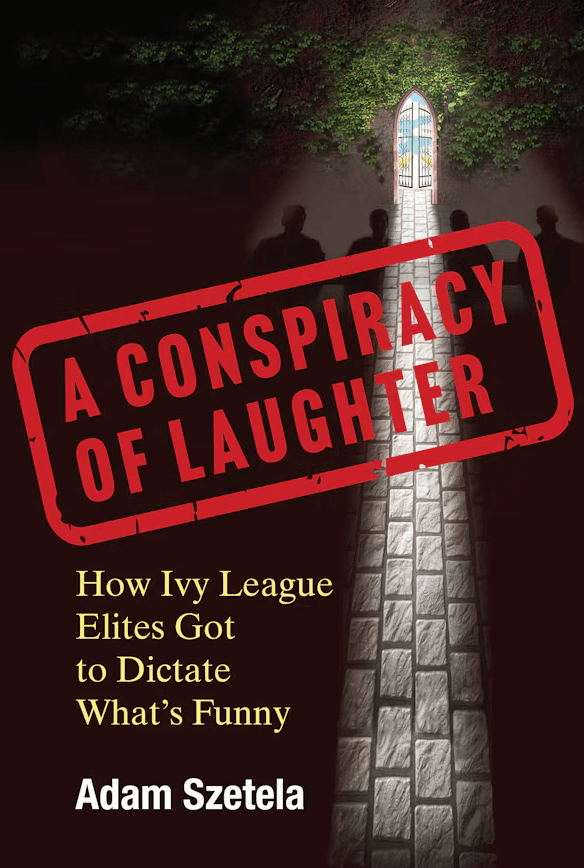
A photo of the famous (or, if for some personal level of retribution, infamous) Harvard Lampoon Castle appears on page 25. “At Harvard, the next generation of comedians succeeds inside a castle.”
The Jack-O-Lantern is Dartmouth’s version of The Lampoon similar to Exit Players (Yale) inclusive of a long list of alumni as writers, producers, actors for Saturday Night Live, Friends, The Colbert Report, Late Night with Conan O’Brien, The Daily Show and of course, there’s Harvard’s Hasty Pudding Theatricals’ players lining the walls of SNL.
Fascinating Stuff to Behold
Szetela details traditions, legacies and inclusiveness as well as exclusion into this very elitist world of ‘manufacturing American comedy.’ Per the galley (Property of The MIT Press), one comes away with a sense of how monolithically upper-class, nose-in-the-air, the comedy scene bows to the true riches of America’s capitalistic enrapturement of all that’s good about wrapping the flag around jokes. Although, none would likely agree with this synopsis, re the flag, uh-huh.
Still, it’s “punching up,” not “punching down” that’s at the heart of the satire: “It’s fine to attack people, but they need to be powerful people. Power, as today’s students and alumni understand it, is not just defined by what one does, but who one is. A university president, a police chief, and ‘macho men,’ to use the language of a Princeton Tiger article, are fair game. A university custodian, a victim of police violence, and trans women, to use three hypothetical examples, are not.” (pg.68)
Indeed, there are exceptions. Szetela refers to the “moral superiority theory of comedy,” when it is okay to poke fun at people who are inferior if they are morally inferior, for example, when The Yale Record poked fun at WH Press Secretary Sarah Huckabee Sanders.
Yet, as much as these Ivy League comedic upstarts like to think they are blazing some out-of-bounds new trails, maybe not so much: “While Ivy League students and alumni continue to see themselves as marginal, as oppositional, and as rebels outside the establishment, they continue to occupy positions in the most mainstream establishments. These Ivy Leaguers are, in the most banal sense of the term, the establishment… There’s nothing marginal or oppositional about getting admitted into Harvard. There’s nothing marginal or oppositional about landing a sitcom with NBC… it’s obedience that gets you through college, especially at a place as prim and proper as Harvard.” (pgs. 94-95) And the apple doesn’t fall far from the tree.
“What Noam Chomsky said about colleges and universities is even truer of elite colleges and universities. ‘They are overwhelmingly composed of the kind of people who showed up to school every day and on time; who did not have bad disciplinary records but did have the right kinds of extracurriculars; who turned in their assignments on time and according to the specified instructions; who mastered regurgitating the information that the teachers provided precisely, and in a form that said teachers found aesthetically pleasing; who craved approval from their teachers and other authority figures… by the same token, there is nothing marginal or oppositional about earning a degree from Harvard. That piece of paper doesn’t signify rebellion. It signifies the fact that you don’t rebel. It signifies the fact that you follow the rulebook that is handed to you.” (pgs. 94-95)
Perfect for the well-touted liberal-branded politics and culture, but, umm
77,302,580 Americans Rejected Liberalism
Trump won 77 million votes in a shockingly powerful slap-in-the-face rejection of liberalism, politically and culturally; correct English tossed out the window, say what’s on your mind, swear, forget scripts, we’re all flawed Americans, live with it, and reject mainstream comedy, because it’s “fake and controlled.”
Lo and behold, in response and very quickly: “At donor retreats and in pitch documents seen by The New York Times, liberal strategists are pushing the party’s rich backers to open their wallets for a cavalcade of projects to help Democrats, as the cliché now goes, ‘find the next Joe Rogan.” (pg. 115)
Authenticity, no script, wide-open, free-flowing chatter is what people understand and vote for. Trump was diametrical to Joe Rogan’s experience with Kamala, whose strict punctilious requirements of a stenographer and ever-present full staff on the set of her choosing turned Rogan inside-out. With Trump, he just simply showed up, nothing ahead of time of what we’ll discuss… let’s talk, just go for it. Kamala stiffly, ungracefully refused ‘the setting.’
“His podcast, like a dinner with Donald J. Trump, doesn’t have all those liberal hall monitors who walk the halls at 30 Rockefeller Plaza to make sure comedians like Colin Jost and Jimmy Fallon stick to the script. The story of Donald Trump and Joe Rogan, two men who were on the margins of American politics and culture for decades, who are now at the very center, is the story of the revolt against what Jonathan Haidt calls ‘the coddling of the American mind.” (pgs. 114-115)
Szetela’s text is full of surprises: “The Form is one reason Harvard is ranked as the worst university in America for free speech… The other Ivies aren’t much better.” (pg.121) At Harvard students can anonymously snitch on others via the “Bias Incident Report Form.” Hmm. Is this the tattletale syndrome?
Not so Subtle Shift in Public Appreciation
“In the real world, more Americans would rather see Shane Gillis (who is headlining arenas) than Colin Jost (who is headlining clubs)” e.g. 300-seat Comedy on State versus Gillis adding a 3rd show at Madison Square Garden because his first two shows sold out.” (pg. 153) At a Gillis’ show the target is everyone’s ‘back,’ right, left, center, black, white, Native American, gay, straight, trans, whatever, no rules, no compromises, no dogmatic rules a la SNL.
A whole generation of comedians “Chappelle, Joey “Coco” Diaz, Rogan, Gillis, Theo ‘The Rat King’ Von aren’t following the oppression hierarchy about who they can and cannot joke about.” (pg. 158) Political ambiguity is central to this new breed, confuse but entertain the public while getting them to laugh… is this person rightwing, a commie lefty, a Trumper, a socialist, a fascist, blah-blah-blah. Who knows, who cares, it’s funny as hell?
Today’s world of comedy: “South Park… just hit its biggest cable share for a season premiere since it debuted in 1999. Whereas Colbert can’t keep the lights on, SNL just hit a fifty-year ratings low, and The Simpsons is as culturally relevant as your grandmother’s snow globe. South Park just signed a $1.5 billion deal with Paramount.” (pg. 159)
Incidentally, Trump didn’t scotch Colbert… according to The New York Times, the show was already bleeding tens of millions per year. They just needed an excuse.
What’s going on with comedy? “When you turn on South Park, you really don’t know if they’re going to be making fun of Donald Trump for having a small penis or a transgender weightlifter for still having a penis.” (pg. 159)
Meanwhile, a cultural shock agenda sent a strong message on Trump’s election swear-in day: “Trump stocked his new cabinet with a venerable who’s who of ‘anti-woke’ crusaders.” (pg. 184) For example, Hegseth’s famous “Pentagon pussies” reference in his NYT bestseller fit the bill to a T.
“It’s hard to image President Trump winning the popular vote— the first Republican to do so in twenty years— without Joe Rogan, Theo Von, and the other popular comedians who hosted him… It’s also hard to imagine those comedians, and their podcasts, being this successful if they hadn’t been excluded from legacy comedy institutions and forced to create their own institutions.” (pg. 192)
“As liberal comedian Marc Maron recently lamented in his new standup special, ‘we annoyed the average American into fascism.” (Pg. 189)
Final words, found on page 192: “In the eyes of many, Trump is starting to look like a fake… (ed.-and even worse yet) Rogan, who also attended the inauguration, described ICE’s crackdown as ‘horrific’ and ‘intolerable to ‘everybody who has a heart’… Andrew Schulz, who welcomed presidential candidate Donald Trump on his podcast a month before the election, recently lamented, ‘I voted for none of this.”
And that says it all!


