
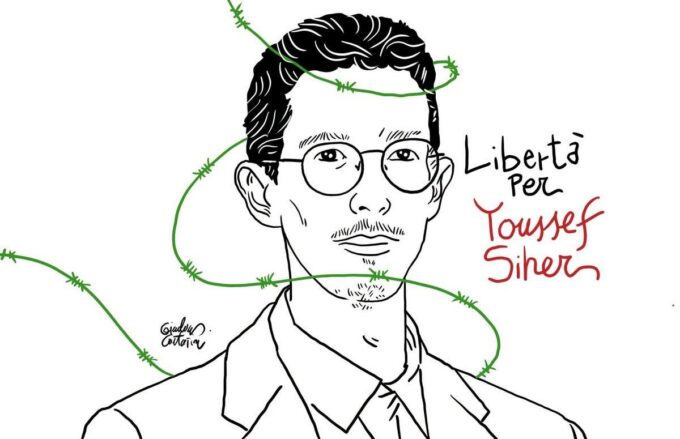
Art by Gianluca Costantini
On the afternoon of 28 October 2026, Youssef Siher left the Carcere di San Vittore (San Vittore prison) in Milan to the applause of friends, family, and Palestinian community leaders. Those who greeted him formed a tight circle and shielded him from the dozens of cameras and microphones of the media that had spent the past week character-assassinating him, painting him as the monstrous kingpin of a spontaneous uprising and as a terrorist, feeding the usual Islamophobic tropes.
The 30-year-old Italian born of Moroccan origin, researcher, freelance journalist, and administrator of the Telegram channel and Instagram page “Movimento 17 ottobre,” had been held since the night of the 24th of October. Milan prosecutors had charged him with istigazione a delinquere (incitement to commit crimes) aggravated by finalità di terrorismo (terrorist purpose) and with violenza organizzata nelle manifestazioni pubbliche (organized violence at public demonstrations)— the latter a new offense under one the Meloni government’s 8 decreti sicurezza (security decrees). The primary reason that these charges are so ludicrous is that they were based on the creation of an Instagram page and chat group that were created on the evening of the 18th of October, after the glass shattering and looting had already taken place as a small part of massive peaceful protests.
Investigating judge (gip) Tiziana Landoni refused to convalidare il fermo (validate the preventive detention). In a 37-page order she found no serious indications of guilt, no concrete calls for violence, and no flight risk. Siher’s messages, she wrote, amounted to civil disobedience, collective mobilization, and “the formation of a collective consciousness,” not the production of terror or organized attacks. He remains under investigation, as does his wife Sagia, but he is free. Solidarity with Youssef and Sagia has been immediate.
The case is the clearest recent example of how the Italian state is treating the intersection of the carovita (cost-of-living) revolt and Palestinian solidarity as a security threat. The 17th and 18th of October clashes in Milan followed weeks of protests over prices, rents, and the visible gap between military spending and collapsing public services.
Those weeks had already produced something larger. On October 10th, hundreds of thousands filled the streets in more than 80 towns and cities across Italy in Palestinian solidarity demonstrations — a massive and somewhat unexpected turnout against genocide and Zionism that put the government on notice before the Milan events even began.
Looting and street fighting occurred on the 17th and 18th; so did large peaceful marches. Prosecutors fixed on Siher’s channels — roughly 50,000 Instagram followers and 11,000 on Telegram — as the organizing hub despite the fact they were created after the fact. They read his posts as a continuous declaration of war.
Landoni read the same texts and found sharp criticism of the government and the media (“lo Stato ci piscia addosso e i media ci fanno credere che piove” — “the State pisses on us and the media make us believe it is raining,” “Meloni dichiara guerra al futuro di questo Paese e noi dichiariamo guerra a questo presente infame” — “Meloni declares war on the future of this country and we declare war on this disgraceful present”), calls for weekly demonstrations, and instructions for remaining calm under tear gas.
She noted that Siher never referenced the 17th and 18th of October violence as a model and that a published vademecum on urban tactics had its aggressive sections removed. The legal threshold for instigation requires concrete danger, not abrasive language. The aggravation of terrorism charge requires an intent to intimidate the population or damage the state; she found neither. The new organized-violence offense requires at least five people acting with offensive instruments; the evidence did not meet it.
Prime Minister Giorgia Meloni’s response was immediate and unfiltered. She called the judge’s decision “vergognosa” (shameful) without qualification. Interior Minister Matteo Piantedosi had earlier praised the police for identifying the “mind” of the movement and framed Siher as close to ambienti antagonisti (antagonistic environments).
The political message was plain: the executive expected the judiciary to ratify the security narrative. When a judge applied ordinary standards of evidence and constitutional free-expression limits, the Prime Minister treated the outcome as an affront.
That reaction sits inside the same pattern of intensifying repression visible across this tension filled autumn: new criminal offenses for organized protest, precettazione (compulsory orders forcing workers back to their jobs) against strikers, and the systematic labeling of Palestinian solidarity as adjacent to terrorism.
In Rome, students attempting a peaceful occupation of their high school —– the Liceo Giordano Bruno – were dragged from the school by police and interrogated. Members of a student art collective were held and questioned by police, preventing them from participating in a march and rally. The targeting of high-school students and cultural collectives is now part of the same apparatus that has been used against organizers and Palestinian activists.
The same logic operates at the highest levels. When UN Special Rapporteur Francesca Albanese presented her recent report on media complicity in the Gaza genocide at the United Nations, she was subjected to a verbal assault by the Israeli and U.S. representatives calling her a lunatic, a fraud and a terrorist — in an attempt to criminalize any documentation of complicity in the war crimes against Palestine and Palestinians.
Mohammad Hannoun, president of the Association of Palestinians in Italy, remains in custody, as do Raed Dawoud, Yasere Elasaly, Ryad Albustanji, Anan Yaeesh, and Ahmad Salem. The movement of solidarity with Palestinian prisoners in Italy has called for the 30 October general strike to be filled with their photos — especially those of Ahmad Salem, a young Palestinian refugee sentenced to four years under article 270 ter, for what supporters call “terrorism of the word.”
In May 2025 Salem went to the Questura (police headquarters) to request political asylum from Israel; instead of protection he was criminalized. The presence of videos and appeals to the resistance of the Palestinian people was enough for a conviction. Despite already being held in a maximum-security facility, the state has now requested sorveglianza speciale (special surveillance); his appeal hearing is set for the 26th of November in Campobasso.
The call is clear: bring a photo of Ahmad Salem and the others into every piazza, every port, every strike site on the 30th of October. The fight against war and the carovita cannot be separated from the fight for the liberation of the Palestinian political prisoners. Repression is the internal face of the generalized state of war the government is waging, from Ukraine to Gaza, and the same government is now declaring an internal war to keep those imperial plans intact. Libertà per tutti i prigionieri e per tutte le prigioniere palestinesi (freedom for all Palestinian prisoners).
Youssef Siher’s biography makes the charges against him especially thin. Born and raised in the Brescia province, he earned a degree in communication and a master’s in political science at the University of Milan, sat on the academic senate, and served as president of the Muslim university students. He interned at ISPI’s Middle East and North Africa observatory in 2024 and wrote for national newspapers Il Fatto Quotidiano and, earlier, Il Foglio.
His Substack, Scritti politici (Political writings), contains long essays on Moroccan Gen-Z protests, Ceuta, Edward Said and Kissinger’s Orientalism, and the political meaning of resistance. He has described the October 7th 2023 attack as “un atto rivoluzionario di decolonizzazione” (a revolutionary act of decolonization). He has criticized the Palestinian Authority’s security coordination as collaboration and called Italian arms exports and institutional partnerships with Israel active complicity in the genocide in Gaza.
None of that is secret; none of it, on the judge’s reading of the specific channels, constituted the offenses charged. The state treated a known, credentialed critic as the director of urban guerrilla warfare after a weekend of unrest that had many authors and many causes.
The timing is not accidental. Truckers and farmers have struck and blockaded roads. Student occupations have spread. Supermarket shelves have emptied in the south. A CGIL-called mobilization in Rome placed Palestinian flags at the center of a cost-of-living protest. On the 30th of October a general strike is scheduled, and more than 100 ports across the Mediterranean and the world will join it against the war economy, refusing to load weapons bound for Israel.
The government has responded with security legislation that expands the tools available against demonstrators and with public rhetoric that collapses economic grievance and anti-genocide organizing into a single threat. Siher’s channels opened after the 17th and 18th of October events and focused on further mobilization against government policy. Judge Landoni treated that as protected speech. Meloni treated the judge’s refusal to lock him up as a scandal. The Meloni government and the media are now slandering the judge because she had previously signed an appeal for Gaza signed by over 3000 jurists in Italy, as if supporting people suffering an ongoing genocide perpetrated by war criminals is somehow subversive. The distance between those two positions is the distance between a constitutional order that still requires evidence and an executive that prefers the appearance of power and control.
The investigation continues. Prosecutors can still seek further measures. Media coverage has already done the work of character construction: the “brain,” the “ideologue,” the man whose 2023 reply to Salvini contained the words “Allahu Akbar.” The judge’s order is a public record that the posts did not meet the legal test for the crimes alleged.
That record will not stop the broader campaign. Across Europe, governments facing simultaneous inflation, rearmament costs, and mass solidarity with Gaza are choosing expanded police powers over material concessions. In Italy the choice is explicit. A researcher who organized online for weekly demonstrations against “questo presente infame” (this disgraceful present) spent four days in the Carcere di San Vittore. The Prime Minister called his release shameful. The streets are still filling.
The next test is not whether the state can invent a terrorist mastermind; it is whether the movement that produced both the October clashes and the October 30th strike can survive the attempt to criminalize its organizers and free the Palestinian prisoners already inside, while the state attempts to destroy the judicial branch of government and trash the italian constitution.


