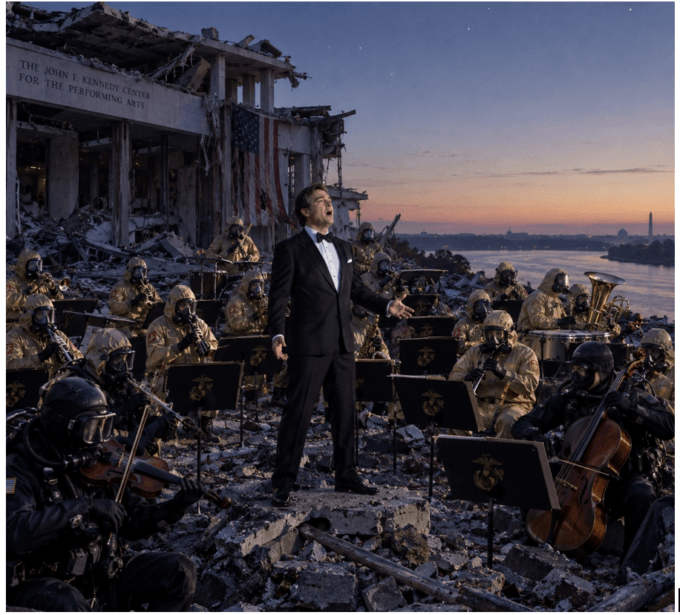
“Art” by ChatGPT
A toxic cloud of concrete and gypsum dust, asbestos, and airborne particulates of glass, cadmium and copper hung over Foggy Bottom. Somewhere beneath the glowing haze sprawled the tangled ruins of a Washington Institution that had stood along the Potomac River for more than half a century.
Not a breath of wind had troubled Washington, DC since the previous day when a half dozen F/A 18-3 Super Hornet fighter planes had hit their target exactly at noon. The squadron that had carried out the mission was the “Vigilantes,” but their actions had been ordered up by the Commander-in-Chief himself. Hours before the bombing, a post had appeared on Truth Social: “Bye-Bye Kennedy Center. Your last Performance will be your BEST. KA-BOOOOOOM! Vigilantes bring Frontier Justice to the Swamp on the Pottomack [not sic, or is that sick?] But there will be an Encore: the NEW BEAUTIFUL TRUMP CENTER.”
After the hail of SLAM-ER missiles had demolished the target, the strike force did not return to sea to the beleaguered USS Abraham Lincoln still more than 500 miles from its destination, the naval base at Norfolk, Virginia. Instead, the chevron of fighters made a hard left directly across the river to land at Reagan National Airport, where a U. S. Army Humvee waited and rushed the five airmen and one airwoman to the Fashion Centre Mall at Pentagon City. There, the emaciated warriors were escorted by Navy nurses directly to the front of the line at Five Guys. “Praise be to God for hand-pattied burgers!” exclaimed Wing Commander Ron Stronga before a phalanx of influencers dispatched by the Department of War and arrayed around his booth. Even before the televised attack on the Kennedy Center, rumors had been swirling that the burger franchise was on the verge of signing a multi-billion-dollar long-term contract to supply the American armed forces with MAG[H]A meals. “This ain’t Saudi Arabia,” said one Pentagon official, “Five Guys have no beef with government pork. On second thought, make that lots of beef!”
Later that afternoon, Trump posted again just before teeing off at his golf course at Bedminster, New Jersey: “From the ashes the TRUMP CENTER for AMERICAN Arts will rise in RECORD time and be inaugurated on my next birthday.” A range of experts in demolition, removal, site preparation, construction, architecture and design expressed skepticism that such a project could be completed in the eight months before the president turns 82 on June 14th.
The president’s message continued: “The dedication celebration will be headlined by the AMGAZING Presidential Tenor, Christopher Macchio.” Trump has repeatedly praised his favorite singer: “Not since the legendary Luciano Pavarotti has there been such a voice!”
Macchio came into Trump’s orbit when he appeared at a Mar-a-Lago New Year’s soiree in 2015 after Sir Elton John had pulled out of the event at the last minute. A member of the resort’s staff recommended Macchio, “the kid from New York.” The tenor was then little known for his brand of Popera—that accessible mix of Classical chestnuts, well-known numbers from musicals and kindred selections classed as middle-to-lowbrow by the self-styled cognoscenti. But that New Year’s night in Florida, Macchio enchanted the Art of the Deal “author,” soon to begin his last season as star of the Celebrity Apprentice.
Macchio was then summoned to the White House in 2020 to sing the “Lord’s Prayer” at the memorial service for Trump’s brother Robert. That summer the singer concluded that year’s Republican National Convention with a night-time performance from the White House balcony in which he sang “Nessun Dorma” (perhaps the most famous operatic tenor aria), Schubert’s “Ave Maria,” as well as patriotic favorites “God Bless America” and “America the Beautiful.” In the midst of this standard fare came “Hallelujah” by the late Leonard Cohen, much to the outrage of representatives of the estate of the Canadian songwriter. No matter, Macchio, by the time of his engagements at the 2024 RNC, the 2025 Presidential Inauguration and the Freedom 250 Rally earlier this year, had assumed the mantle of “America’s Tenor.”
At the mid-term RNC staged last week in Dallas, Macchio was presented as the “Presidential Tenor”—a change in designation that has implied to political and aesthetic opponents of both the singer and the politician that the President puts himself first and America a distant second.
In Dallas, Macchio opened the proceedings with the National Anthem, sharing the stage only with the Dallas Police Color Guard. The tenor was also called on to close the event, now joined before the cameras by Trump, who grinned, fist-pumped and swayed to a customary medley which, aside from the usual favorites, included Andrew Lloyd Weber’s “All I Ask of You.” These declarations of unconditional love songs included, as always, Puccini’s “Nessun dorma,” during which Macchio turned at times to face the President, who beamed back at his tenor.
Reached for comment in his office in southeastern Maine, Mark Stallings, a Professor of Musicology and Sound Studies at Cornhole College, offered the following analysis:
“’Nessun dorma’ is a love song to an untouchable, sadistic, genocidal Chinese princess who resists marrying the ardent royal suitor who sings the famous aria. This suitor has successfully answered the three riddles that previous contenders for the princess’s hand have not been able to and have then been summarily beheaded. But the prince has allowed her an out from marriage to him if she can guess his name. She now promises to murder all her subjects unless someone can discover his name. There can be no creepier nor more fitting anthem for Trump—who unwittingly plays the princess in these musico-political spectacles—than this aria. In Dallas, the Presidential Tenor and the President consummated the relationship with a hug and the crowd went wild.”
Stallings, author of Ping, Pang, Pong: The Othering of Asia in Song, added that, “Even the most avant-garde opera director couldn’t come up with a more bizarre or apt distillation of our historical ‘moment.’” Interviewed on Zoom, Stallings was seen to pluck the air on either side of his ears with his index fingers on that final word.
In spite of Trump’s high praise for Macchio’s talents, the singer’s many critics have pointed to his pinched vowels, forced nasal tone, aggravated vibrato, reliance on microphones, and his limited repertoire’s oozing sentimentality. In some circles this catalog of alleged deficiencies has earned him the sobriquet, the “Sultan of Schlock.”
Trump has in turn slammed these detractors as “Democrat Palestines.” Commentators have surmised that he meant Philistines.
A half-an-hour before dawn the day after the airstrike on Kennedy Center, three dozen frogmen emerged from the waters of the Potomac and scrambled through rubble at the place where the facility’s main stage had once stood. It was Supersecret Symphony Seal Team 7 carrying special waterproof cases from which they pulled their instruments: violins, violas, cellos, even contrabasses that had been ferried across the river on Zodiacs. A dozen Bradley troop transports arrived and out climbed the President’s Own Marine Corps Band as well as the U. S. Navy Chorus.
All were in military hazmat gear and with special, skin-tight, sensa-gloves supplied and airtight apertures to allow the wind and brass players to operate their instruments without inhaling the toxins.
An Osprey helicopter drew towards the scene from the direction of Andrews Air Force Base. A lone figure rappelled into the drop zone as speakers blared out through the chop of the rotors, “Presidential First Tenor Responder, Christopher Macchio!” He hit the ground, then stepped out of his jumpsuit to reveal a Dolce & Gabbana tuxedo, pulled out his microphone and switched on his portable battlefield boom box. Dramatically ripping off his CBRN (chemical, biological, radiological, nuclear) headgear and throwing it down, he shouted, “Macchio doesn’t wear a mask!”
The orchestra started into “Nessun dorma.” Macchio filled his lungs.
As the dawn’s early light began to color the sky, mirrored in the broad water’s surface, he came to the aria’s closing lines:
“And my kiss will dissolve the silence that makes you mine!…”
The chorus intoned: “(No one will know his name and we must, alas, die.)”
“Vanish, o night!
Set, stars! Set, stars!
At dawn, I will win! I will win! I will win!”
The aria advanced towards its climax with the Presidential Tenor launching a fusillade of high A’s. A shattered pillar and sagging balcony that had not been totally flattened wavered under the sonic assault, then came crashing down just behind the double basses, who valiantly held their positions.
In the eastern sky, more pricks of light appeared, as if the stars were resisting the onset of day. But they weren’t stars. The rest of the Vigilantes had taken off from the Abraham Lincoln 45 minutes earlier. The planes screamed towards Foggy Bottom with Macchio ascending towards the famed high-B as Super Hornets hit their objective just a few blocks away. “I will win!” sang the Presidential Tenor as the rocket’s red glare and bombs bursting set the State Department in operatic flame.