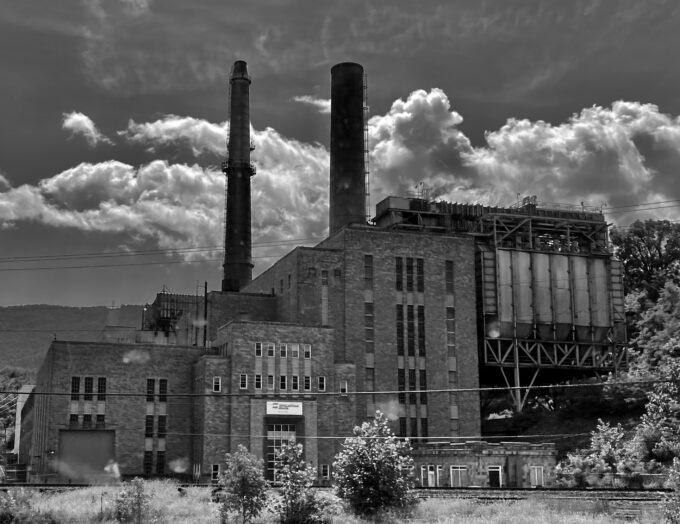
Power plant, West Virginia. Photo: Jeffrey St. Clair.
There’s one thing about President Trump saying the quiet part aloud. His repeated threats to annihilate and obliterate the Islamic Republic of Iran since the unprovoked U.S.-Israel attack of February 28 pulls the curtain back on language of extermination. Meanwhile, the epicenter of omnicide, or total destruction of humans, is Israel’s live streamed genocidal campaign against the populations in Gaza, the West Bank and southern Lebanon with Uncle Sam’s funding.
There’s an historical continuity which Chris Kaspar de Ploeg covers in his new book The Exterminating Empire: Capitalism’s War on Life from Palestine to the Burning Planet (Monthly Review Press, 2026). In brief, he lays out the past and current connections and conclusions for understanding and transforming the whys and wherefores of global capitalism, ecocide and genocide, the deliberate and intentional destruction of groups of people. The connective tissue is the logic of a grow-or-die economics and politics fueling capital accumulation, which depends on state-sanctioned violence to acquire people’s land, labor and resources.
For example, de Ploeg, who does far more than compile lists of atrocities, draws parallels between the American holocaust of the native inhabitants’ relations with buffaloes and Israel’s genocide against Palestinians and their farming of olive trees. Land theft and separating those living on the land from it are nothing new. The author has skin in the game, given his family survived the Armenian genocide and Nazi holocaust.
Marx’s critique of capitalist imperialism that runs counters to the classical political economists such as Adam Smith runs a red thread throughout de Ploeg’s book. As Marx writes in Chapter 26 of Capital, “conquest, enslavement, robbery, murder, briefly force, play the great part” in the capitalists’ acquisition of other people and their resources, not the least of which is human labor. State-sanctioned violence remains a bludgeon for the monopoly corporations via the military industrial complex infused with Artificial Intelligence now. The peaceful narrative of Adam Smith and David Ricardo is a myth, as Michael Perelman, the late author and economist highlights in The Invention of Capitalism: Classical Political Economy and the Secret History of Primitive Accumulation (Duke University Press, 2000).
The Exterminating Empire
cuts a wide swath of the past and current moment to drive home its radical points. For instance , in the Introduction: Life Against Imperialism, the author introduces the systemic character of current conditions such as climate mitigation. It acts as a smokescreen for Big Oil and Big Tech to perpetuate the ecological crisis, a little like the ceasefire in Gaza allows the Israeli genocide against Palestinians to continue at a slower rate, buying time for more settler land theft and human displacement. Chapter 6, Greening Colonial Capitalism: Sustaining Mass Murder and Exploitation, details the processes of omnicide around the world. The author subjects carbon capture to a withering critique. To this end, de Ploeg interrogates climate apartheid, ethnic cleansing and population control. 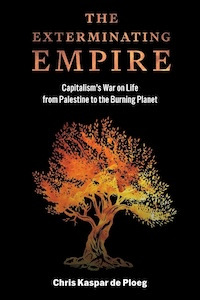
The ideological and material oppression extends to the cultural dimension. The U.S.-led West’s campaign of cultural imperialism engulfs populations around the world. Ad-generated consumerist images and messages proliferate to prop up and expand the establishment, a corporate-run enterprise.
In eight punchy chapters, de Ploeg shows and tells how, for instance, the climate emergency and its handmaiden of corporate-government inaction, are part and parcel of the daily genocidal campaign against Palestinians. He sees that as our future unless we organize for an alternate order. In the meantime, a global system of ecocide and genocide holds sway. On the African continent, the less visible but no less deliberate extraction of resources and destruction of people is ongoing in the Democratic Republic of the Congo, site of rare earth minerals like coltan that enable the high technology of the West. Since the U.S. Central Intelligence Agency assassinated the popular revolutionary Patrice Lumumba, the nation’s prime minister, in 1961, the nation’s bitter fate has been a bonanza for foreign corporations, shifting wealth away from the poor and working class.
In the book’s final chapter, What Is to Be Done: Strategizing in Defense of Life, de Ploeg writes of revolutionary resistance in Venezuela before the January 2026 U.S. assault to seize President Nicolás Maduro and First Lady Cilia Flores, in part using AI. This was of course a blatant grab to secure the nation’s oil reserves. The author, writing of the resistance forces in the country, including its popular communes underestimated the level of violence that the White House would deploy to try and maintain hegemony of the global system, which Trump dubbed an example of the Donroe Doctrine, voicing a might-makes-right worldview: “to the victor go the spoils.”
In this chapter, the author makes many salient points, discussing departures for international solidarity between the population minority in the North and the majority in the South. A goal is to weaken imperial class collaboration in the North, and give breathing room for national development in the South, what the late Marxist social scientist Samir Amin called delinking from global capitalism. The weakness of internationalism in the North is tied to the political duopoly that exists to boost the bottom lines of its corporate and wealthy donors.