
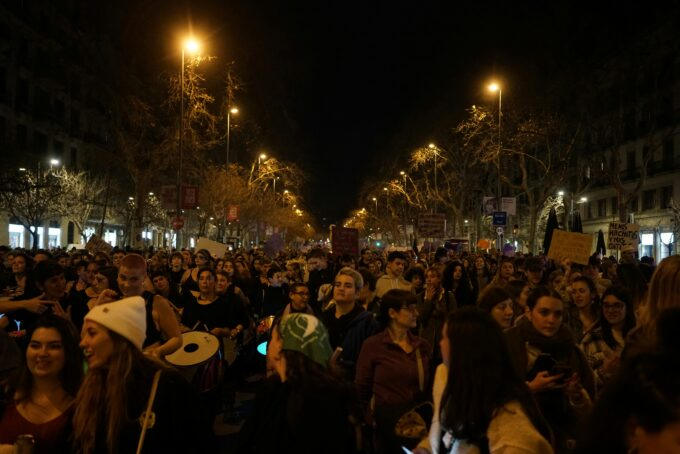
Image by Anastasiia Nelen.
From Puerta del Sol in Madrid, a ray of hope radiates throughout the country. After many years of political compromises and rising costs of living, people have simply had enough. They want to live with dignity.
Origins of the Crisis
María del Carmen Abascal, known widely as Maricarmen, an 87-year-old woman, was evicted on September 23rd from her apartment in Retiro Park, a central neighborhood in Madrid. Living on a pension, Maricarmen had limited income, and could not pay the five-fold increase on rent. Due to her ailing health, she was taken out in a stretcher. On October 7th, Maricarmen died in a hospital bed, elevating her to a near martyr status.
There are many Maricarmens in Spain. For example, Olga Matute, a 54-year-old mother of two daughters, was evicted from her apartment in L’Hospitalet de Llobregat, Barcelona, and driven to suicide. A 60 year-old shoemaker in the same neighborhood, Javier, killed himself after his landlord gave him a notice. These deaths are a reminder of the pressure put on renters in Spain who, on average, spend 50% of their income on rent.
The roots of Spain’s housing crisis can be traced back to the dictatorship, when Franco prioritized home ownership over regulation of rents. Even after the democratic transition, similar policies persisted. In 2008, when the global economic crisis hit, the vulnerabilities in housing markets were exposed, with mass foreclosures and evictions. The Plataforma de Afectados por la Hipoteca (Platform for People affected by Mortages) was created at that time.
Then, in 2011, came the wave of 15M, named for the 15th of May, the first day of a camp in the Puerta del Sol, in the center of Madrid. The movement spread, and camps popped up in other cities with calls for “real democracy” connecting the economic and political crisis. The camp was not evicted, but left voluntarily, and pivoted to neighborhood assemblies focused on housing.
In brief, much of the energy of 15M was channeled into the left political party, Podemos. Despite some early optimism, and promises to address housing in particular, the party could not deliver, and dramatically declined. The PSOE (Spanish Socialist Workers Party) benefited from the demise and took power. The legislative focus was on mortgage restructuring and bank bailouts, which left the underlying issue of the market unresolved.
Now, large landlords and international vulture funds like Black Rock are buying up housing stock in city centers and converting it into short-term and tourist rentals. In place of homes, there are hotels, The social fabric is being ripped apart, with long term residents forced out to the peripheries or the streets. This is especially the case in major cities like Madrid and Barcelona.
Puerta del Sol
After the eviction of Maricarmen, the Sindicato de Inquilinas (Tenants’ Union) called for an encampment at Puerta del Sol on September 26th. On the northern edge of the plaza stands the Statue of the Bear and the Strawberry Tree, a symbol of Madrid. Underneath, a memorial is erected complete with her photo framed by red flowers, candles, and messages of solidarity.
Arriving in Sol, the resemblance to 15M is undeniable. Blue tarps stretch across the plaza, covering hundreds of tents and pathways, named for revolutionary figures like the poet Federico Garcia Lorca. Areas are arranged along north/south/east/west coordinates, called “nodes,” which have their own assemblies, and correspond to areas of Madrid. This is, as many campers mentioned, a “city within a city.”
The organization of the camp has now expanded beyond the tenants’ union. There’s an ever-evolving array of working groups. So far these include communication, town planning, care, facilitation, mediation, cleaning, and health. These organize physical structures in the plaza, such as the kitchen and medic tent. Each working group chooses a coordinator, and there are meetings held earlier in the day between working groups. Discussions on the larger movement are held in general assemblies at night, and anyone can participate.
Some veterans of 15M like Lill, are offering support for the next generation. She explained, “Since 15M, we’ve been dedicated to fighting financial speculation and mortgage overpricing. That was our first action within that assembly.” For her, the continuity is clear, and there must be radical solutions, addressing property ownership. She stressed, ““Enough is enough!” We must do something about the housing problem and change the model. It’s direct actions like this that bring about significant changes.”
A younger camper, Amber, a recent college grad from Madrid, wanted to apply lessons from 15M to the current moment. She also mentioned the importance of the okupa (squatting) movement in neighborhoods. She analyzed, “a lot of the energy of participation, and neighborhood organization, was sucked away by electoral politics… that energy was hibernating, that it’s re-awakening.”
Placa de Catalunya
On September 28th a camp was established at Placa de Catalunya, in the center of Barcelona. The initial flyer called for “autonomous individuals” without any organization taking credit. Notably, this plaza is also where the local 15M camp happened years earlier. At the entrance appear memorial alters for Olga and Javier. Streets are named for the anarchist José Buenaventura Durruti and communist Walter Benjamin, both references to the Spanish Civil War. History is very much informing the present, and time feels nonlinear.
Like Madrid, the camp in Barcelona is horizontal and self-organized. The first working groups were for food, logistics, communication, and community watch. Now, there’s a kitchen, information station, press/media tent, and art building space. Every day there are new additions, and increasing complexity. Logistical assemblies are held for decisions about living in the camp during the day. At night, there’s an open assembly for anyone to speak.
Marsi, a queer game developer from Barcelona and anarcho-syndicalist, has been active in multiple working groups. She’s often pulled in different directions and called to facilitate assemblies. Casually, she remarked, “With assemblies or horizontal participation, it’s all very organic. I think, of course, it’s very hard to hear all the people. Sometimes it’s tedious, but my heart is full of warmth later.”
Mónica, originally from a working-class neighborhood in Valencia, saw the housing crisis affect her neighbors, and wanted to help. She had never been active in anything before but joined the communications commission and threw herself into organizing. She reflected, “The encampment has almost become a project. It’s a self-managed, horizontal project—an alternative society set up right in the middle of a city as industrial and capitalistic as Barcelona.”
Political Response
The Sindicato de Inquilinas pushed for an emergency housing bill, with two main decrees, one aimed at stopping evictions for vulnerable people, and another for automatic lease renewals on long term leases. On Friday, October 2nd, Parliament held a vote, but they did not pass. Political opposition from multiple right-wing parties, including the People’s Party (PP) Spanish nationalist Vox, and Catalan separatist, Junts, voted against.
Following the legislative defeat, Prime Minister, Pedro Sanchez, of PSOE, called for snap elections on November 29th. To do so, he resigned, dissolved Parliament, and installed a caretaker government charged with overseeing the national elections. He promised to institute the decrees If elected again.
PSOE has been hit with a series of corruption scandals in last few years. Former PSOE Prime Minister José Luis Rodríguez Zapatero has been under investigation for influence peddling. Sanchez’ wife and brother face charges. This has left an opening for the People’s Party (PP) and Vox to gain ground. If this continues, a coalition of the right-wing parties is likely to govern. Housing is a wedge issue, and reforms have popular appeal. Sanchez is clearly taking this opportunity to win back support and stay in power. He has framed this as a choice between fascism and socialism.
General Strike
All the major unions, such as the UGT, CGT, and CCOO, issued joint statements alongside the tenants’ unions, for a general strike on Nov 11th.This year has seen a wave of strikes by transit workers, teachers and librarians- all affected by cuts to the public sector. November 11th will be a culmination of these efforts and connect struggles. The housing crisis is compounded by precarious employment, and stagnant wages that do not keep up with costs of living.
In the camps, especially, the idea of a strike, is more holistic, resembling a social strike, not only a general strike. Leyre in Sol explained, “We’re talking about a strike- strike in I think every way possible. So basically, it’s a work strike. We’re not going to work. It’s a consumption strike. We’re not consuming anything. So basically, no public transport, no private transport, not buying anything.” From the camp nodes, there are now organizing committees in neighborhoods.
Monica in Place de Catalunya made a similar point to Leyre saying, “The general strike goes beyond who’s in power and who isn’t. No political party or politician represents us.” At the front of the camp, there’s a committee with flyers and posters advertising 11N, and zines on how to strike in your neighborhood.
What happens after the 11th is an open question. Even teachers and librarians have called for indefinite strikes. The conditions are here for a general strike that includes many sectors and extends beyond merely one day of action, or even the election on the 29th. Even if PSOE manages to stay in power, the structural issues around housing, and property interests, would still need to be addressed. Historically, the PSOE has not been able to tackle them. Neither have the other left parties. To have a right to housing, would require actions beyond the elections, and in the streets.
Hope in Dark Times
In Sol, I attended a workshop on political imagination. Dozens of young people, created a circle to discuss both the camp, and the world they wanted to live in. They drew maps, and envisioned everything held in common, and housing, healthcare, education- all aspects of life- self-organized. In place of Parliament, they would hold assemblies, for people to have a real say in political decisions. They saw a future worth living in.
Nothing is inevitable. People can and do change the course of history. There is an ongoing crisis, caused by the capitalist system, and failure of representative politics. Far right and fascist forces have taken advantage of this and created dystopian nightmares rooted in fear and confusion. However, these can be countered, not with pragmatic reforms, but utopian visions. As Amber said, “Apathy is our biggest enemy, I think, at the end of the day. We need hope.”


