Photo by Satyam Pathak
The lack of affordability is the curse of the working class, whether its individual members are working or not. Politicians talk about it and some might even propose legislation to moderate it, but the cost of almost everything keeps going up more than wages and retirement benefits. The domination of the economy by monopolies and cartels–many of which are invested in the business of war and resource extraction–and by politicians at their service means the bills they rack up are going to be paid by us. When the ruling class tells us they can’t afford to continue providing social services, they’re lying. It’s not that they can’t, it’s that their priorities lie elsewhere, with consistently higher profits being near or at the forefront.
A new book, titled Grand Theft Capital: What Workers Should Know about the Affordability Crisis, explains where: in making money off other people’s money, in manufacturing war materials, then provoking and maintaining wars, and in hoarding the wealth they have accumulated. Furthermore, the text makes clear that this is no accident or mistake, but is intentional and the logical result of capitalism’s trajectory; a trajectory that without curbs on it results in monopolies and a government that works for the wealthiest instead of reining them in. The phenomenon known as neoliberalism may be the final realization of capital’s progression, however, one thing it is not is an aberration or anomaly.
There is no capitalist way out of this truth. We may be able to tax the billionaires, but doing so won’t result in an economy that thrives for working people, whether they are making $30,000 a year or $100,000. Their debt will continue to rise and their peonage will intensify. Those at the bottom of the economic ladder, especially those who have historically been forced to be last—African-Americans, immigrants—will continue to suffer the most. Working class whites, who have seen their futures diminished as factories were moved to regions and nations where salaries are lower and unions often non-existent, can expect little positive change as long as the current system remains in place. Elections may change the faces, but the underlying mechanism that informs the economic reality remains.
In making their argument, the authors of Grand Theft Capital Fred Magdoff and John Bellamy Foster re-establish the idea that the United States is run by a ruling class. They discuss the various theories popular in the decades following World War Two that dismissed that concept and argued that it was some kind of managerial class composed of corporate officers, academics, government bureaucrats and the media that ran the nation. The rich and super-rich were relegated to the roles of non-players and financiers whose money and actions had little if anything to do with the running of the United States. There were a few dissenters to these theories, with William Domhoff, Paul Sweezy and Harry Magdoff probably foremost among them, but the general understanding rejected their insistence that the US had a ruling class and it did run things.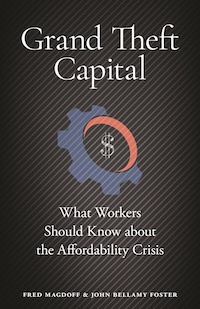
The reign of Donald Trump—especially the second round—has made it clear that there is a ruling class, it is extremely wealthy, has enormous power, and does run the country. It is not a monolith, but when it comes down to the essentials, it can and does will act as one. One of its more deceptively clever aspects is that its members can occasionally portray certain individuals among them as something other than as opponents of the ruling class and get themselves elected as such. Donald Trump is the current representation of this deceptions. Millions of working people vote for him convinced that he is on their side against the ruling elites. Of course, the truth is quite different: Donald Trump is of the ruling class, just a different sector of it than Gavin Newsom or Kamala Harris. He is also an obvious fascist, something those opposed to Trump and Trumpism understand while often pretending otherwise.
Grand Theft Capital is a relatively brief text. It lays out the history of how the United States (and the world) got to the current fiasco. The reader is presented with the creation of the dollar standard and the Powell Memo—a letter written by corporate lawyer and future U.S. Supreme Court Justice Lewis F. Powell to Eugene B. Sydnor Jr. of the U.S. Chamber of Commerce expressing deep concern about the supposed downfall of the US capitalist system. It’s not like US capitalism was being defeated, only that it wasn’t reaping the percentage of the profits as the capitalists believed it should be.
Powell’s concerns stemmed from the massive public rebellion against the US war on Vietnam, the liberation movements by Blacks and other non-white residents of the US, the strength and increasing radical nature of labor union rank and file and the growth of public assistance provided to US residents. The letter’s recommendations focused on censoring public education especially in the university, the media from television to the movies to newspapers and the book business. It also called for populating the courts with business-friendly judges, passing more business-friendly legislation and calling for more proactive participation by big business in politics. The modern manifestation of this approach is found in the document written by the current director of the Office of Management and Budget Russel Vougt and the American Enterprise Institute known as Project 2025. That document is not full of new ideas, but looks to be the final incarnation of the movement towards a complete takeover of the US government by the wealthiest people in the US. One can reasonably argue that this movement has been successful in its endeavor.
The authors continue their history, detailing the efforts of capital to take back the pieces of the economic pie that was set aside for the population as a result of New Deal and Great Society programs. They discuss how financialization of capital works, why the rich and their corporations prefer to earn their money this way instead of by actually producing things and why those good-paying blue-collar jobs aren’t coming back no matter how many plants open in the United States. They discuss the attacks on unions and the potential the current growth of unions could have (it’s limited). Written in a straightforward and understandable style, Grand Theft Capital lays out the facts of today’s economy—and by extension—our lives. Readable, informative and comprehensive, this book makes sense of the situation (or shit storm, if you prefer) working people find themselves in. If I was still working and serving in my union local, I would insist every member read this text or, at the least, discuss its content with someone who has. Not only does it spell out the facts, it tells the truth about how we got here, who’s to blame and how we must proceed to change the current trajectory. Indeed, I encourage every union local to buy copies for its members, discuss its content and act on it. Voting for another capitalist politician isn’t going to change things; this book and our experience makes that clear. Like Bob Dylan sings in his tune “Workingman Blues #2,” “You can hang back or fight your best on the front line….”