

Photo by Filipe Nobre
Last week was a minor earthquake in the AI world, and DeepSeek’s latest release could mean an even bigger one this week. Focusing first on last week, CoreWeave, the largest of the neoclouds, is now in the Intensive Care Unit. The interest rate on its long-term debt passed 16 percent. This is a huge deal.
Neoclouds are a big part of the AI infrastructure. They buy and rent out computing capacity to AI users. And in the AI boom, they are heavy borrowers. When they have to pay over 16 percent on the money they borrow (junk bond territory is 8.0 percent), they do not have a terribly viable business model.
And the troubles for the AI industry went far beyond CoreWeave. As I pointed out last week, even the stock market was taking notice.
The bad news from Wednesday carried through for the whole week. Here’s the story for the publicly traded neoclouds, along with Oracle, by far the leading target for collapse among the hyperscalers.
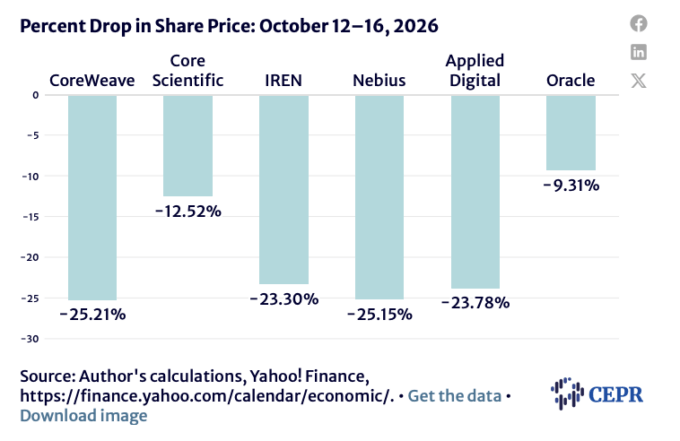
We’re still some distance from zero; all of these companies still have very high market caps, especially for businesses that are losing money hand over fist. But it’s like the old joke about 10,000 lawyers at the bottom of the ocean: a good start. At least some investors in the bond market are beginning to approach AI (or SI) companies like they would any other business, asking about their current and expected future profits, and not getting all giddy about anything involved with AI.
That is a huge deal, since as many of us have been arguing for some time, it’s hard to tell the story where the AI companies have the sort of otherworldly profits that would justify their stratospheric valuations. And everything on the horizon seems to point in the opposite direction.
It’s also worth some mention of Oracle here, the Bear Stearns of the hyperscalers. The yield on its debt peaked at more than 8.5 percent last week. This is well into junk bond territory. At this point, the company is at serious risk of a downgrade by the rating agencies from its current status of one step above junk. A downgrade would likely lead to a major selloff by pension funds and other institutional investors, putting Oracle alongside CoreWeave in the ICU.
The AI companies are in a situation where they make expensive frontier models —for which there is limited demand — and lower-cost, more widely used models that don’t make them any money. On the former point, as Ed Zitron points out (his Substack is definitely worth getting), roughly 80 percent of the revenue for both OpenAI and Anthropic comes from 1 percent of their customers.
Ed’s assessment is that these are mostly AI startups, for whom it may make sense to use frontier models. The problem is that none of these AI startups are profitable. They are relying on funding from venture capital, of which there is a limited supply. At some point, presumably the venture capitalists get tired of throwing their money in the toilet. If these startups can no longer hoover up vast amounts of tokens, the AI companies’ prospects suddenly look considerably darker.
The Chinese Competition
Turning back to the world of AI more generally, it seems the pace of growth has slowed markedly. As Ara Kharazian points out, August and September were consecutive months of virtually zero growth in spending. While token usage is still increasing rapidly, the price of tokens is falling even more rapidly. That is not a story consistent with the AI companies being able to meet their enormous lease commitments with the hyperscalers.
Two months of zero growth is already a big deal in an industry where the bet is on exponential growth. Also, the weak September removes the possibility, as some had suggested, that August’s weakness was the result of the leading AI engineers going on vacation. But the bigger problem is that there is good reason for thinking that August and September were not anomalies.
This is where the latest release from DeepSeek could be a very big deal. Its latest model ranks near, or in some cases above, the performance of the frontier models of OpenAI and Anthropic, but it comes at a small fraction of the price. For many tasks, it would cost less than 1/10th or even 1/20th as much as the frontier models from these companies.
The overwhelming majority of potential AI users are not going to care about whatever edge OpenAI or Anthropic’s frontier models might have over DeepSeek’s latest release. They will care much more about saving 90 or 95 percent of their spending on AI. And even if these leading US companies can produce lower cost versions that are more price competitive, it doesn’t change the picture in a big way. They are not going to be able to make good on trillions of dollars of lease commitments selling cheap AI. If they can’t give companies a reason for spending large sums on their frontier AI, they are going bankrupt.
Can the Big Money Folks Be This Stupid?
Many people are reluctant to believe that people who control tens or even hundreds of billions of dollars can toss around vast sums so foolishly. I keep pointing to the housing bubble where trillions were lent out on mortgages even as there was an unprecedented 70 percent run-up in nationwide house prices, when rents were only slightly outpacing inflation. The fact that vacancy rates were hitting record highs also didn’t bother the big money folks. And the deterioration in mortgage quality was a source of pride for the financial industry.
But we don’t have to go back two decades to find evidence of large-scale stupidity. In 2019, WeWork hit a peak valuation of $47 billion. Its great innovation was renting out office space. Theranos, the medical testing fraud, had a peak valuation of $9 billion in 2016. Before the fraud was exposed, it got big investments from Rupert Murdoch and Larry Ellison. And its board boasted former cabinet members from administrations of both parties. And in the still more recent category, we should always remember Mark Zuckerberg threw $80 billion in the toilet pushing Metaverse. And don’t forget crypto.
There is little reason to believe that control of vast wealth is associated with clear thinking, or at least acting, on investment decisions. The big money types keep telling us this again and again with their actions. We should believe them.
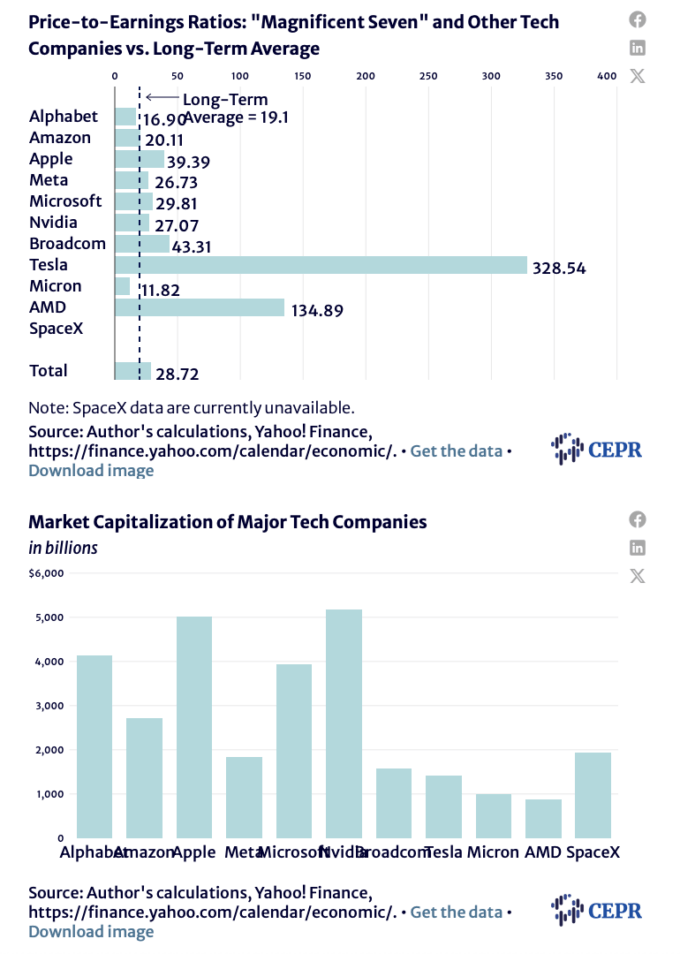
While we wait to see what happens this week, here are last week’s numbers:
This first appeared on Dean Baker’s Beat the Press blog.


