
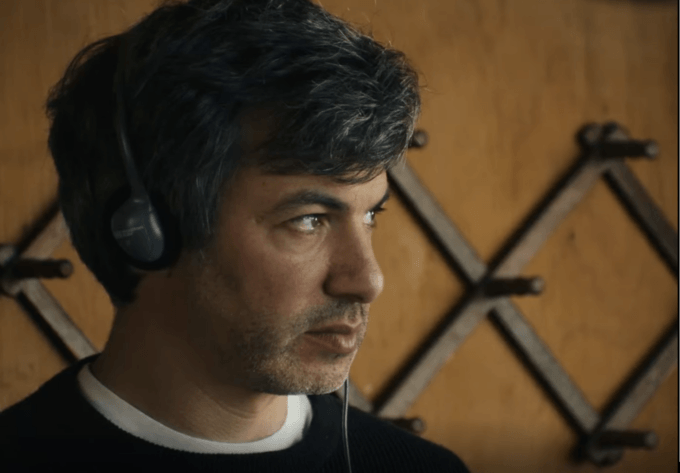
Nathan Fielder as Nathan Fielder in You Can See Everything (A24).
What if Alfred Hitchcock decided he finally wanted to star in his own movies? No longer content with those clever quick cameos in which he is spotted getting off a bus or walking down a street carrying a trumpet case, or winding a grandfather clock in an apartment spied across a courtyard, the famed director suddenly begins basking in long, tight close-ups of himself trying to penetrate the psychology of his madmen and murderers—and his own impenetrable self. This Hitchcock doesn’t only want his name above the title on the marquee. He also wants the vast majority of the screen time and dialogue to boot.
In the docu-thriller You Can See Everything, which raked in an expectation-smashing $15 million on its first weekend, the film’s co-director, Nathan Fielder, assumes the role of a Hitchcock who can’t resist hogging long stretches of the shadowy limelight. Fielder appears never to have thought of not hogging it.
Fielder’s got a stronger chin than Old Alfred, a lot more hair on his head, and is slenderer of figure—even if he has gained in embonpoint since he first attained comic celebrity as a discomfiting comedian with his HBO series Nathan for You, in which he undertakes outlandish—maybe even sometimes only barely legal—stunts and schemes. In spite of these obvious physical differences between the two filmmakers, there is something uncannily similar in their auras and actions: the lugubrious mien, the deliberate, unflinching, monotone delivery of lines, even if Fielder’s deadpan is a lot deader than Hitchcock’s.
The craving to be seen and heard is one Hitchcock would never have succumbed to, finding it much more dramatically potent to practice his dark arts from behind the camera, not in front of it. Nor would Hitchcock have had the chutzpah or been allowed by the studios to make a three-hour movie. I, too, am a product of these times: I wasn’t bored for a second during You Can See Everything, whereas I dozed off during several chapters of Christopher Nolan’s Odyssey. That the slack former (running time 2:54) outlasts the action-packed latter (2:52) by two minutes is yet another of Fielder and company’s legion of winking gags.
We first see Fielder—or better, are made to see him by himself—leering through a picture window at Holmes and her bad-guy partner, Billy Evans. The reference to Hitchcockian voyeurs Norman Bates in Psycho and Jimmy Stewart’s wheelchair-bound photographer “Jeff” Jeffries in Rear Window is obvious. The audience in the sold-out theatre in Ithaca, New York, where I saw the movie last Saturday, burst into laughter at this soon-to-be-biggie-sized cameo, not only, I suspect, because they knew that he was the star instead of the putative subject of the “documentary”—the convicted felon fraudster, Elizabeth Holmes, whose start-up Theranos promised a miracle machine that could perform at home hundreds of medical tests from a pinprick of blood. She staged fake results and fooled Silicon Valley investors for a few heady years, proving herself a master of suspense and deception worthy of a Hitchcock.
Fielder’s co-director, Lance Oppenheim, has another Hitchcockian thriller, Prime Time, in cinemas now (both films have scores by Ari Balouzian), his “documentary” and the feature spurring each other on at the box office and demonstrating his command of supposedly distinct genres. In You Can See Everything, Oppenheim gives himself a single cameo along with his crew. Like Fielder, Oppenheim, too, is playing himself.
The pair has scads of self-conscious fun with these post-Hitchcockian riffs and ruses in what is not really a documentary at all, but a post-post-post-modern remake of Vertigo: Fielder as Hitchcock as Scottie Ferguson falling inexorably, impossibly in love with Holmes (played by Holmes) as Madeline (Kim Novak in the original); her manipulative partner Billy Evans (Billy Evans) and father of her two children (played by the children themselves) as a Silicon Valley version of the murderous shipping magnate Gavin Elster. The romantic surf off Cypress Point on the Monterey Peninsula becomes the gentle waves in front of the beach house that Holmes and her family have rented in Del Mar near San Diego as she awaits her transfer to a federal penitentiary. In these accommodating Pacific waters, Scottie’s rescue of Madeleine from the treacherous currents below the Golden Gate Bridge is reenacted with a few waist-deep cold plunges and a couple of bracing strokes of crawl. The sumptuous cashmere, silk, and chiffons of Novak’s cross-your-heart outfits are shed in favor of Holmes’s spandex leggings, sweatshirts, and nursing bra. Novak’s meticulously made-up face is replaced by Holmes’s scrubbed skin that might seem to some to exude honesty. Her unblinking eyes gaze at Fielder and into his camera with the guilelessness of those seen in Saul Bass’s celebrated Vertigo credit sequence. Both Vertigo and You Can See Everything are movies about the movies: seeing is disbelieving.
Close those viewing eyes and you can even hear Hitchcock in the ghosts of Bernard Herrmann’s score for Vertigo. These ethereal forms don’t so much haunt the slo-mo proceedings of You Can See Everything as smirk at, whisper amongst, and hum along with them in Balouzian’s soundtrack. This canny, often creepy music does much of the work of stoking suspense, insinuating ominousness, and sowing doubt. The circulating, obsessive figures of the opening echo the oscillations of Herrmann’s title music, but are pared down, simplified as if to suggest that we are seeking a purer truth than can be heard in the old fictions. At times, too, the surfeit of coy, even cloying visual and musical references crashes foamily onto the rocks of the unconscious.
Herrmann’s full orchestral score, which makes especially unsettling, yearning use of woodwind colors, is here replaced by a battery of digital sounds and effects populated by remnants and revenants of Herrmann’s harmonic and melodic language. It’s like Brünnhilde has thrown off her chain mail and horned helmet for a Vangelis stealth spacesuit.
These clear, if somewhat indirect, resonances are unambiguously cinched down in the scene when Fielder, driving a Cybertruck, follows Holmes and family from San Diego to Texas, where she will begin serving her decade-long sentence at the minimum-security federal prison. As Fielder pursues, we hear music lifted almost directly from that which Herrmann wrote for the scene in which Scottie tails Madeleine’s car through San Francisco. We are being played like Herrmann’s not-so-cheap violins. That much is obvious even if we don’t lend credence to Theranos whistleblower Tyler Schultz’s claims that Holmes didn’t drive from California to Texas at all but flew there in a friend’s jet.
As if to allay—but also to augment—such ambiguity, the soundtrack and film close with a piano quartet that pays homage to Herrmann’s finely wrought sonorities and cerebral compositional technique, in this way gesturing towards a classy timelessness and emotion-laden meaningfulness.
You Can See Everything mischievously, even magnificently, misleads. Nothing in it is true. To be sure (if one can be), documentaries are necessarily selective with their truths, all in the telling. Like Oppenheim’s Prime Time, this is merely based on real events.
The autofiction features—happenings in Fielder’s “real” life introduced as if disarmingly into the film—might as well be ploys to make us sympathize with a character whose shtick is played so flat there is not the slightest texture of emotion. Nothing is real in You Can See Everything. All is staged, either with plenty of forethought or in the moment. To be sure, there is a celebrated comic named Nathan Fielder and a notorious charlatan named Elizabeth Holmes. In the real world, people are convicted, fall in love, even listen with noise-cancelling headphones to the soundtracks of their lives as they move through them.
Form folds into content, bends and blends with it: the marketing of the movie is itself a con game. You Can See Everything isn’t a documentary at all; it’s Slow Hitchcock.
Just imagine how much harder and more rewarding it would be to make a successful two-hour sequel to Hitchcock’s Vertigo.
[A note from my lawyer: “The statute of limitations on spoiler alerts is fifteen years.”]
We pick up the action with George Clooney as Scottie on the ledge of the bell tower of Mission San Juan Bautista (never mind that the real place doesn’t have a tower) after Madeleine (to be played in the sequel by Amanda Seyfried, who appears in You Can See Everything and in the 2022 miniseries The Dropout about Holmes) has fallen to her death, as revealed in the flashbacks built into the script. Scottie is now on the hook for killing two women (Gavin Elster’s wife and her double). Cathartically freed from his vertigo, Scottie must now escape the law and hunt down Madeleine’s shipping magnate husband, who threw the real Madeleine to her death. Like Harrison Ford in The Fugitive, he must clear his good name. The thrilling—yes, vertiginous—duel between the former friends is staged atop the Campanile above the Piazza San Marco in Venice. Ari Balouzian will be commissioned to compose the soundtrack—not for synths, but for a symphony orchestra!


