
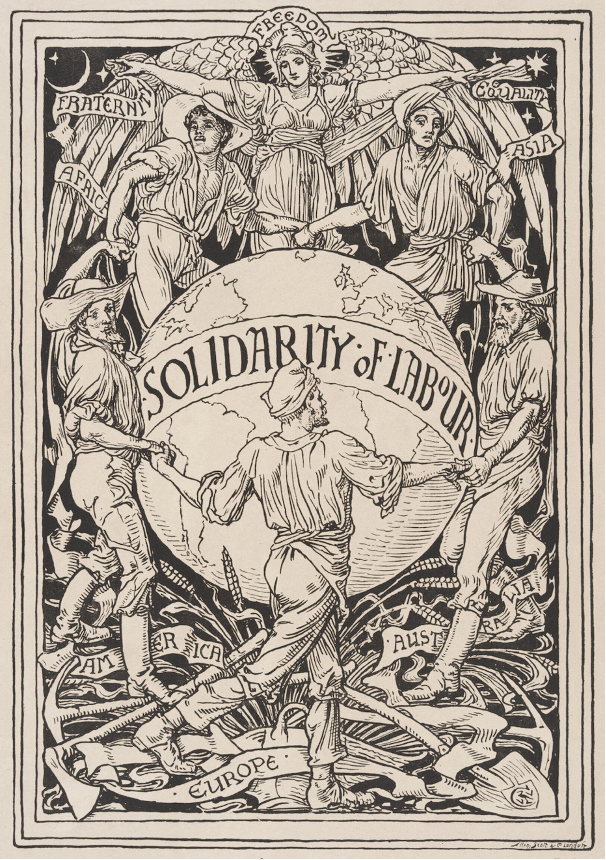
Walter Crane, Labour’s May Day, c. 1890. London: Victoria and Albert Museum.
The international nature of workers’ struggles
I just came back from a twelve-day holiday in Spain. To call it a vacation, however, isn’t quite right. First because I’m retired from my job as a professor, and second because I did in Spain the same things I do here in England: read, write, walk, and look at art. It sounds blissful, I’m sure, but happiness for most of us is circumscribed by the global rise of fascism and decline of nature. Having more time to think can be a mixed blessing, and not just for me: Psychotherapy in the U.S. and Europe has been experiencing a boon in recent years; but what’s needed instead of cognitive behavioral therapy is organizing.
I hate to sound like a Marxist scold, but the old mole was right. The struggle of the working class is international. Today, anger at elites – business and governmental — is apparent across Europe and beyond: they are properly blamed for the deterioration of schools, healthcare, infrastructure, housing, the environment, and the general standard of living. But there’s only modest coordination among those most hurt by the declines. In France, Germany, Spain, and elsewhere in Europe, there’s mobilization, but little organization. While capital cooperates internationally to limit wages, stymie regulation, and stop progressive taxation, workers and students are ring fenced by nation, culture and language — alienated in their own homelands. Even a modicum of synchronization or coordination of demands would make a huge difference to the effectiveness of anti-systemic (progressive or socialist) campaigns. “Workers have no country,” Marx wrote in The Communist Manifesto. They must cooperate across borders to be effective.
Spain
Apart from the art and architecture, what was most remarkable in the three Spanish cities I visited — Madrid, Sevilla and Valencia – was the political engagement of a large part of the population, especially its youth. In each city, we saw encampments set up by activists from local tenants’ unions. At the Puerta del Sol in the center of the capitol, thousands of young people have conducted an occupation for more than a month and aim to maintain it until their demands are met. They want among other things: 1) rent caps; 2) an end to evictions of vulnerable tenants; 3) reduction in tourist rentals which raise housing costs for locals; 4) overhaul of ineffective housing laws; and 5) curbs on profiteering by investment firms, which they call fondos buitre — vulture funds. The hungriest of these is Brookfield Asset Management, which in 2026 purchased the $1.4 billion Fidere real estate portfolio from Blackstone Inc. It consists of some 5,300 rental properties in Madrid or its environs.
In Sevilla and Valencia, the tent cities are more compact than Madrid’s but better organized. In the former, tables are set up to in several places along the perimeter of the encampment to distribute educational materials to passersby. In Valencia young protesters established security patrols in early October, to protect them from small, groups of fascist counterprotesters. They also temporarily relocated their settlement to accommodate a major, national parade on October 9. In both cities, they appear to have earned the good will of residents; while I was speaking to protestors, city dwellers stopped by to chat, bringing drinks and snacks.
Rents in Madrid, Sevilla, Valencia and elsewhere are lower than other major European cities, but so are wages. The case of Juan, a taxi driver I spoke to in Valencia, is perhaps exemplary. Born in Oaxaca, Mexico but now a Spanish citizen, he works nine hours a day five days a week and makes $3,000 a month. The rent for a two-bedroom apartment for him and his family on the outskirts of the city is just affordable — about $1,000; but it would be double that and unaffordable if he lived closer to the center, a necessity for many students as well as workers who need to be close to their jobs. Juan felt sympathy for the young people in the tent city but was too busy with work and family to join in rallies or protests.
Despite widespread complaints about the fondos buitre, the housing crisis in Spain is not primarily due to them. Most rental properties in the country are owned by local landlords, many of whom acquired them during the real estate boom of the late 90s and early 2000s. Having bought at the top of the market – when mortgage rates were low — they feel justified in charging rents high enough to recoup their investments plus profit. (These days, it seems like everyone wants to be a rentier.) Getting these landlords to agree to rent reductions will be difficult. Getting the government to build or buy affordable housing units in sufficient numbers to make a difference will be even harder, given the power of the European and Spanish central banks and bond markets. Their priority is to protect investors; deficit spending or higher taxes on the rich to pay for social programs are to them anathema.
Students and labor unions (the latter are very powerful in Spain) are planning a one-day general strike for November 11, two days before the official start of the campaign for the national election on November 29. In recent weeks, movement leaders have expanded their asks beyond housing to include a rise in the minimum wage, a higher floor for monthly pensions for the elderly, and increased funding of public services. At a meeting this week of union leaders and housing advocates, the language was one of working-class solidarity. The goal of the strike, one union leader said, was to “to change the rhythm of history.” Another spoke about unity as “the merit of the working class.” A third called for the working class to “take direct action…to save our rights.” Student and union leaders plan to vastly expand their organizing in the run-up to the election, but it’s not yet clear if that is anything more than aspirational. The talents of the movement’s most activist cadres are wasted just sitting all day in tents.
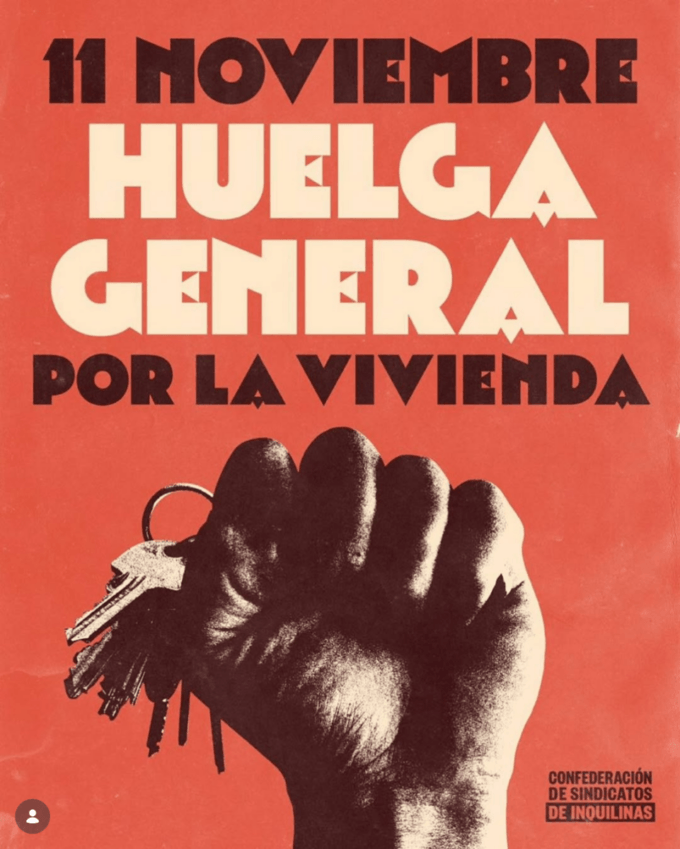
Artist unknown. Poster by the Confederación de Sindicatos de Inquilinas (Confederation of Tenants’ Unions), 2026
France
Coincident with our stay in Spain, a youth movement across the border in France suddenly exploded in scale and intensity. The first sparks appeared about two months earlier at the Lycée Saint-Exupéry in Créteil, a working-class suburb southeast of Paris. There, students protested poor school conditions and frequent cancellation of classes due to absent teachers and lack of substitutes. Soon, student protestors all over the country were leaving classes in sympathy strikes, even at elite Paris lycées like Louis-Le-Grand and Henri IV. A police crackdown on marchers – French gendarmes are notable in Europe for their brutality – only increased sympathy for the students and swelled the ranks of protestors. The latter now included workers, union members and enragés from the gilets jaunes (yellow vest) movement. The latter are mostly workers – originally farmers and truckers — who organized in 2018 by the tens of thousands to protest increased fuel taxes and the lack of democratic accountability. Their effort lost impetus in 2020 due to internal divisions, police infiltration and finally, Covid. Now they are back.
Last Saturday, October 17, hundreds of thousands of protesters marched in Paris and other cities across the France as part of a convergence des luttes (convergence of struggles) against the high cost of living, inequality, and lack of investment in education. Long feared by President Macron, his technocratic Prime Minister Lecornu, and the right-wing and pro-business parties in the National Assembly, this unified coalition of protestors was met, in many places, with force and mass arrests. Small factions of black masked, anarchist protesters broke away from the main groupings and engaged in arson and looting. In once case – in Limoges – they burned almost to the ground the late 19th C., French Renaissance-style Hotel de Ville (city hall). That destruction recalled the burning of the Paris Hotel de Ville by retreating Communards during the “bloody week” in May, 1871, when Versailles troops attacked and slaughtered thousands of working-class men and women who had seized political power following the Franco-Prussian War. It’s an historical irony that the Limoge city hall was modeled upon the reconstructed French one, itself modeled from the burned one.
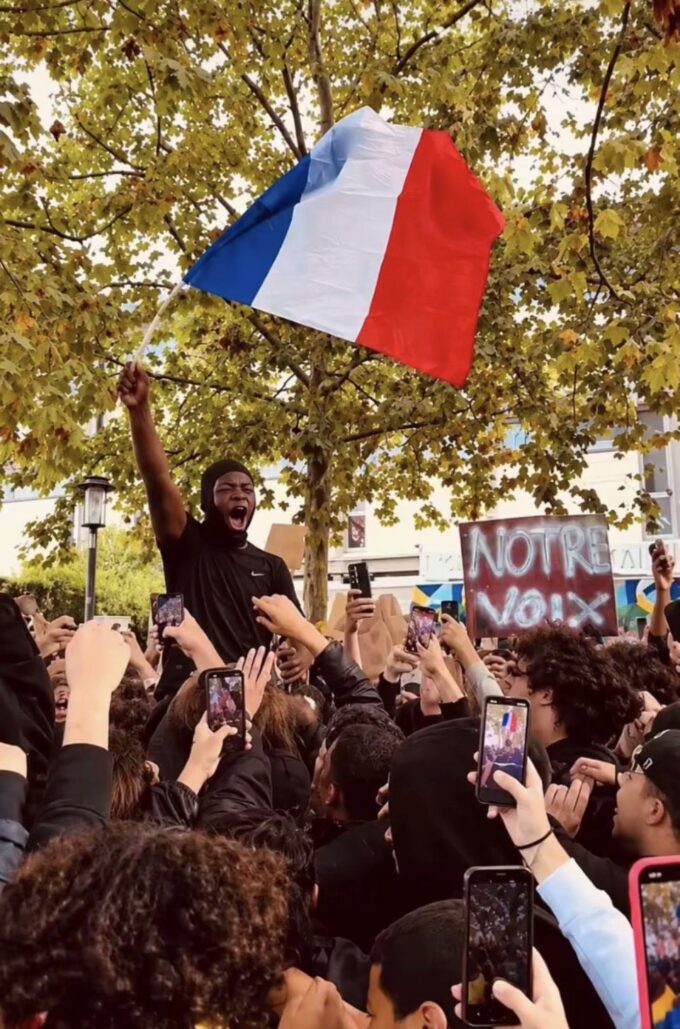
Photographer unknown, Paris school protest, October 1, 2026. CC BY-SA 4.0,
The real culprit in the French crisis, of course, is the widely reviled President Emmanuel Macron, nearing the end of his ten years in office. Macron, dubbed by many “president of the rich” and his center-right coalition have cut taxes on businesses and the wealthy while reducing social security payments. The unsurprising result of this neoliberal program has been increased social inequality, rising poverty, food insecurity and diminished government services. The president has also presided over a vast rise in the wealth of billionaires and millionaires, growing state deficits, and rising yields on bonds. The latter has increased government borrowing costs, further reducing money available for social services, education and everything else. Now, Macron and his Prime Minister are proposing an austerity budget for 2027 that will slash the social safety net by more than $50 billion. His party’s chief rival for the presidency, Marine Le Pen of the far-right National Rally party, promises to cut even more if elected, while somehow also protecting pensioners from reductions.
During his decade in power, Macron has occasionally tacked left (during Covid) only to shift back to the far right, for example passing in 2023 a stringent anti-immigration bill, subsequently voided by the courts. After the fires and looting broke out last week, he regained his confidence, sternly calling for harsh punishments for anyone charged with crimes against persons or property and blaming the political parties to his left. His law-and-order grandstanding – a posture shared by Le Pen – may relieve pressure on him for a while. But the economic and political crisis caused by neoliberal austerity will not go away. It’s now up to progressive forces – particularly at the grass roots level – to come together to make demands for state investment in schools, infrastructure, health and anti-poverty programs that will shift the nation in a new direction.
Germany
In Germany, political stability has been shattered by multiple crises – housing, inflation, education, inequality, and infrastructure – that the mainstream political parties (SPD and CDU) have been incapable of addressing. In five recent state elections, the neo-fascist AfD was the leading party in two, and absent a left/center coalition, there’s no way to stop their rise, apart from court interdiction. A petition to ban the party may soon be submitted to the Federal Constitutional Court.
Formerly the strongest and most resilient economy in Europe – and the biggest scold during the Eurocrisis of 2009-10 – Germany has suffered sluggish growth in the last decade, declining investment in it is formerly vaunted infrastructure, environmental breakdown (low water levels of the Rhine and Ruhr rivers have crippled shipping) and declining birth rates. The last of these issues, combined with a failure to establish a sane immigration policy, is leading to significant labor shortages in healthcare, construction, and education among other sectors. Ironically, this shortfall coincides with huge layoffs in manufacturing, especially automotive. (The industry has been challenged by Chinese imports but is mostly victim of its own price gouging and profiteering.) The overabundance of auto workers, however, can’t easily compensate the lack of healthcare workers – each has different training and expertise. And the former has higher wage expectations.
Germany has not yet experienced the same scale of protest activity as France and Spain, but it’s coming. Tens and in one case, hundreds of thousands of people have marched against neo-Nazism and the rise of the far-right AfD. In addition, students protested earlier this year against Chancellor Friederich Merz’s plans to spend billions of Euros to increase military preparedness and introduce conscription. Unions representing Volkswagen as well as the metal, electrical, and transport sectors are planning Fall and Winter labor actions.
For two generations, German politics and economy was buoyed by the decades of investment following the second world war and Marshall Plan – the years of the so-called Wirtschaftswunder (economic miracle). That’s when German capital and labor struck a “social partnership” that assured solid profits for the one and a state-backed social safety net for the other, promising unemployment protection, good pensions, universal health insurance, free higher education and other social services. But beginning the mid and later 1970s, capital staged a revolt, rejecting worker representation on corporate boards (while demanding increased profit) and inaugurating a decades long process of globalization and labor arbitrage leading to layoffs, pay cuts, worker precarity and declines in tax revenue and welfare spending. The question now is not how stiff will be student and worker resistance, but when will it arrive?
Collaboration between anti-systemic groups
As suggested earlier, all European nations – indeed all major capitalist countries across the globe from India to Bolivia – are beset by the same set of challenges, the consequence of policies of austerity. They are:
1) Rising prices for essentials such as food, water, energy, housing and transportation
2) Crumbling or inadequate infrastructure, including roads, bridges, and railways
3) Global warming, toxins in air and water, and other environmental threats
4) Poorly funded primary schools and overly expensive universities
5) A housing shortage
6) Failure to assimilate migrants or indeed to establish any coherent immigration policy
7) War or the threat of it in the Middle East and Eastern Europe/Russia
8) Rising inequality of income and wealth
9) The cost and availability of healthcare
10) The disappearance well-paying jobs and the threat of AI to eliminate more
Since at least the 1970s, central governments have refused to pay what Wolfgang Streeck calls the “overhead cost of capitalism,” that is, the social wages essential for the survival and reproduction of workers, including healthcare, environmental safety, education, and protection from violence at home and abroad. And when they refuse to pay, workers themselves are compelled to — or when they can’t, suffer the consequences.
One solution to the crisis of underinvestment in social infrastructure during the decades of neoliberalism has been for governments to simply borrow the money required for whatever is deemed politically essential. By selling bonds in the open market, governments kill two birds with one stone: 1) they obtain the money they need (or at least a sizeable portion of it); and 2) they gratify wealthy, often politically aligned groups glad to be paid a fair rate of return for loans of money they didn’t need anyway. That this investment is safe as houses is a bonus. But when a nation’s debt reaches a high level – say 100% of GDP – lenders may begin to fear their loans won’t be paid back. When that happens, they sell their bonds at a discount in the marketplace and purchases new government bonds with a higher rate of return. That’s where many capitalist states are right now – deeply indebted, unable to borrow at an acceptable interest rate, and unwilling to simply tax or confiscate the wealth of the billionaires who have profited from the system. At that point, economics becomes too important to be left to the economists; the people must step in.
The protest movements in the three countries discussed above – Spain, France and Germany, and many others, including the U.S. – are largely uncoordinated. Every nation has its own unique challenges and constituencies that requires its own political solutions and organizing strategies. But all affected nations are impacted by the same fundamental crisis: government policies of austerity or dis-investment that result in a rising cost of living, poorer opportunities for education and employment, inadequate healthcare, greater inequality, and an environmental crisis – not just global warming, but also diminishing water supplies, soil erosion, toxic chemicals, and oceanic dead zones.
Global challenges require global solutions; the working class of one nation can only succeed in its quest for economic, political and environmental justice if it collaborates with the working classes of other nations. Up until recently, that has sounded utopian – “Workers of the world unite! You have nothing to lose but your chains!” But the singularity of the current crisis is such that a few basic steps, taken in just some countries, can begin to shift power from the few to the many. Here are three proposed demands:
1) Social movements should press their politicians to impose an annual wealth tax – perhaps five to 10% on individuals above a certain level, perhaps $100 million. Such a tax would raise about a trillion dollars over a decade. Combined with higher income and corporate taxes, windfall profit taxes, and financial transaction taxes, significant money will be made available for social welfare, green infrastructure, and education. But in order for these taxes to work, similar laws would need to be passed in other nations, along with prohibitions on capital flight.
2) The bond markets will need to be tamed. That means laws must be passed to limit a nation’s spending on debt servicing – perhaps two percent of GDP, or 10% of the federal budget. Anything beyond that would simply be written off with the bond traders taking the hit. This measure would need to be phased in over several years to prevent pension funds from bearing the brunt of the write-off. The consequence of this approach would be to end the stranglehold bond traders have on national budgets, interest rates, and public investments.
3) Pass laws that will change the role of central banks, like the European Central Bank, the Bank of England and the Federal Reserve. Their role should switch from protecting private banks, to assuring public investments. They could offer public infrastructure bonds to their own governments at 0% interest to ensure adequate funding for major public investments. They could also offer bonds to the public at low interest (one to five per cent) to enable ordinary people to invest in the future of their nation, while also earning a modest return on their money.
In presenting these three proposals – none of them original — I’m not suggesting they are the only, or even the best ways to tackle the global crisis of underinvestment in social and environmental needs. Progressive economists will have many other, and possibly better ideas, including carbon taxes, consumption taxes, global minimum taxes, reform of patent, licensing and copyright laws, and universal basic income benefits. The point is that national, anti-systemic movements need to get behind one or several of these ideas – in addition to local demands — so that progress in one country isn’t undermined by the ability of capital to shift wealth to another country. Achievement of even one of these proposals in several nations, might soon begin to shift the balance of class power in all countries. “Workers of the world…!”


