
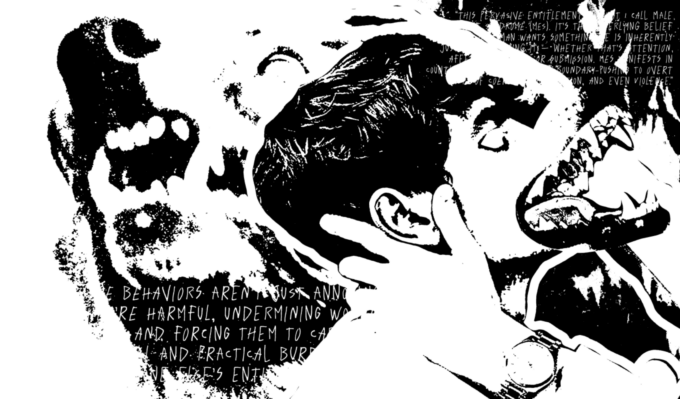
Illustration by Arielle Chhunkeo.
Editor’s note: The following opinion piece includes explicit language and discusses of rape and sexual assault. Reader discretion is advised.
The “Cornell 7” lawsuit describes the alleged gang-rape of a 20-year-old student drugged inside a Cornell fraternity house. Sexual violence of this nature is disturbingly common, and although newspaper headlines feign outrage every few weeks, the usual outcome is that the perpetrators get away largely unscathed. The Cornell 7 is a real-life example of the social structures that perpetuate male impunity, and the hypermasculine movement’s response to the case has exposed the manosphere’s role in preserving modern society’s rape culture.
As a corner of the digital world claiming to address men’s struggles, the manosphere relies on rhetoric that weaponizes hypermasculinity and grievance. Commentators within this space aim to frame the Cornell 7 case as a “woke” mob’s witch hunt; painting the accused as victims, they evoke public outrage against the survivor. The machinations of a radically misogynistic online community reveal a larger, purposeful movement, which twists the standards of brotherhood and masculinity to enforce male impunity in contemporary society. Traditional ideals of brotherhood — integrity and honor — have been co-opted and perverted in the name of hypermasculinity, resulting in a culture of silence and collective entitlement. Such entitlement and silence were grossly displayed in the Cornell 7 fraternity group chat, where defendant Jonathan Newell snapchatted his peers the message “free pussy in alum pu” in reference to the heavily drugged victim, Jane Doe.
Of the 57 active members in the fraternity group chat, not one chose to intervene. In hypermasculine spaces like fraternities, messages like Newell’s demand conformity and participation, not intervention. The manosphere has built a rhetoric that demonizes stepping in to stop an assault or defending a survivor as ultimate violations of the “bro code,” which risks instant exile from masculine society. This effectively converts peer pressure into complicity, teaching young men to prioritize loyalty to the male circle over basic morality and advocacy. And when a victim comes forward, the manosphere brings out the false allegation and “poor young boy” rhetoric.
Whenever sexual assault allegations gain traction and break into public view, the manosphere’s online mob and gender-supremacist influencers immediately shift focus away from the survivor and their trauma, postulating that the real victim is the accused man and his alleged persecution — often called counter-victim rhetoric or a reversal of victimhood. This process of inversion rebrands alleged rapists as innocent victims; the headstone martyrs of false allegations, meant to stoke the flames of male grievance and rage. This strategy feeds directly into what sociologist Michael Kimmel termed “aggrieved entitlement:”: a state of defensiveness, resentment and rage among dominant groups who feel the privileges they consider their rightful due are being lost or taken away. In the case of the manosphere, it is the belief among privileged young men that immunity from consequences is a right, and that holding assaulters accountable is an act of oppression. By casting legal consequences and social fallout of sexual assault as a war on men, the manosphere manufactures a sense of collective, misogynistic male martyrdom.
The co-existing result of aggrieved entitlement within the manosphere is a network of intimidation. The digital weapons of this network are deployed against survivors like Jane Doe, who has already faced multiple death threats and doxing attempts after coming forward. When male-supremacist creators broadcast a survivor’s details or host livestreamed defenses of accused men — like manosphere influencer Myron Gaines, who defended the Cornell 7 at the University of Texas on October 7, 2026 — they call for a digital army to wage war on the true victims. The movement threatens personal consequences for seeking justice. In doing so, the manosphere’s network, formed by perverted ideals of brotherhood and masculinity, sustains modern rape culture through intimidation and counter-victim rhetoric, slowly raising the price of coming forward until silence feels like the only option.
It is natural, I would even say necessary, to feel visceral outrage and disgust at the Cornell 7 case, its defendants, and the digital mob that rallied to defend it and invert a survivor’s trauma. The entire dynamic is absurdly dystopian; a surreal collapse of society’s basic moral consensus. But playing whack-a-rapist — attacking individual court cases while ignoring the larger structure — targets the symptoms, not the systems. The manosphere sustains itself through insufficient definitions of manhood that fail to offer young men a grounded vision of positive, accountable masculinity, leaving them susceptible to hypermasculine rhetoric. Systems are not abstract entities; they are powered by everyday compliance.
Exposing the mechanism of conversion is not an excuse, nor is it a gateway to absolution. The men who subscribe to misogynist doctrines, perpetuate sexual violence and enforce silence need to be named and held responsible. This does not, however, mean we can be blind to the patriarchal funnel that directs these men down such a path. When a young man’s malleable moral and intellectual beliefs are stained by rhetoric that purports equality as oppression and empathy as weakness, his pathway toward aggression and misogyny is not a deviation, but rather the system working as it was designed.
Defeating the system requires structural clarity and a recognition that the manosphere’s network of male entitlement and impunity relies on compliance at the individual level. The silent group chat and unchallenged perversions of brotherhood are the primary infrastructures that provide institutional cover and funnel young recruits into the patriarchal pipeline. Standing up and breaking rank in private, male-only spaces replaces the cowardice of complicity with the courage of active rejection; by stripping impunity of its peer-group protection and proving that real brotherhood demands accountability, men can begin dismantling male supremacy from within.
This piece first appeared in the Vanguard.


