
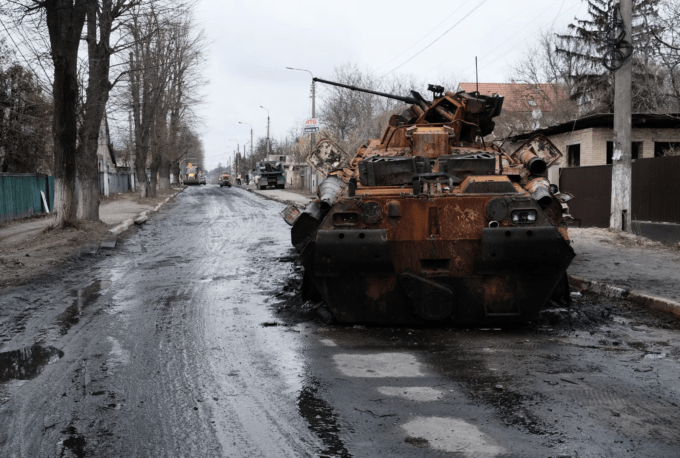
Photo by Sonia Dauer
Imagine the house.
A man has entered it by force and occupied several rooms. Boots. Mud. Broken glass. A smell of stale cigarettes. The owner has fought him from the staircase, the landing, the kitchen, the garden. He has bloodied him considerably. He has somehow prevented him from taking possession of the whole house.
But he cannot get him out.
The intruder, meanwhile, cannot get any farther in. Doors are now boarded up.
There they remain. A deadlock of hatred.
There are people—there are always people—who will say the important thing in a situation like this is to determine with moral clarity who owns the house.
But we already know who owns the house.
The difficulty is that one man owns it and another is presently sitting in the drawing room with a PKM machine gun across his lap.
This is, in miniature, the Ukrainian predicament.
Russia did not conquer Ukraine. Kyiv did not fall. The Ukrainian state did not disappear. The Ukrainian nation survived predictions of its defeat.
But Ukraine has not expelled Russia either. Russia still occupies a substantial part of Ukraine. The front is still industrial war at full scale. Pulverised villages. Thousands killed or maimed. The inevitable stench of death. Enormous quantities of expended metal. And then someone looks at the map and discovers the line has hardly shifted at all.
So, if you want the killing to end, why not begin with silence? Not with justice, which remains massive as a concept, but with silence.
Thirty days, say.
That means thirty days without missiles, drones or artillery. Thirty days in which Russian troops stay approximately where they are and Ukrainian troops stay approximately where they are.
Immediately, of course, comes the first objection: But doesn’t that reward conquest?
No.
We can recognise a fact without blessing it. There is a difference between possession and ownership. The intruder may be in your drawing room. It doesn’t make him the homeowner.
The existing line of contact can become the starting line of the ceasefire—without becoming an international frontier. Ukraine needn’t say Crimea, occupied Donbas, Zaporizhzhia or Kherson are Russian. It need only say: Russian soldiers are there today, Ukrainian soldiers are here today, and tomorrow we would prefer them not to be killing one another.
This is not a settlement.
It is the one thing you need in place before you try for a settlement.
And because everyone distrusts everyone else—and because distrust, in this instance, is hardly a psychiatric disorder—the ceasefire needs witnesses.
Satellites watching. Drones watching. International observers watching. Violations logged. An isolated incident investigated. Repeated or organised attacks producing consequences agreed beforehand.
Peace agreements have a well-known vulnerability. Everybody knows how to sign them and nobody knows what to do on Tuesday afternoon when somebody lobs a mortar.
So you build Tuesday afternoon into your agreement.
Then do the human things. Remember them?
Exchange more prisoners. Release unlawfully held civilians. Trace the missing. Return children deported or forcibly transferred. Stop attacking power stations, heating systems, water supplies—the machinery that lets ordinary life continue.
And then there is land.
There will be no ingenious wording that makes the land question pain-free. So stop looking for ingenious wording.
Again, peel control away from sovereignty.
The ceasefire line says who controls what on Monday morning. It doesn’t say who owns what forever.
Who knows? Maybe the land issue takes five years. Maybe fifteen. Maybe some questions stay unresolved even longer.
In which case, fine.
There’s nothing sacred about speedy diplomacy if speed gets people killed.
The formula can be brutally simple:
We disagree about whose land this is. We may continue disagreeing. We will not attempt to improve our legal argument with artillery.
Then comes the matter that destroys most beautiful peace plans: what happens when somebody cheats?
Ukraine’s fear requires no imagination. Russia stops, rebuilds, reloads and returns. Russia, for its part, says it fears Ukraine becoming the forward operating base of an increasingly powerful Western military system.
Neither concern can simply be wished away. Nor can peace require Ukraine to make itself defenceless in order to find out whether Russia has become trustworthy.
Ukraine therefore keeps a serious army, formidable air defences and the capacity to make another invasion catastrophically and prohibitively expensive. European states provide training, intelligence and defined security guarantees.
But defensive must mean something. Major deployments and exercises are notified. Russia knows what forces are approaching the ceasefire zone and why. Ukraine receives equivalent information about Russian forces.
Then there are sanctions.
Do not remove them all because an agreement has been signed. Don’t keep them irrespective of conduct.
Build a staircase.
Russia complies: restrictions are suspended in stages. It fulfils further obligations: another step. It launches another large-scale offensive: the staircase travels rapidly in the opposite direction.
You don’t exchange leverage for promises. You exchange leverage for behaviour.
None of this means forgetting.
War-crimes investigations continue. Evidence is preserved. Where individual criminal responsibility can be established, individuals can be prosecuted.
The dead don’t cease to matter because the living don’t want to join them.
But neither should tomorrow’s living be asked to die because every argument about yesterday’s dead has not reached its final courtroom.
Justice has a clock.
War has another.
And then comes the boring stuff, which is where peace really lives: rail timetables, customs posts, mine-clearance maps, water agreements, electricity connections, property claims, family reunions, telephone numbers for generals who would otherwise communicate through explosions.
The grand language recedes. Committees appear.
Excellent.
Civilisation can be the replacement of exciting methods with boring ones.
Nobody has to like anybody. Russians and Ukrainians may distrust one another for generations. They may teach incompatible histories. They may argue about Crimea until everyone presently alive is dead.
What they must acquire is the discipline of not killing one another over it.
That does not mean Russia and Ukraine bear equal responsibility for the war. It does not convert occupation into sovereignty. It does not require Ukraine to declare Russian conquest legitimate or anyone to pretend atrocities did not happen.
It requires only that five enormous questions stop pretending to be one.
Who owns the land? Who committed crimes? Who bears responsibility? What security order should follow?
And:
How do we stop people killing one another?
The first four may consume conferences, courts, archives, governments and generations.
The fifth cannot sensibly be told just to wait until they are finished.
Hobbes made his first law of nature brutally modest: “to seek peace, and follow it.”
That is the distinction between reconciliation and peace.
Reconciliation is ambitious. It asks memory to soften. Peace, at the beginning, asks almost nothing of the human heart.
It asks something of the human hand.
Put down the weapon. Don’t fire it.
Tomorrow, do the same.
And then, the day after that.
Everything else can begin there.


