

Coal plant smokestack, Ohio River Valley. Photo: Jeffrey St. Clair.
Chris Kaspar de Ploeg’s The Exterminating Empire: Capitalism’s War on Life from Palestine to the Burning Planet (Monthly Review Press, 2026) looks at how capitalism and imperialism have created violent systems against people and the environment. Using Palestine as his starting point, de Ploeg argues that these destructive forces exist in an ecosystem of conflict. The “burning planet” creates attacks on the “inner lives” of people as they continue to suffer under State violence. de Ploeg, an activist and political leader in Amsterdam, is the author of The Great Colonial Warand Ukraine in the Crossfire. In this exclusive interview for CounterPunch, de Ploeg breaks down his arguments for the reader.
Daniel Falcone: What is the central argument of The Exterminating Empire and how is the book structured? It looks as though the book serves as an intervention as well as an addition to current scholarship.
Chris Kaspar de Ploeg: I open the book with some jarring facts that seem paradoxical at first sight. We need about 30 percent of our productive capacity to give everyone on the planet a good life. Not just the basics like housing, clothing and healthcare, but also modern appliances like refrigerators, laptops, access to the internet and more. At the same time, that standard of living is denied to about 80 percent of the world population. Green energy has been cheaper than fossil fuels for years, yet climate breakdown is only accelerating. We could solve world hunger with about 0.03 percent of global GDP, but hunger is only increasing.
That looks like an extraordinarily wasteful system, and it is. The point, however, is that under capitalism, these are not paradoxes at all. In fact, they are signs of capital’s success. Under our current economic system, the primary goal, ruthlessly pursued, is profit maximization. That profit maximization is reached through pushing down costs–and we are those costs, our labour, our environments, our lives–and by conquering markets, often through a mix of military and economic warfare. That essentially puts capitalism on a warpath against life. The system is working exactly as it is supposed to.
We see, for example, that profit rates are higher in the fossil fuel industry because it essentially functions through monopolies, despite the higher costs. We see that the military-industrial complex is growing exponentially, targeting any vestiges of resistance against US-led global hegemony, which globalized harsh budget cuts in social welfare, healthcare and education. These very conditions of structural impoverishment then create the conditions of desperation necessary for people and countries to accept their status as sources for cheap labour, resources and land for global corporations, mostly centered in the Global North.
In the book I write about a dialectic between slavery and genocide, and between structural genocide and active genocide. A good way to understand that relationship is by going back to the We Charge Genocide petition, which was presented in 1951 at the United Nations by William L. Patterson, on behalf of the Civil Rights Congress. He estimated that, since the abolition of slavery, some 10,000 black people had been lynched, often for something as small as looking a white woman in the eyes. These lynchings were not hidden affairs, but were a public spectacle, for which neighbors came together, and pictures were spread on postcards across the country.
Patterson goes on to argue that this kind of active violence serves a deeper purpose. It was meant to intimidate the black masses to accept lower living standards, functioning as a dehumanized workforce for corporations. At the time, this led 32,000 excess deaths every year among Black Americans compared to white death rates. Patterson charges this as a ‘genocide for profit’, based on the article in the UN convention that lists “deliberately inflicting on the group conditions of life calculated to bring about its physical destruction.” Combining two studies that were done since that time, I show that between 1940 and 2020 the total excess death toll of African Americans is 6 million.
Nowadays, scholars tend to call this ‘structural genocide’. And I argue that this is a global phenomenon under capitalism. In a sense, the active genocide in Palestine is a lynching aimed at intimidating the Global South into accepting its role as devalued lives for Western profits. The blatant, live-streamed and openly announced nature of that genocide is exactly the point, just as the lynchings of the American South were broadcast widely. It is aimed to intimidate people, because the active genocide serves the broader, structural genocide.
The histories of genocide and slavery are deeply intertwined. In fact, almost every genocide in history also deployed slave labor–even in the archetypical death camp, Auschwitz – and chattel slavery also contained genocidal dynamics of cheapened lives and heightened death rates. In a sense, even in Gaza the exterminated are forced to labor as guinea pigsfor the global arms industry, whose weapons are then sold as ‘battle tested.’ But on a more structural level, the survival mode that is forced upon the global masses makes them accept conditions they normally never would. Generations of workers used to call this ‘wage slavery’, to emphasize the lack of freedom underlying these conditions. Indeed, the global peasantry first had to be robbed of their communal lands – where they could often provide for themselves – before they could be forced to work under the hierarchical system of capitalism. Essentially, then, the global architecture of capitalism promotes various modes and gradations of extermination and slavery.
The book marshals a lot of data and history to demonstrate how this system has functioned so consistently throughout the centuries. I also fuse ecology and climate breakdown deeply into this analysis, both theoretically and empirically, as any attack on human life tends to be equally fused with attacks on their environments. Ecocide and genocide go hand in hand, both on the active and structural level. The very idea that we can separate the humans from ecology is itself a colonial and capitalist phantasy. But the book is not only gloom and doom. I end with a long chapter on strategizing how to beat this system, learning both from the accomplishments and failures of resistance movements from the past and the present. Honestly, the pace of the book is quite high, so it is impossible to summarize everything in one interview.
Daniel Falcone: To what extent does the spirit of resistance become the prime target for annihilation? Also, how is cultural genocide related to capitalist alienation? You discuss the cogs in the hierarchical machine, but I am wondering how this idea explains your thesis and impacts collective identity.
Chris Kaspar de Ploeg: When the Polish-Jewish legal scholar Raphael Lemkin coined the term genocide in 1944 in his Axis Rule in Occupied Europe, he was not thinking primarily about mass killings. Rather, he saw in Nazi rule an attempt to wipe out the collective coherence of peoples, their languages, their institutions, their intelligentsia, cultures, all of it. He defined genocide as imposing ‘the national pattern of the oppressor’, either on the people themselves or on their territory after their deportation or slaughter.
We now know that most active genocides in history also had an aspect of cultural genocide. Think, for example, of the boarding school systems in Turtle Island (North America) and Makar Yindi (Australia), where kids were stolen and then told to ‘let everything Indian inside you die,’ many of them dumped into mass graves at the first sign of disobedience, or simply because of the terrible conditions in the schools. At the same time, we see how private property was forced onto First Nations in the United States through the Dawes Act and how practices like the Ghost Dance were banned. And this is not surprising. When we accept that communities are complex interdependent systems, where we cannot easily separate humans from ecology or economy from culture, destruction is aimed at the totality, or their ‘pattern of life.’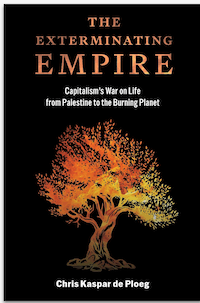
In the book I argue that we can also analyze a global structural cultural genocide that is ingrained in the capitalist system. Even without such blatant genocidal practices as the boarding school system in the settler colonies, for example, we see that languages, cultures, and communal relations are systemically dismantled and erased across the globe. This tends to happen through the process of integrating people into the hierarchical machine of capitalism, which creates an individualized, atomized and consumerist culture, and where our labour, which is the bulk of our waking life, does not directly serve our communities, but is decided top-down by some boss, often at the other side of the world through a complicated production chain. At the same time, communities become dispersed by poverty – we see massive migrations from the countryside, where people are starving, to the city, where they work for a pittance – or by the capitalist infrastructure, whose roads and gentrification processes disperse communities slowly but surely.
Life starts losing its meaning. The WHO has increasingly recognized ‘loneliness’ as a global public-health issue. This has direct health effects as well, worsening the structural genocide enveloping the global working class. When capitalism first arose, drugs like tobacco, but also opium, were pushed onto the masses to distract from their unbearable conditions. I believe the rise of social media, explicitly designed to trigger dopamine addictions, largely serves the same purpose, distracting us from our deep alienation. Simultaneously, we are constantly bombarded by commercials – capitalist propaganda – that prey on our deep spiritual hunger, offering salvation through materialism, which it never does. The very destruction of life’s meaning itself becomes a profitable model for capital.
There is, however, an important nuance. We know that capitalism is quite capable of co-opting some parts of different cultures and languages, stripping them of their communal and resistance contexts, to disarm them and sell them back to us for a profit. These cultures become individualized products that we can engage in after work or offer some spectacle but have no bearing on how we organize our societies. One example is how Mobutu Sese Seko promoted native dances and attire, while he collaborated with the United States, Belgium and apartheid South Africa after the assassination of Patrice Lumumba, the first democratically elected leader of the Democratic Republic of Congo, leaving the country to languish in deep poverty. This is why anti-colonial leaders like Amílcar Cabral emphasized that culture is not necessarily about folklore or dances, but that it needs to be grounded in the material struggle for liberation. It is that culture of resistance, rooted in the collective struggle for liberation, that always becomes the prime target for annihilation.
Daniel Falcone: In the Foreword, Jason Hickel dismisses the notion of a double standard in Western foreign policy. He insists it is rather a “single standard” (capitalism). Further, he touches on how capitalism explains Western governments’ support for Israel and other interventions in China and the Global South. How do his ideas change the way we understand Western responses?
Chris Kaspar de Ploeg: This goes back to the nature of capitalism, which, as I explained earlier, is very consistent in its exterminatory logic. The US-led Western bloc is essentially the center of this capitalist architecture, and we need to understand its foreign policy in that context. In 2023-2024, for example, 95 percent of profits of the 100 most profitable privately owned corporations in the Forbes 2000 were centered in the Global North, with 70 percent in the Anglo-countries of the United States, the United Kingdom, Canada and Australia, and another 20 percent in the rest of Western Europe.
The Forbes figures do not include foreign ownership. The largest shareholder of the single most profitable privately owned corporation in the Global South, Tencent Holdings, is Naspers Limited, a holdover corporation of white monopoly capital from apartheid South Africa. At number three comes Alibaba Group, whose largest shareholders are the Japanese and US investment firms SoftBank Group, Vanguard Group, and BlackRock. As recently as 2022, 80 percent of the corporations within China that process imported materials, encompassing most of the high-tech sector, were “foreign-invested enterprises.”
Major US tech corporations gain about 50 percent of their revenue from abroad. And this still does not account for the enormous value that is extracted year in, year out from international value chains, where the soils, peoples and resources of other countries are systemically cheapened. The numbers are massive: every year, 12 billion tons of raw materials, 822 million hectares of land, 21 exajoules of energy, and the equivalent of 188 million years of human labor, are net extracted from the Global South. The amount of land and energy that is robbed yearly would be sufficient to feed 6 billion people and build out and maintain the necessary infrastructure for decent housing, healthcare, education, sanitation, and so on, for 6.5 billion people.
During the Cold War, the key architect of American foreign policy, George Kennan, explicitly stated that “We have about 50 percent of the world’s wealth but only 6.3 percent of its population,” in a founding strategic document of the US Policy Planning Staff. “Our real task,” he claimed, is “to devise a pattern of relationships which will permit us to maintain this position of disparity.” That is exactly what the US has done since that time, whether it is propping up capitalist-aligned dictators or whether it is overthrowing, sanctioning and invading governments that nationalize and develop their own sovereign industries or invest in their healthcare, education and social welfare. It does not matter to the US whether its enemies are democratically elected or not. The United States itself sponsors, according to its own data, 73 percent of dictators across the globe.
During the Cold War, we saw that in internal communications, Western policymakers were not at all concerned with human rights abuses or the well-known famines that struck various socialist countries. In fact, the latter was actively desired, and explicitly named, for example, as a goal for the U.S. embargo against Cuba. What really struck fear in the heart of the American empire was the long-term success, despite great setbacks, of most socialist countries. Systemic data shows that they outperformed their capitalist counterparts, with a similar level of per capita GDP, on every single metric on their physical quality of life, whether it was life expectancy, doctors per capita or mean years of schooling. And they did so by cutting themselves off from the circuits of Western capital.
Interestingly, Kissinger viewed Salvador Allende, the democratically elected socialist president of Chile who was overthrown by the United States, as an even greater threat than Fidel Castro, exactly because he feared that Allende’s success could lead to an electoral spread of socialism. In Korea, Vietnam and Indonesia, the United States backed the murder of millions of communists and other leftists, even if they privately admitted that they would probably win if fair elections were held there at the time. So truthfully, the West is indeed fighting a war about democracy. But it is a war against democracy. Or more specifically, against democratizing the economy, which right now is dictated by ever-fewer corporations and billionaires, mostly centered in the West.
Daniel Falcone: Can you talk about how you connect the history of colonial violence (from slavery and Palestine to war and climate change) to capitalism’s “atrocity propaganda” and “omnicidal” tendencies? Further, what is climate apartheid and how does it show that global political issues are peripheral to each other?
Chris Kaspar de Ploeg: Let us start with atrocity propaganda. It is often said that every Zionist accusation is a confession. When Zionism speaks about its enemies, it’s describing itself. Yet this is a truism of imperialism tout court. It was the same language of the American Declaration of Independence, which spoke about “merciless Indian Savages, whose known rule of warfare, is an undistinguished destruction of all ages, sexes and conditions.”
Atrocity propaganda accompanies almost every genocide. This is also called “accusation in a mirror.” The perpetrator projects his own genocidal intentions onto the victim. This goes beyond dehumanization, which is supposed to make genocide seem acceptable. Genocidal projection should even make genocide seem necessary, creating a choice between us or them. And we also see this happen on a more structural level.
In the book, I go back to the Roman invasions against Palestine and show how deeply atrocity propaganda, and the Manichaean vision of good versus evil, has been ingrained in the history of imperialism. The religious doctrine of holy war and absolute morality of good and evil was simply secularized over the centuries. From race wars to anti-communist wars to civilizational wars. Each era found its appropriate doctrine.
Just as the crusades against Palestine innovated imperialism, so did the genocide against Native Americans, which formed the basis of the American warfare that was later globalized. Because capitalism is a global system, every struggle impacts another. Or as the Palestinian revolutionary Ghassan Kanafani once said: “Imperialism has laid its body over the world, the head in Eastern Asia, the heart in the Middle East, its arteries reaching Africa and Latin America. Wherever you strike it, you damage it, and you serve the world revolution.”
I mentioned before that ecology and human society cannot be separated. So, it is no coincidence that the genocide in Gaza also meant the systemic destruction of its ecosystem. In less than a year, nearly two-thirds of the tree cover and farmland in Gaza had been destroyed, as orchards, olive groves, and greenhouses were razed to the ground by bulldozers and bombs. What happens in Gaza is not only genocide, nor only ecocide. It is omnicide, the killing of everything.
Even within Israël’s own borders, with the ethnic cleansing of Palestinians, we also see a systemic rooting out of olive trees, what some have called an environmental Nakba. They are replaced by European pine trees that do not actually fit the climate and are more susceptible to forest fires. The same happened in the settler colonies, from Australia to North America, which systemically wiped out native ecosystems, importing European invasive species, creating so-called neo-Europes in their wake.
As always, the settler colonies are some of the most extreme and direct modes of violence. But just as there is a structural genocide enveloping the globe, we see a structural ecocide wiping out the ecosystems of the Global South, from Indonesia to the Amazon. Just as there was, essentially, a system of apartheid in the US South, we essentially have a global system of apartheid between the Global South and the Global North, masked by artificial borders that were created by European powers in the first place. And climate apartheid is one aspect of that, as a dividing line between those most impacted by its effects, and those who can shield themselves with climate-proofed homes.
Global pollution and climate breakdown are all forms of structural omnicide that kill millions of humans and non-humans alike, year in and year out, and with the worst effects happening in the Global South. Even before counting deaths from global warming, direct air pollution from factories and toxic fumes kills 10 million people each year. These same toxic fumes also collapse the lungs of plants, which are unable to properly breathe and grow, leading to massive stunting or even die-offs. Lead and other chemicals kill another two million people a year, again mostly in the Global South; again, a mass killer of ecosystems as well. Climate breakdown is only the amplifier of this entire process. And solving it will require us to dismantle the very economic system driving it.
Daniel Falcone: You discuss the consequences of BRICS in the latter stages of the book. Describe how China and the greater Global South’s approach to economic and social development might rearrange the US posture and priorities internationally moving forward.
Chris Kaspar de Ploeg: The GDP of non-aligned organizations of the Global South, the BRICS being the most important one, has now overtaken that of the G7. We see that the potential for trade, financing and technology sharing between countries of the Global South is increasing, which loosens the stranglehold of Western corporations and banks. We know, for example, that countries that receive loans from China tend to get better deals, with less forced austerity policies, from the IMF. This is the logical result of gaining bargaining space, and exactly why US hegemony had such devastating effects in the 90s, when preventable diseases made a major comeback in many parts of the globe.
The rise of China is the most threatening to the United States, because it has a massive internal market and increasingly manages to control larger parts of its entire production chain, which in the long term, could threaten the dominance of Western corporations. Even more so if they started actively sharing that technology with the Global South. The fact that China has also been massively raising its wages and environmental standards and has been leading the global boom of solar and wind energy, deeply threatens western profits.
This does not mean that the BRICS economies offer a coherent challenge to capitalism. I explain that their rise is both necessary and insufficient. The bloc includes countries like India and Brazil, which are or were ruled by neo-fascist leaders like Narendra Modi and Jaïr Bolsonaro. Even China is inconsistent. Much of what is written about Chinese foreign policy, such as the long-debunked claims of ‘debt-trap diplomacy’, are Western projections of its own imperialism. China truly does have a policy of ‘non-intervention’, which is infinitely better than Western imperial aggression. Nevertheless, that also means it trades with and finances reactionary regimes, just as it does progressive and leftist forces. That means salvation will not come from outside, but from organizing ourselves, as the working classes, the peasants, and oppressed nations, to challenge capitalism.
Nevertheless, even an incoherent challenge is powerfully threatening to capitalism. The sociologist Ali Kadri, for example, shows how imperialism wants to wipe out even the potential for revolutionary changes before it arises, by wiping out the coherence and state capacities of countries in the Global South. China’s economy is now larger than that of the United States, so if revolutionary changes happen in parts of the world, they will have a powerful trading partner and will not so easily be choked by Western economic warfare. At the same time, we see economic inequalities rising rapidly, ecological and climate breakdown accelerating, and capitalism offering no answers, except for violence. For this reason, I think the timing of the genocide in Palestine and the rise of Trump are no coincidence. They show that the system is in deep crisis, and it increasingly feels the need to drop any pretenses. This was also an essential part of what drove the rise of fascism in the 1930s, which aimed to wipe out the communist threat, especially in Italy and Germany.
In my book, I argue that there are essentially two forms of climate denial. On the one hand, there is the far-right that denies the very existence of climate change. On the other hand, there is the political center that denies the need for any thorough policies that tackle the corporations responsible. I analyze the failure of a whole host of climate policies, such as carbon trading, lab meat and carbon capture and storage (CCS). Yet the truth of the matter is that these technologies have never been the Global North’s actual climate policy, whose corporations and militaries have never aimed for prevention, but for adaptation. These policies are obstructions, buying time for capitalism, until the moment when an ecofascist policy of ruthless violence can be enacted openly on the world stage. Until the climate solution becomes—in plainer terms—the Gaza solution.


