Since its inception in the last quarter of the 18th century, the United States has, on numerous occasions, used its armed forces to expand its influence, territory, power and control over the natural resources of other nations. As I described in the article ‘The Western Hemisphere : a history of the United States written by war’ [1] , they began in their immediate vicinity, and, over time, their official or covert military operations have extended to every continent. An official report by the US Congressional Research Service (Congressional Research Service) entitled ‘Instances of Use of United States Armed Forces Abroad’ lists several hundred armed interventions from 1798 to 2023, a substantial number of which took place after 1945 [2] (Congress.gov).
These interventions constitute the most visible form of the exercise of their global power. However, they represent only part of a much broader apparatus that also includes coups d’état, covert operations, military alliances, proxy wars and the global network of military bases.
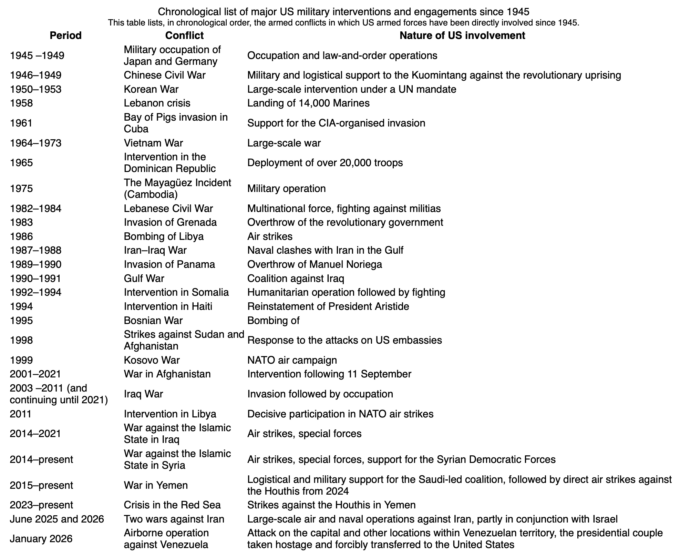
This section examines the main conflicts in which the US armed forces have been directly involved in combat operations since the end of the Second World War. Figures on human casualties are estimates: they vary according to source, particularly in the case of civilian casualties and enemy losses. Where data are uncertain, ranges are given.
The overall trend is marked by a profound shift: following the large-scale ground wars of the Cold War (Korea and Vietnam), Washington has gradually favoured interventions combining air superiority, precision technologies, special forces and cooperation with local allies.
1. The Korean War (1950–1953): the first major war of the Cold War
The Korean War was the first major conflict in which the United States deployed its armed forces on a massive scale after 1945. Under a United Nations mandate — due to the temporary absence of the Soviet Union from the Security Council — the United States led an international coalition. In total, around 1.8 million US military personnel took part in the conflict between 1950 and 1953. The peak number of US troops deployed at any one time reached around 325,000 to 350,000 in 1952. The intervention relied on a major ground mobilisation, as well as massive air and naval superiority. The US suffered significant casualties, with approximately 36,500 American service personnel killed and over 100,000 wounded. On the opposing side, estimates put the number of North Korean military deaths at between 200,000 and 400,000; Chinese military deaths at between 400,000 and 600,000; and several hundred thousand deaths amongst South Korean forces. Civilian casualties were particularly high. Estimates range from 2 to 3 million Korean deaths, the result of fighting, bombing, massacres and forced displacement. The war ended with the Panmunjom Armistice in July 1953, without a definitive peace treaty. The peninsula remained divided along the 38th parallel. One of the major outcomes was the establishment of a lasting US military presence in South Korea, which continues into the 21st century.
2. Invasion and occupation of the Dominican Republic (1965–1966)
In April 1965, the United invaded Santo Domingo to quell a constitutionalist revolution seeking to restore Juan Bosch, the democratically elected left-wing president who had been overthrown in 1963, to power. Some 22,000 American soldiers were deployed (more than 40,000 would pass through the island during the operation). American casualties numbered in the dozens. On the Dominican side, generally accepted estimates put the death toll at between 2,000 and 4,000, including both civilians and combatants.
3. The Vietnam War (1965–1975): the heyday and subsequent crisis of the American model of intervention
The Vietnam War represented the largest US military commitment of the Cold War prior to Iraq and Afghanistan. Following increasing involvement during the 1950s and early 1960s, under J.F. Kennedy, the commitment accelerated sharply. The number of advisers rose to several thousand; it reached around 16,000 US military personnel in November 1963, according to the official history of the Department of Defence. As early as 1962, nearly 300 aircraft belonging to US military units were deployed to Vietnam to provide support to the South Vietnamese forces. Washington intervened on a massive scale from 1965 onwards, officially to prevent the victory of the communist government of North Vietnam and the National Liberation Front in the South. In total, around 2.7 million US military personnel served in Vietnam between 1964 and 1973. The peak deployment was reached in 1969, with around 543,000 US troops present at any one time. US casualties were heavy: around 58,200 American service personnel killed and over 150,000 wounded. Vietnamese casualties were much higher. Estimates vary considerably: around 1 million North Vietnamese soldiers and National Liberation Front fighters were killed, according to several estimates; several hundred thousand South Vietnamese soldiers were killed. Civilian casualties are estimated at between 2 and 3 million deaths in Vietnam, to which must be added the victims in Laos and Cambodia, which were subjected to an intense campaign of US bombing (Cambodia from 1969 onwards). Laos became the most heavily bombed country in history in proportion to its population, until Gaza surpassed this horrific record following the genocidal war waged by Israel against the Palestinian people.
.
US intervention in Vietnam sparked one of the most powerful anti-war movements in contemporary history. From the mid-1960s onwards, millions of Americans – students, trade unionists, civil rights activists, intellectuals, artists, veterans and even serving soldiers – demonstrated against a war that was increasingly perceived as illegitimate and criminal. The massive demonstrations in Washington in 1967 and 1969, the student strikes that paralysed hundreds of universities following the killing of four students by the National Guard during the crackdown on a demonstration at the University of Kent in 1970, as well as refusals to fight, desertions and dissent within the army, deeply undermined American authority.
This mobilisation resonated widely on an international scale. Mass demonstrations took place in Europe, Japan, Australia, Canada, Latin America and elsewhere, exacerbating Washington’s diplomatic isolation.
The heroic resistance of the Vietnamese people primarily led to the United States’ defeat. But this resistance was bolstered by an anti-war movement of unprecedented scale, which, within the United States itself, helped make the continuation of the conflict politically untenable. For the first time, the world’s leading military power was forced to abandon a war under the dual pressure of a people who refused to submit and of massive popular opposition, both at home and abroad.
The 1973 Paris Agreements led to the American withdrawal. In 1975, the fall of Saigon marked the strategic defeat of the United States and the reunification of Vietnam under communist leadership. Vietnam was a major turning point: Washington retained considerable military capability but became much more reluctant to commit large ground forces to protracted conflicts.
4. Lebanon (1982–1984): a limited intervention in a complex civil war
The US intervention in Lebanon took place against the backdrop of the Lebanese civil war and the Israeli invasion of 1982. US Marines were sent to Beirut as part of a multinational force. Around 12,000 to 15,000 US military personnel took part in the operation at various times. The main contingent of Marines numbered several thousand men. On 23 October 1983, an attack on the Marine barracks in Beirut killed 241 US service personnel, the heaviest loss suffered by the United States in an operation since the Vietnam War. Lebanese and regional casualties are difficult to ascertain against the backdrop of a fragmented civil war, but several hundred thousand people died during the Lebanese Civil War (1975–1990). Following the attack, Washington withdrew its forces in 1984.
5. Invasion of Grenada (Operation Urgent Fury) in 1983.
Some 7,000 American soldiers landed to overthrow a severely weakened left-wing government after one of its factions had deposed and executed Maurice Bishop and other leaders of the New Jewel Movement. The Grenadian government had an army of only around a thousand fighters.
6. Panama (1989): an intervention aimed at regime change
Operation Just Cause, launched in December 1989, was officially aimed at overthrowing General Manuel Noriega, who was accused, among other things, of drug trafficking and had become hostile to US interests at a time when the Canal was considered strategically important. Noriega had, however, been an ally of Washington for nearly two decades and a key collaborator with US intelligence services: he provided information to the CIA and the DEA and was paid by the CIA, notably in 1976–1977, while George H. W. Bush was head of the agency. Around 27,000 US military personnel took part in the operation, which combined ground forces, air power and special forces. US casualties were relatively limited: 23 US military personnel killed and several hundred wounded. Panamanian casualties are more difficult to ascertain: between 500 and 1,000 military and civilian deaths, according to various estimates. The operation quickly led to Noriega’s capture and the installation of a government favourable to Washington. Panama is an example of a rapid intervention explicitly aimed at regime change, a model that would be replicated in other forms after the Cold War.
7. Somalia (1992–1994)
The US intervention in Somalia began as part of Operation Restore Hope, launched in December 1992 under a UN mandate to address the famine caused by the civil war. Around 25,000 to 30,000 US military personnel took part in the first phase. A smaller US contingent continued to engage after the UN took over the mission.
The situation escalated into a confrontation with the forces of faction leader Mohamed Farrah Aidid. The Battle of Mogadishu on 3 and 4 October 1993 resulted in the deaths of 18 US military personnel and around 70 wounded. Estimates suggest that between 300 and 1,000 Somalis, including both combatants and civilians, died. The US withdrawal took place in 1994. Somalia became a symbol of the difficulties faced by the United States in stabilisation operations in fragmented societies.
8. Kosovo and Serbia (1999): the post-Cold War air war
NATO’s intervention against Serbia in 1999 marked an important turning point in the evolution of US military power. Although officially led by the North Atlantic Treaty Organisation, Operation Allied Force was largely dominated by Washington, which provided the bulk of the intelligence, command and control, and logistical capabilities, as well as a major proportion of the air assets.
Unlike in the Korean or Vietnam Wars, the United States did not deploy any significant ground forces. The campaign relied primarily on aerial bombardment. Around 40,000 US military personnel took part in the operation or associated operations, but the number of forces directly involved in the strikes remained limited.
US casualties were low or non-existent: officially, no American soldiers were killed in action during the air campaign. Serbian casualties are estimated at between 1,000 and 2,000 military personnel killed. Depending on the source, Serbian civilian casualties are estimated to be between 500 and 2,000 dead. The bombing of the Chinese embassy in Belgrade on 7 May 1999 triggered a major diplomatic crisis. Three Chinese journalists were killed. Washington claimed that it was a mistake resulting from erroneous intelligence. Beijing disputed this explanation. The intervention led to the withdrawal of Serbian forces from Kosovo and the deployment of an international force.
9. The wars against Iraq (1990–2021): a three-decade cycle of military intervention
Iraq has been one of the main theatres of US military intervention since 1945. This is not a single war but a cycle that began in 1990 with the Gulf War and continued through to the operations against the Islamic State in the 2010s.
The Gulf War (1990–1991)
Following the invasion of Kuwait by Saddam Hussein’s Iraq in August 1990, the United States organised an international coalition under a United Nations mandate to force Baghdad to withdraw. Operation Desert Storm began in January 1991 with a massive air campaign followed by a short-lived ground offensive.
The United States deployed around 540,000 troops to the region, marking the largest US military commitment since the Vietnam War. The conflict resulted in relatively limited US casualties, with a few hundred soldiers killed and just under 500 wounded in action.
Iraqi casualties were much higher: according to various estimates, between 20,000 and 35,000 Iraqi soldiers were killed, with tens of thousands more wounded or taken prisoner.
Iraqi civilian casualties are estimated at between 3,000 and 10,000 deaths directly linked to the fighting, to which are added the indirect consequences of the destruction of infrastructure and international sanctions in the years that followed. The war ended with the ‘liberation of Kuwait’, but Washington decided not to overthrow Saddam Hussein. The Iraqi regime endured international inspections, regular air strikes, and sanctions that severely impacted the people.
The invasion and occupation of Iraq (2003–2011)
In March 2003, the United States invaded Iraq with a coalition of allies led by Washington. The administration of George W. Bush claimed that Baghdad possessed weapons of mass destruction and posed an international threat. These accusations would be unfounded. The real objective quickly became regime change: Saddam Hussein was overthrown in April 2003. Around 1.5 million US military personnel served in Iraq between 2003 and 2011, with a peak of approximately 170,000 US troops present simultaneously in 2007. US casualties totalled around 4,600 American service personnel killed and more than 32,000 wounded in action. Iraqi casualties are much more difficult to determine. The number of Iraqi service personnel killed during the invasion is estimated at between 10,000 and 30,000. Following the fall of the regime, the occupation triggered a civil war, an armed insurgency and sectarian clashes.
Estimates of Iraqi casualties vary widely: several hundred thousand deaths according to the highest epidemiological estimates and around 200,000 to 300,000 documented violent deaths according to other sources. The invasion also resulted in several million people being displaced. The United States formally withdrew its combat forces in December 2011 but returned to Iraq from 2014 as part of the fight against the Islamic State.
10. Afghanistan (2001–2021): the longest US war
Following the attacks of 11 September 2001, the United States launched Operation Enduring Freedom against al-Qaeda and the Taliban regime that harboured it. The intervention began with an air campaign and support for the Afghan Northern Alliance forces. The Taliban were quickly driven from power, but the war gradually evolved into a counter-insurgency conflict. In total, more than 800,000 US military personnel served in Afghanistan over the course of the twenty-year war. At the peak in 2010–2011, the US deployed around 100,000 troops simultaneously, reaching the peak of troop levels. US casualties: approximately 2,460 US service personnel killed and over 20,000 wounded. Casualties among opposing forces: approximately 50,000 to 70,000 Taliban fighters killed, according to various estimates. Afghan forces allied with the United States suffered very heavy losses: over 60,000 Afghan military personnel and police officers killed between 2001 and 2021. The Costs of War Project estimates the number of direct deaths from the war in Afghanistan between 2001 and 2021 at around 176,000 across all categories, including more than 46,000 civilians, in addition to indirect deaths caused by the consequences of the conflict. After twenty years of intervention, the United States withdrew in August 2021. The Taliban quickly regained control of the country, exposing the failure of Washington’s strategy for political and institutional transformation.
11. Libya (2011): air warfare and regime change without occupation
The intervention in Libya represents a different model from the wars in Afghanistan and Iraq. The United States led the NATO operation against Muammar Gaddafi’s regime against the backdrop of the 2011 Arab Spring uprisings. The intervention was officially justified on the grounds of protecting the civilian population and was based on a Security Council resolution that authorised a no-fly zone. The United States played a central role: initial command, intelligence, in-flight refuelling, cruise missiles and air strikes. Unlike in Iraq, Washington did not deploy significant ground forces. US casualties: officially, no US military casualties in combat. Libyan casualties are estimated at several thousand deaths among government forces and rebel groups. Civilian casualties are estimated at several thousand. The intervention led to the fall of the regime and the death of Gaddafi in October 2011, but without any real political reconstruction. Libya then entered a prolonged period of institutional fragmentation and civil war.
12. Syria (since 2014): limited intervention, special forces and local partners
The United States has been militarily involved in Syria since September 2014 as part of the campaign against the Islamic State. Unlike in Iraq in 2003 or in Afghanistan, Washington is not officially seeking to occupy the country or to directly overthrow the Syrian government. The intervention relies on air strikes, special forces, support for the Syrian Democratic Forces and intelligence operations.
The number of US military personnel present remains limited: between approximately 900 and 2,500 US soldiers, depending on the period. US casualties: several dozen military personnel killed since 2014. Islamic State casualties are estimated at several tens of thousands of fighters killed by the coalition. The Syrian conflict as a whole has resulted in considerable human casualties: around 500,000 deaths or more, according to various estimates, and several million refugees and displaced individuals.
13. Yemen and the Red Sea (since 2024): direct US air strikes
From January 2024, the United States intervened directly in Yemen against Houthi forces, alongside operations in the Red Sea. Following an initial phase of strikes conducted jointly with the United Kingdom, Washington significantly intensified its air campaign in 2025. This intervention differed from the military, logistical and intelligence support provided since 2015 to the Saudi-led coalition. Since 2024, US forces have themselves carried out air and naval strikes against Houthi targets in Yemen. These operations continued into 2026.
This intervention forms part of a broader shift in US military strategy: the extensive use of air and naval power, missiles and drones, without significant US ground involvement.
14. Venezuela (2026)
On 3 January 2026, more than 150 US military aircraft took part in Operation Absolute Resolve. Launched from around twenty land and naval bases in the Western Hemisphere, they included, in particular, F-22s, F-35s, F/A-18s, EA-18Gs, E-2s, B-1 bombers and numerous drones. Helicopters from the 160th Special Operations Aviation Regiment transported, among others, Delta Force commandos who attacked and penetrated the complex where Nicolás Maduro and Cilia Flores were located and captured them. Fort Tiuna, La Carlota Air Base, the port of La Guaira and several other military or strategic installations were also been struck. On 3 January 2026, more than 150 US military aircraft took part in Operation Absolute Resolve. Launched rom around twenty land and naval bases in the Western Hemisphere, they included, in particular, F-22s, F-35s, F/A-18s, EA-18Gs, E-2s, B-1 bombers and numerous drones. Helicopters from the 160th Special Operations Aviation Regiment transported, amongst others, Delta Force commandos who attacked and penetrated the complex where Nicolás Maduro and Cilia Flores were located and captured them. Fort Tiuna, La Carlota Air Base, the port of La Guaira and several other military or strategic installations were also been struck. According to the Venezuelan authorities, the IVIC research centres and medical supply depots in La Guaira also sustained damage. Maduro and Cilia Flores were subsequently transferred aboard the USS Iwo Jima, then flown via Guantánamo to the United States, where they were detained at the Metropolitan Detention Centre in Brooklyn whilst pending a trial scheduled for 2027. The operation reportedly caused no American fatalities, but several US military personnel were injured. On the Venezuelan and Cuban side, available estimates put the death toll at around 75 to 80, including at least 32 Cuban military personnel and several dozen Venezuelan military personnel, in addition to civilian casualties.
.
A few months later, on 12 June 2026, the United States also carried out an extrajudicial execution by means of a targeted air strike on Venezuelan territory against an alleged drug cartel leader. Donald Trump explicitly described the operation as an ‘execution’. This thus constitutes a further example of extrajudicial targeted assassination by US forces outside US territory. Maduro and Cilia Flores were subsequently transferred aboard the USS Iwo Jima, then flown via Guantánamo to the United States, where they were detained at the Metropolitan Detention Centre in Brooklyn whilst pending a trial scheduled for 2027. The operation reportedly caused no American fatalities, but several US military personnel were injured. On the Venezuelan and Cuban side, available estimates put the death toll at around 75 to 80, including at least 32 Cuban military personnel and several dozen Venezuelan military personnel, in addition to civilian casualties.
.
A few months later, on 12 June 2026, the United States also carried out an extrajudicial execution by means of a targeted air strike on Venezuelan territory against an alleged drug cartel leader. Donald Trump explicitly described the operation as an “execution”. This incident thus constitutes a further example of extrajudicial targeted assassination by US forces outside US territory.
15. Iran (2025–2026): two direct US military interventions
The United States’ direct military intervention against Iran took place in two distinct phases in 2025 and 2026.
In June 2025, the United States intervened directly in the war launched by Israel against Iran. On the night of 21–22 June, the US Air Force carried out Operation Midnight Hammer against three Iranian nuclear facilities: Fordow, Natanz and Isfahan. This operation constitutes a direct but time-limited US military intervention, carried out primarily by air, with no deployment of ground forces on Iranian territory.
From 28 February 2026, the scale of the intervention changed. The United States participates directly, alongside Israel, in a much larger war against Iran. Washington then mobilises a considerable military presence in the region and conducts large-scale air and naval operations. Once again, this is not a war of occupation comparable to that in Iraq in 2003 or in Afghanistan: the strategy relied primarily on air and missile strikes, naval operations, satellite intelligence and coordination with Israel.
At the start of operations, two carrier strike groups and nearly 2,000 US military personnel were directly involved in the initial strikes, whilst US forces stationed at bases in the Middle East provided support, intelligence, defence and logistics. This deployment represents one of the largest concentrations of US forces in the Middle East since the 2003 Iraq War.
The scale of the US-Israeli bombardments against Iran is difficult to establish with precision in the absence of an official consolidated report. The operations nevertheless involved tens of thousands of strikes and a considerable volume of bombs, cruise missiles, ballistic missiles and drones. The Pentagon has not published a complete tally of the munitions used, but the rapid depletion of certain US stocks gives an indication of the intensity of the operations. According to an investigation published by Reuters on 4 August 2026 and reported by several media outlets, the United States had used ‘almost all’ of its stocks of ATACMS (Army Tactical Missile System, long-range tactical ballistic missiles fired from HIMARS/M270 ground-based launchers) and PrSM (Precision Strike Missile, a new generation of surface-to-surface missiles intended to gradually replace the ATACMS), as well as nearly half of their Tomahawk cruise missiles. Stocks of Patriot and THAAD interceptor missiles had also been significantly depleted.
The significant Iranian casualties — both military and civilian — must be assessed with caution based on available sources and the course of the conflict; they amount to at least several thousand. According to the Iranian Ministry of Health (statement of 15 July 2026), the Israeli-US attacks launched from 28 February 2026 had resulted in 3,468 deaths and over 26,500 injuries in Iran. The official toll does not distinguish precisely between civilian and military casualties, but it indicates that the dead include, in particular, 496 women and 376 children, confirming the scale of civilian casualties. The figures regarding military personnel are far more uncertain: Iranian sources report that more than 1,200 members of the armed forces and security services were killed, whilst US and Israeli estimates suggest a significantly higher military death toll.
This intervention, however, illustrates a general trend: the US preference for operations capable of dealing a severe blow to an adversary whilst limiting the direct exposure of its own forces. So far, this joint US-Israeli aggression has proved a failure from their perspective.
Conclusion to Part One
The history of direct US wars since 1945 reveals a profound transformation in the use of force. Korea and Vietnam exemplify the model of mass industrial warfare, involving hundreds of thousands of American soldiers and considerable casualties. Following the trauma of Vietnam, Washington has gradually favoured interventions involving fewer troops, based on technological, air and naval superiority.
However, the experiences in Afghanistan and Iraq show that military dominance does not guarantee the ability to impose a political order in the long term. The United States possesses exceptional destructive power but encounters significant limitations when seeking to transform foreign societies.
This shift explains the growing reliance on other instruments of power: covert operations, support for local allies, proxy wars and a global network of military bases, which have constituted the other dimensions of US intervention since 1945.
II. Other forms of US power projection since 1945
1. Coups d’état and regime changes: intervening without open warfare
The United States has not only exercised its power through the direct use of its armed forces. During the Cold War, it frequently sought to influence political developments in other countries through covert operations, diplomatic pressure and support for local forces capable of overthrowing governments deemed hostile to American interests.
These interventions were primarily directed at three categories of adversaries: communist governments or allies of the Soviet Union; nationalist and/or revolutionary movements; and reformist or progressive governments threatening American economic interests. Resorting to regime change enabled Washington to achieve strategic objectives without officially committing its armed forces. US intervention took different forms depending on the country and the period: organising or participating directly in a coup, providing material or political support to coup forces, encouraging destabilisation, or subsequently supporting a regime that had come to power through a coup. It’s important to distinguish between these situations, as the nature and scale of Washington’s role was different in each.
Iran (1953)
The overthrow of Prime Minister Mohammad Mossadegh constitutes one of the first major examples of covert US intervention after 1945. Following the nationalisation of the Iranian oil industry in 1951, Washington and London regarded the Mossadegh government as a threat to their economic and strategic interests. Operation Ajax, organised by the CIA and Britain’s MI6, contributed to the overthrow of the government in August 1953 and to the consolidation of the power of Shah Mohammad Reza Pahlavi. The coup paved the way for twenty-five years of an authoritarian regime allied with the United States, until the Iranian Revolution of 1979.
Guatemala (1954)
In 1954, the CIA organised Operation PBSUCCESS against President Jacobo Árbenz, who had been democratically elected and was engaged in agrarian reform that particularly affected the interests of the US-based United Fruit Company. The overthrow of Árbenz ushered in several decades of military dictatorships in Guatemala, characterised by widespread repression of indigenous populations and left-wing movements.
Congo (1960–1965)
Following the independence of the Belgian Congo in 1960, Washington regarded Prime Minister Patrice Lumumba as a threat due to his nationalist stance and his determination to control the country’s mineral resources. The United States provided political and financial support to the forces opposed to Lumumba. He was assassinated in January 1961, with the involvement of Congolese and Belgian officials, against a backdrop in which US officials had considered his elimination. The consolidation of power by Joseph-Désiré Mobutu, who definitively took power in 1965, subsequently enjoyed sustained Western support.
Brazil (1964)
The Brazilian military coup of March–April 1964 overthrew President João Goulart, whom Washington accused of pursuing a policy that was too independent and too close to progressive forces. The United States prepared Operation Brother Sam, designed to provide logistical support to the Brazilian military in the event of resistance. The Brazilian military dictatorship lasted twenty-one years (1964–1985) and carried out systematic repression against the opposition.
Indonesia (1965)
The overthrow of Sukarno and General Suharto’s rise to power constituted one of the most significant regime changes of the Cold War. Following an attempted coup in September 1965, the Indonesian army launched a massive campaign against the Indonesian Communist Party (PKI) and its sympathisers. The United States provided political support, intelligence and material assistance to Suharto’s forces. The death toll is estimated at between 500,000 and one million, mainly communist activists, alleged sympathisers and members of targeted minority groups.
Greece: US support for the Colonels’ regime (1967–1974)
The military coup of 21 April 1967, organised by a group of Greek officers led notably by Georgios Papadopoulos, overthrew the Greek government and established a military dictatorship that lasted until 1974. The United States did not directly organise the coup, but it maintained close ties with the Greek military and welcomed the rise to power of a strongly anti-communist regime that was considered reliable within the NATO framework. Some US officials viewed the junta as the lesser of two evils in the face of the risk of political developments deemed favourable to the left. The dictatorship suspended political freedoms, arrested thousands of opponents, and the security services practised torture. Washington maintained its military and diplomatic support for several years despite growing criticism in the US Congress and among the public. The break in relations came gradually after the collapse of the junta in 1974, particularly following the Cyprus crisis.
Philippines (1972)
On 21 September 1972, President Ferdinand Marcos declared martial law, officially to deal with the insurgency and political unrest, and subsequently used this state of emergency to concentrate all power in his own hands, imprison his opponents and gradually dismantle democratic institutions. Washington actively supported the shift towards authoritarianism and then dictatorship initiated by Marcos.
Chile (1973)
The overthrow of President Salvador Allende is one of the best-known cases. For several years, Washington pursued a policy aimed at preventing a democratically elected socialist government from coming to power and supported political and economic forces opposed to Allende. Following General Augusto Pinochet’s military coup on 11 September 1973, the United States swiftly recognised the new regime. The Chilean dictatorship lasted seventeen years and resulted in around 3,000 deaths or disappearances; tens of thousands of people were tortured; and hundreds of thousands were exiled.
Uruguay (1973)
In Uruguay, President Juan María Bordaberry, with the support of the armed forces, dissolved Parliament on 27 June 1973 and established a dictatorship that lasted until 1985. As early as February 1973, Washington had been supporting the preparations for this coup. The Uruguayan dictatorship relied on the systematic repression of the left and the trade union movement, involving mass arrests, torture, assassinations and disappearances.
Argentina (1976)
The military coup d’état of 24 March 1976 overthrew President Isabel Perón and brought to power a junta led by General Jorge Rafael Videla. Washington, which had been aware of the preparations for the coup, supported the junta.
US diplomatic documents show that the Ford administration was prepared to support the new regime whilst expressing, to a limited extent, concern about the scale of the repression. The ‘dirty war’ waged by the dictatorship resulted in tens of thousands of victims (at least 30,000 murders and enforced disappearances), as well as torture and imprisonment.
Operation Condor (1975–1980)
Cooperation between the dictatorships of the Southern Cone took on an international dimension with Operation Condor, established in 1975 by the secret services of Chile, Argentina, Uruguay, Paraguay and Bolivia, later joined by Brazil. It aimed to coordinate intelligence-gathering, surveillance, abductions, torture and the assassination of political opponents, including across national borders. Opponents who had sought refuge in Argentina, Chile or Uruguay were thus tracked down, abducted and sometimes murdered; operations were also planned or carried out in Europe and the United States. The CIA closely monitored the establishment and operation of Condor: declassified documents show that, as early as 1976, it was aware of plans for assassinations abroad and that the United States was, in particular, supplying equipment for the Condortel communications network. In September 1976, the assassination in Washington of the former Chilean minister Orlando Letelier and his colleague Ronni Moffitt by agents of the Pinochet dictatorship spectacularly illustrated the extent of this international network of repression.
Turkey (1980)
On 12 September 1980, the Turkish army overthrew the elected government of Süleyman Demirel and established a military regime led by General Kenan Evren. At the time, Turkey was a key strategic ally of Washington and a pillar of NATO in the face of the Soviet Union. The United States was not behind the coup, but the Carter administration reacted swiftly by reassuring the Turkish military, maintaining economic and military aid, and intervening within NATO to prevent the coup from causing a rift with Western allies. The dictatorship suspended political freedoms, dissolved political parties, and imprisoned and tortured opponents on a massive scale.
2. Support for authoritarian regimes: a enduring feature of US strategy
After 1945, US foreign policy frequently combined a professed defence of democracy with support for authoritarian regimes viewed as strategic partners. This contradiction was particularly evident during the Cold War, but it continued after 1991.
South Korea
After 1945, Washington supported the consolidation of an anti-communist South Korean state under US protection. Following the Korean War, the United States maintained a permanent military presence and supported several authoritarian regimes: Syngman Rhee, Park Chung-hee following the 1961 coup, and Chun Doo-hwan following the 1979 coup d’état.
Franco’s Spain: from diplomatic isolation to strategic partnership
The Spanish case illustrates the evolution of US policy towards European dictatorships that emerged from the Second World War. After 1945, the Axis powers’ links officially marginalised Francisco Franco’s regime. However, with the onset of the Cold War, Washington gradually viewed Spain as a strategic partner in the face of the Soviet Union. From the 1950s onwards, the United States normalised its relations with Madrid. The 1953 Madrid Agreements allowed for the establishment of US military bases in Spain in exchange for economic and military aid. Washington thus supported an authoritarian regime which banned political parties; suppressed the opposition; and maintained a corporatist system until Franco’s death in 1975. The US priority at that time was Spain’s geostrategic position in the Atlantic and the Mediterranean.
Salazar’s Portugal: a strategic NATO ally despite the dictatorship
Portugal provides another example of the contradiction between the professed defence of the ‘free world’ and support for authoritarian regimes. The regimes of António de Oliveira Salazar (1932–1968), followed by that of Marcelo Caetano (1968–1974), were conservative, anti-communist dictatorships. Despite its authoritarian nature and its maintenance of a colonial empire in Africa, Portugal became a founding member of NATO in 1949. The United States regarded the Azores as a key strategic military position in the North Atlantic. Washington therefore agreed to cooperate with Lisbon despite censorship and political repression and Portugal’s colonial wars in Angola, Mozambique and Guinea-Bissau.
Pakistan
Since the 1950s, Pakistan has been a key ally of the United States in the region. Washington supported several military regimes: Ayub Khan (1958–1969), Yahya Khan (1969–1971), Zia-ul-Haq (1977–1988) and Pervez Musharraf (1999–2008). Following the US withdrawal from Afghanistan in 2021, its strategic importance has diminished, but the army retains a decisive influence over Pakistani political life. Since 2025, however, Washington has been seeking to re-establish ties with the Pakistani military establishment: Donald Trump received Army Chief Asim Munir at the White House in June 2025, and the two countries have strengthened their cooperation on counter-terrorism, regional security, energy and mineral resources. In 2026, this rapprochement continued. The Pakistani case thus illustrates the continuity of a policy in which democratic considerations take a back seat when Washington considers that cooperation with the army and the authorities linked to it serves its strategic interests.
Suharto’s Indonesia
After 1965, the United States regarded Suharto as a key ally in South-East Asia. Washington provided political and economic support to the regime until its downfall in 1998, despite domestic repression, the invasion of East Timor in 1975, and massive human rights violations.
Mobutu’s Zaire
Mobutu Sese Seko enjoyed American support throughout the Cold War. Washington viewed Zaire as a bulwark against revolutionary movements in Central Africa. Despite authoritarianism, corruption and repression, Mobutu remained a strategic ally until the end of the Cold War.
South Africa
The relationship between Washington and the South African apartheid regime evolved over time.
For a long time, the United States favoured a policy of discreet cooperation, notably due to the strategic position of Southern Africa and the fight against revolutionary movements supported by Cuba or the USSR. The US government long refused to sever ties entirely with Pretoria, despite its apartheid policy.
Saudi Arabia, Egypt, Turkey
These three countries illustrate another form of support: Saudi Arabia: a strategic partnership based on oil, regional security and the fight against common adversaries; Egypt: massive support following the 1979 peace agreement with Israel, despite the regime’s authoritarian nature; Turkey: a strategic alliance within NATO, even during periods of military rule.
Saddam Hussein’s Iraq against Iran
During the Iran–Iraq War (1980–1988), Washington, having severed ties with Tehran in 1979, developed a policy of indirect support for Baghdad. The United States provided military intelligence, diplomatic support, and economic assistance. The primary aim of this policy was to end the Islamic Republic and reduce its regional influence.
3. Proxy wars: fighting indirectly through allied intermediaries
Another major characteristic of US power is the use of partner forces to confront its adversaries without directly deploying large US units.
Afghanistan (1979–1989)
From 1979 onwards, Washington supported Islamist armed groups fighting the Afghan government allied with Moscow. The CIA, with the support of Pakistan and Saudi Arabia, provided weapons, funding, and training. This policy contributed to the weakening of the Soviet Union and helped strengthen the armed Islamist groups in the long term.
Angola
During the Angolan Civil War, the United States supported Jonas Savimbi’s UNITA against the MPLA, which was backed by Cuba and the Soviet Union. The war became one of the main proxy conflicts of the Cold War in Africa. It resulted in several hundred thousand deaths.
Nicaragua
In the 1980s, Washington supported the Contras against the Sandinista government. US aid included funding, training, and covert military assistance. The war resulted in tens of thousands of deaths.
El Salvador
The United States supported the Salvadoran government against the guerrillas of the Farabundo Martí National Liberation Front. Washington provided substantial military aid despite the massive human rights violations committed by government forces and their paramilitary allies. The civil war resulted in approximately 75,000 deaths.
Syria
After 2011, the United States supported various local partners in Syria against Islamic State and, at certain times, against the Syrian government.
Ukraine
Since 2022, Washington – which already had a covert presence in Ukraine – has been providing massive military aid to Ukraine against the Russian invasion: weapons, intelligence, and technical assistance. This war constitutes one of the major contemporary examples of a proxy war between major powers. However, the war in Ukraine is not limited to a proxy war, as there is genuine resistance from the Ukrainian people against the Russian invasion. During Trump’s second term, the White House sought an agreement with Putin to allow the US to operate freely in the rest of the world, and in this context, military aid to Zelenskyy was scaled back.
4. Covert operations: acting in the shadows to influence the balance of power
Beyond open warfare and official support for certain allies, since 1945, the United States has developed a vast apparatus of covert interventions relying primarily on the CIA, special forces, intelligence operations, influence campaigns, targeted assassinations and, more recently, cyber capabilities. During the Cold War, these operations were driven by a central objective: to prevent the spread of Soviet influence and safeguard American interests without triggering a direct military confrontation between the major powers.
Covert operations by US intelligence agencies in Western Europe (1945–1950)
The first major US covert operations following the Second World War focused on Western Europe itself. Washington regarded the communist parties, which wielded considerable influence in Italy, France and Greece, as posing a major strategic risk in the emerging context of the Cold War.
Western Europe: France, Italy and Greece (1945–1950)
Beyond open warfare and official support for certain allies, the United States has, since 1945, developed a vast apparatus of covert interventions relying primarily on the CIA, special forces, intelligence operations, influence campaigns, targeted assassinations and, more recently, cyber capabilities. During the Cold War, these operations were driven by a central objective: to prevent the spread of Soviet influence and safeguard US interests without triggering a direct military confrontation between the major powers.
The first major covert operations by the US after the Second World War targeted Western Europe directly. Washington regarded the communist parties, which wielded considerable influence in Italy, France and Greece, as posing a major strategic risk in the emerging context of the Cold War.
France
To contain communist influence within the French trade union movement, the United States intervened as early as 1945–1946, notably through Irving Brown, the European representative of the American Federation of Labour (AFL). Brown provided financial support to the anti-communist trade unionists grouped around Léon Jouhaux and the Force Ouvrière faction, with the aim of encouraging them to break away from the Communist-dominated CGT. This intervention intensified in 1947, when the political and social crisis in France, the major strikes of November–December and the dispute over the Marshall Plan precipitated the split. On 19 December 1947, Jouhaux and several non-Communist leaders left the CGT; the new organisation, the CGT-Force Ouvrière, was officially founded at its congress on 12 and 13 April 1948.
Italy
In Italy, the Italian Communist Party (PCI) became, after 1945, one of the most important communist parties in Western Europe. The United States intervened politically and financially to prevent a Communist electoral victory. In particular, the CIA supported anti-Communist forces during the 1948 elections: clandestine funding of parties and organisations favourable to Christian Democracy, propaganda campaigns, and the mobilisation of political and religious networks. The victory of Christian Democracy, led by Alcide De Gasperi, constituted a major success for Washington.
Italy subsequently became a pillar of US strategy in Western Europe and a founding member of NATO.
Greece: civil war and US intervention
In Greece, the civil war (1946–1949) was one of the first major conflicts of the Cold War. It pitted the monarchist government, supported by the Western powers, against communist forces centred mainly on the Democratic Army of Greece (DSE). Following the British withdrawal, the United States took over with the Truman Doctrine, announced in March 1947. Washington provided massive military, economic and logistical aid to the Greek government in order to prevent a Communist victory. The human cost of the civil war was extremely high. Estimates vary depending on the source, but it is generally accepted that the conflict resulted in a total of around 80,000 to 100,000 deaths; tens of thousands of combatants killed on both sides; an estimated 20,000 to 40,000 civilians killed or victims of reprisals; and more than 700,000 people displaced or affected by the fighting. The defeat of the Communist guerrillas in 1949 consolidated Greece’s integration into the Western bloc. The country joined NATO in 1952.
These three examples show that US covert interventions did not begin in the Global South: they were first carried out in post-war Europe in order to consolidate a political order favourable to the United States.
5. The CIA and operations to bring about political change
From the 1950s onwards, the CIA became a major instrument of US foreign policy. Its operations included intelligence gathering; propaganda; the funding of political parties and organisations; support for armed groups; destabilisation operations; and support for coups d’état. The examples of Iran (1953), Guatemala (1954), Indonesia (1965) and Chile (1973) illustrate this aspect. The revelations of the Church Committee in the US Senate in the 1970s brought to light several clandestine programmes, notably assassination plots targeting certain foreign leaders.
Among the CIA’s major operations, the Bay of Pigs invasion of Cuba (1961) is particularly noteworthy
In Cuba, following the victory of the revolution led by Fidel Castro in January 1959, Washington swiftly set about overthrowing the new regime. The CIA organised and funded the training of several hundred Cuban exiles, grouped together within Brigade 2506, with a view to invading the island. On 17 April 1961, under the presidency of John F. Kennedy, around 1,400 men landed in the Bay of Pigs, in southern Cuba. The operation received logistical and air support from the US, but Kennedy ultimately refused to directly deploy the US armed forces. The invasion was crushed in less than three days by Cuban forces: around 1,200 members of Brigade 2506 were captured and more than a hundred were killed. This failure did not lead to the abandonment of the policy of regime change: on the contrary, Washington stepped up covert operations against Cuba, notably with Operation Mongoose from November 1961 onwards, which combined sabotage, infiltration, propaganda and plans aimed at eliminating Fidel Castro. By 2026, Washington had significantly escalated its measures against Cuba to put an end to the island’s sovereignty and effectively restore it to a neo-colonial status.
6. Special forces: a permanent form of limited intervention
Following the wars in Afghanistan and Iraq, US special forces became a central instrument of power projection. They operate in numerous countries to train local forces, conduct counter-terrorism operations; carry out reconnaissance missions; and capture or eliminate enemy leaders. The best-known units include the Navy SEALs, the Green Berets, and special units from the army and intelligence services. The operation against Osama bin Laden in Pakistan in 2011 illustrates this new form of intervention: a short, covert operation carried out by a limited number of highly specialised soldiers.
7. Drones and targeted assassinations
Since the 2000s, armed drones have become a central tool in the US war on terror. The administrations of George W. Bush, Barack Obama, Donald Trump 1, Joe Biden, Trump 2 have made extensive use of drone and missile strikes in Pakistan, Yemen, Somalia, Afghanistan, Iraq, Iran, Venezuela, the Caribbean Sea, the eastern Pacific Ocean and elsewhere. Whilst this strategy helps to limit US casualties, it results in numerous civilian casualties; it constitutes a crime when it involves extrajudicial killings; and it violates the sovereignty of the states concerned. Drone programmes illustrate a major transformation: the ability to strike an adversary from a distance has become an essential element of US military power.
8. Cyber operations and information warfare
Since the 2010s, the digital realm has become a new arena of conflict. The United States is developing offensive cyber capabilities, digital intelligence operations, and electronic warfare capabilities. Operation Stuxnet, developed in cooperation with Israel in the early 2010s as a counter to the Iranian nuclear programme, is one of the best-known examples of a cyber operation designed to undermine an adversary’s strategic capabilities.
9. US military bases: a permanent projection of power
One of the most significant aspects of US power since 1945 has been its global network of military bases.
Unlike previous great powers, the United States has maintained a permanent military presence outside its mainland territory since 1945. This network enables rapid intervention; surveillance of strategic regions; the protection of allies; control of sea lanes; the capacity to conduct long-range military operations; and permanent intimidation. Depending on estimates and the definition used, the United States has at least 128 military sites abroad in the 21st century, some of which are permanent bases, whilst others are facilities or support points used on a more ad hoc basis, spread across 55 countries and territories worldwide. In addition to these officially recorded sites, there are numerous access agreements, cooperation sites and opportunities for temporary deployment that enable US forces to operate in an even greater number of countries.
Europe
Bases are located in: Germany; Italy; the United Kingdom; Spain; Greece; Belgium; the Netherlands; Portugal; Poland; Romania; Bulgaria; Kosovo; Norway; Denmark (Greenland)
Asia-Pacific: containing China and ensuring maritime dominance
The second major pillar of the US military presence is in Asia. The main bases are located in Japan, South Korea, Guam, and the Philippines (with a renewed presence after 2010).
Middle East: oil, sea lanes and regional balance
Since the 1970s, the United States has developed a strong military presence in the Middle East. The main bases are in Bahrain (US Fifth Fleet), Qatar, Kuwait, Saudi Arabia, and the United Arab Emirates.
Latin America and the Caribbean
The United States has a number of permanent bases in the region, notably Guantánamo in Cuba and Soto Cano in Honduras, as well as military cooperation sites in Comalapa in El Salvador, Aruba and Curaçao. In addition, there are agreements allowing access to military facilities, the temporary presence of US personnel, and joint exercises or operations, notably in Colombia, Ecuador, Paraguay, Panama, the Bahamas, Guatemala, Argentina, Brazil, Peru, Chile, Uruguay and Trinidad and Tobago[1]. In 2026, this framework was further expanded with the strengthening of military cooperation with Ecuador and Colombia and the signing, in August 2026, of a status-of-forces agreement with Jamaica.
Africa: a more limited but growing presence
Having long maintained a lesser presence in Africa, the US military has, since the 2000s, been developing a framework tailored to counter-terrorism. The creation of the US Africa Command (AFRICOM) in 2007 marked this development. The main permanent base is in Djibouti, which facilitates operations in the Horn of Africa, the Middle East, and the Indian Ocean.
General conclusion: a global intervention system
Since 1945, US power has not been based solely on its open wars. These constitute only the most visible aspect of a much broader system combining several instruments.
The United States has employed direct warfare when its leaders deemed that a massive military commitment was necessary (Korea, Vietnam, Iraq, Afghanistan); regime change when governments were considered hostile (Iran, Guatemala, Chile, Indonesia); support for authoritarian regimes when these served their strategic interests (South Korea, Pakistan, Mobutu, Marcos, Saudi Arabia); proxy wars to weaken adversaries without major confrontation (Afghanistan, Angola, Nicaragua, etc.); covert operations to influence the political balance of power; and a global network of military bases enabling a permanent presence on every continent.
This combination explains the longevity of US power since 1945. It enables Washington to act simultaneously on several levels: military, diplomatic, economic, technological and political.
The history of US interventions since 1945 thus appears less as a succession of isolated wars than as a comprehensive system of power projection, adapted to the different configurations of the Cold War and subsequently the post-1991 world.