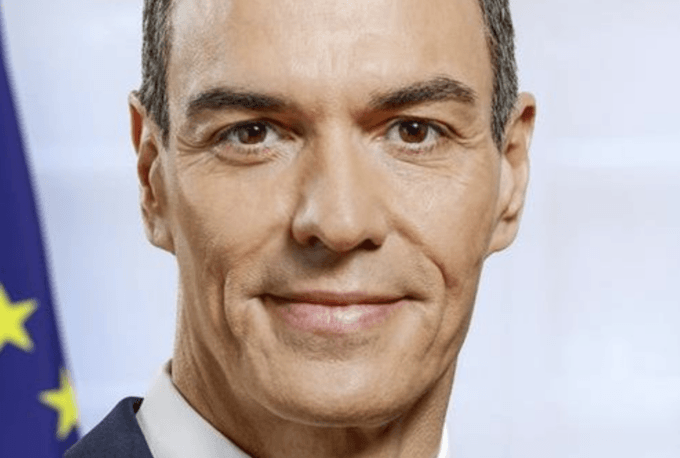
Image Wikipedia.
Pedro Sánchez, The Knight of the Sad Countenance
It’s a curious time to be alive. An almost never-before-seen moment where you can utter one word and perhaps 90% of the world’s population will associate it with the exact same thing — well, in this case, person. Don’t believe me? Let’s try it.
Petulant.
See? Your brain immediately drew the same orange-tinged image. And those who didn’t make the same association were either busy looking up the meaning or wrestling with a more fundamental literacy problem.
This word is particularly effective, but what’s even more surprising is that the same magic trick works — to varying and increasingly disturbing degrees — with a remarkable range of adjectives. Try: boorish, loutish, braggadocious, amoral, bungling, cretinous, doltish, kakistocratic, mendacious and pandering.
It still works. Every. Single. Time. With the grim reliability of a coin that only has one side.
In fact, in a poll taken in 2017 of his own constituents — his people, his base, the ones who’d presumably spent the most time in close spiritual proximity to the great leader — the ten most common words offered were: “incompetent,” “arrogant,” “strong,” “idiot,” “egotistical,” “ignorant,” “great,” “racist,” “asshole” and “narcissistic.”
His own countrymen could only produce two semi-positive adjectives (we’ll forgive the nouns). One could have been used to quantify their dislike, while the other — strong — requires some squinting. Mussolini was considered strong. Idi Amin was considered strong. History is littered with strong men, and the wreckage they left behind is not generally what their admirers had in mind when they used the word.
But there is one adjective you would never associate with this man. Not under any constellation of circumstances.
Quixotic.
For that, you need to come to Spain.
Because here is where the story gets strange and beautiful and somehow inevitable — the way all the best stories do when you’ve had enough of the bad ones.
Four hundred and twenty years ago, a broke, maimed tax collector named Miguel de Cervantes sat in a debtor’s prison in Seville and conjured the greatest novel ever written. He invented a deluded old gentleman from La Mancha who read too many chivalric romances, went magnificently, gloriously mad, and rode out to defend justice in a world that had long since stopped believing in it. Don Quixote de la Mancha. The Knight of the Sad Countenance. The man who charged windmills because he couldn’t look at injustice and do nothing.
The world laughed at him. That was the point. That was always the point.
What Cervantes understood — from his prison cell, with his crippled hand, with the full weight of the Spanish Empire’s hypocrisy pressing down on him — was that the only truly mad thing is to look at the machinery of power grinding people into dust and conclude there is nothing to be done. The windmill doesn’t care that it’s a windmill. It will kill you anyway. But you ride at it. You tilt at it. Because the alternative is to become the machinery.
This is not merely a book. It is a national operating system. It is the source code of the Spanish character, burned into the cultural hard drive over four centuries of reading, staging, arguing about, and living alongside this impossible, infuriating, magnificent man on his broken horse. Every Spanish schoolchild absorbs it (though unfortunately the school system murders it). Every Spanish adult carries it. The collective unconscious of this peninsula is stitched together with the thread of Quixote’s utterly impractical, utterly necessary honor.
Which brings us to this week. Which brings us to right now. Which brings us to the other afternoon in Madrid when a tall, thin Socialist from the province of Ávila stood at a podium and did something so straightforward, so preposterously simple, that the entire geopolitical order short-circuited trying to process it.
He said no.
The sequence of events, for those just tuning in from whatever rock of comfortable detachment you’ve been living under: the United States and Israel attacked Iran. The bases at Rota and Morón — in the sun-baked south of Andalucía, American-operated on Spanish soil since the days when Franco was still alive and shaking hands with Eisenhower — were lined up to serve as launching pads and refueling stations for the operation. Pedro Sánchez looked at this request and invoked, with the calm clarity of a man who has read his Cervantes, the United Nations Charter.
Spain’s government had the audacity to say that those bases could only be used for activities consistent with the United Nations Charter. In shorthand, for legal actions.
The reaction from the other side of the Atlantic was immediate and perfectly, almost artistically, on-brand. “Spain has been terrible,” came the verdict, delivered in the Oval Office, in front of the German Chancellor (a supposed EU partner), to reporters and the assembled dignity of the free world. This was followed by the announcement that the United States would cut off all trade with Spain, that it would have “nothing to do with Spain.”
Nothing to do with Spain.
Let that sentence wash over you for a moment. Nothing to do with the country that gave the western hemisphere one of its dominant languages, its legal traditions, its architecture, its patron saints and most of its culinary relationship with olive oil and garlic. Nothing to do with the country that invented the very concept of international law — through Francisco de Vitoria, the Dominican friar who first articulated the rights of peoples against conquest, writing in Salamanca in 1532 — a full century before Hugo Grotius, whom the textbooks credit. Nothing to do with the country that, just to complete the historical irony to a pitch of perfection, first colonized and then lost an empire partly because it couldn’t restrain its own imperial ambitions.
Spain knows something about empire. Spain has been one. Spain has been what the empire leaves behind.
And so here is Pedro Sánchez, el guapo as some American news networks once branded him — a man nobody thought was particularly heroic when he first scraped his way into the Moncloa palace through parliamentary arithmetic and baroque coalition-building — suddenly embodying something that the moment required and most of the world’s leaders were too cowed, too bought, or too comfortable to provide.
He stood before the cameras and summarized his government’s position in three words: no to war. “It is the same position we have maintained in Ukraine and also in Gaza,” he said: no to the breaking of international law, and no to the assumption that the world can only solve its problems through conflict, through bombs, through brute strength.
Read that again. The same position in Ukraine. The same position in Gaza. This is a man applying a consistent principle — the radical, apparently career-ending notion that international law should apply to everyone, including the countries powerful enough to ignore it. In the current political climate, this is roughly equivalent to standing up in a crowded theater and shouting that two plus two equals four and then being considered a madman.
“The question is not whether or not we are in favor of the ayatollahs,” Sánchez said. “The question is whether or not we are on the side of international legality and, therefore, of peace.”
He even reached back, unprompted, to the ghost that haunts this country. He warned against repeating the mistakes of the past — the Iraq War, the Azores Trio, the weapons of mass destruction that were never there. He named it directly. He reminded us: we have been here before, we know how this ends, and it ends badly for everyone except the people who started it.
Spain in 2003 had José María Aznar, a man who flew to the Azores to pose for photographs with George W. Bush and Tony Blair and essentially sign Spain up for an illegal war that its population opposed by margins of 90%. The streets of Madrid, and the entire country, filled with millions of people. Aznar ignored them.
A few months later, the trains.
Sánchez remembers the trains.
The reaction from Madrid to this week’s trade threats was not panic. It was not capitulation. It was something that, if you squint at it from the right angle, looks almost like dignity. The Spanish government stated that any review of the relationship must respect “the autonomy of private companies, international law and bilateral agreements between the European Union and the US.” Spain’s second deputy Prime Minister Yolanda Díaz went so far as to announce that the country would not accept “blackmail or lectures from an aggressor state.”
An aggressor state.
Said out loud. Into microphones. By an official of a NATO member country about its largest military patron. The Emperor was in fact disgustingly naked.
We are living in a world where the Overton window has been so thoroughly detonated that the phrase “aggressor state” now describes the country that invented the Overton window. And yet, astonishingly, polls indicate nearly three-quarters of Spaniards hold negative views of the administration making these threats, the vast majority believe its policies pose risks to global stability. This would mean that Sánchez is not charging this particular windmill alone. He has an entire country of Sanchos on his side, and Sancho, let us remember, was the one who actually knew what was real.
The Spanish right, the same that so happily went to war in Iraq, are appalled. Their opposition performative at best and simply groveling at worst. The political heirs of Franco’s regime have never really been all that comfortable with the idea of international law and human rights and have all piled on against Sanchez’s decision. Their patriotism rests mainly on waving flags and wearing little flag ribbon bracelets while looking for ever more ingenious ways to defund public systems and squander their money in tax havens. Quixote they are happy to leave bleeding out in airless classrooms. The book was never meant for them anyway.
Here is the thing about Quixote that people always get wrong: the book is not a comedy about madness. It is a tragedy about the gap between the world as it is and the world as it should be, and the particular kind of courage it takes to keep insisting on the latter even when everyone around you is pointing at the windmill and saying: just walk away, old man. It’s just a windmill.
The man in La Mancha didn’t walk away. And in the strange, funhouse-mirror logic of 2026, in the week that a 79-year-old property developer-turned-president sat in the Oval Office and told a sovereign nation that he could “do anything he wants” with it — I have the right to stop it. Embargoes. I’ll do whatever I want with them. I’ll use the bases if I please. — the spirit of the Knight of the Sad Countenance has apparently taken up residence in the Palacio de la Moncloa.
They called Quixote mad. They always call them mad, the ones who ride at things they have no business riding at with equipment that cannot possibly be adequate to the task. The broken lance. The rusty armor. The horse that is barely a horse.
But across the centuries, in the telling and the re-telling, something strange has happened to our understanding of who was truly deluded in that story. It was not the old man who believed the windmills were giants. It was the world that had decided giants could not exist and that the only sensible posture was to grind grain and keep your head down and not make a fuss about the machinery.
Pedro Sánchez is not Don Quixote. He is too pragmatic, too political, too much a creature of the parliamentary deal and the morning press cycle to be mistaken for a literary archetype. He knows his time will soon be up as the global far right wave threatens the Costa del Sol and all behind it. He is padding his resume for the well-paid Amnesty talk circuit and maybe a cushy teaching position at a progressive University (if any remain standing).
But in this particular moment, in this particular confrontation, he is doing the thing the book was written to honor: riding at the thing that cannot be defeated, because the alternative is to be the thing that does the grinding.
The windmill is enormous. It has nuclear weapons and a trade surplus and a commerce secretary who visited a convicted sex traffickers island with his wife and children. It has spent the better part of a century building institutions designed to ensure that its windmill-ness is never effectively challenged. Pedro Sánchez knows the windmill is a windmill. He tilts anyway.
But even so, it turns out that there is, somewhere in the genomic memory of the country that invented the idea, a man on a horse.
Ride on, caballero. The whole sad, beautiful world is watching.