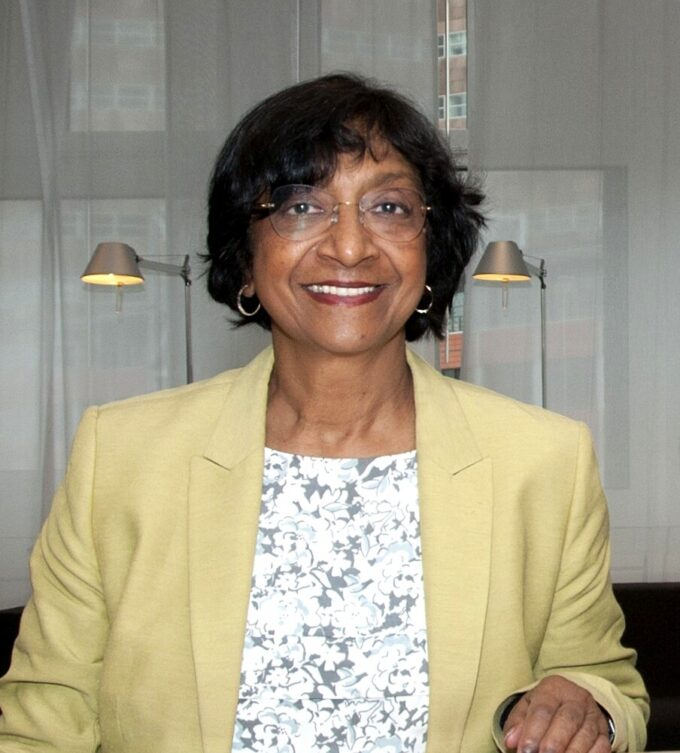
Justice Navi Pillay. Photo: Dutch Ministry of Foreign Affairs.
Judge Navi Pillay’s Nobel Peace Prize award on October 9 was a rare bit of very good news. “If you clap a little bit more, I may share this prize with Trump,” she said, laughing, alongside Nuremberg Forum members in Germany, upon hearing the news. She was attending a commemoration of the Nazi war-crimes prosecution that ended in October 1946. Pillay’s willingness to attack broader socio-political conditions reflects a long history of fusing ideological radicalization and practical reforms.
Yet at the very same time, a xenophobic movement – ‘March and March’ – was rioting and burning cars both in Pillay’s native Durban and in Johannesburg next to South Africa’s Constitutional Court. The vigilantes were both trying to influence the November 4 municipal elections (and will do so again and again in the next few weeks), and specifically protesting the state’s new implementation of a ConCourt ruling that empowered immigrants through a more generous interpretation of asylum regulations.
And the same day, their own Zulu nationalist leader, 84-year old Jacob Zuma – who was SA President from 2009-18 – was reported to be on his last legs at a KwaZulu-Natal hospital. If he passes on, that could inflame matters further this week, requiring a more extensive army deployment to the province.
These local crisis conditions mean Pillay’s sudden high profile could help society figure out what to do next, to shift momentum back to progress. But her global role is vital, too. The lead organizer of South Africa’s Boycott Divestment Sanctions campaign, Roshan Dadoo, explained:
South Africa is the largest exporter of coal to Israel, fuelling genocide, ethnic cleansing, illegal settlements and the military-industrial complex. Scandalously, just last month, the South African government granted an Israeli oil company, Navitas Petroleum, offshore oil and gas exploration rights in the Orange Basin, off our west coast. We urge our government, in honour of Nobel Prize laureate Navi Pillay, to immediately implement policies of academic, cultural and sporting boycott, to impose an embargo on sales of South African coal to Israel and a ban on all trade that benefits the economy of genocidal Israel, including the rejection of Navitas Petroleum.
Since August 2025, Glencore and African Rainbow Minerals – the latter owned by Patrice Motsepe, who is President Cyril Ramaphosa’s brother-in-law and potential replacement – have been supplying close to 100% of the coal that the Israeli genocidaires need to run around a fifth of their own grid. The two firms’ export contracts with Israel are more than two decades old, including a period before 2014 when coal-mining tycoon Ramaphosa himself was in league with Glencore to sell to South Africa’s electricity parastatal, Eskom.
Not all the great leaders of the anti-apartheid movement – like Ramaphosa, who was the founding president of the National Union of Mineworkers and then African National Congress (ANC) General Secretary before losing an internal battle to succeed Nelson Mandela, to Thabo Mbeki – have such fast-disappearing ethics. Pillay is among the most principled.
Increasingly respectable radicalism
An active 85-year old judge, Navi Pillay witnessed apartheid’s racial, class and gender oppressions at a young age, one of eight children in a low-income Indian ghetto of Durban. Her grandparents cut sugar as indentured laborers, and her father drove a municipal bus.
Pillay began her social justice career as a working-class student cadre of the quasi-revolutionary Non-European Unity Movement in Durban during the early 1960s, in spite of most nationalist anti-apartheid leaders of Indian origin refusing to join due to its radicalism. She shook off the Unity Movement’s purist ‘militant abstentionism’ and went on to start her own law firm in 1967 when Durban’s white-run firms refused her employment applications for predictable racist reasons – although she was the local university’s top student.
Pillay then learned courtroom tactics while defending heroic anti-apartheid activists including armed guerrillas from the New Unity Movement in 1971, the imprisoned Mandela and others from the ANC in 1973, and members of (Steve Biko’s) Black Consciousness Movement from the mid-1970s. In the 1980s, in addition to earning a Harvard law doctorate, she co-founded an office committed to women’s defence against domestic violence.
In 1995 she was nominated by Mandela to join a UN tribunal on the 1994 Rwanda genocide. As its chair, she guided a crucial ruling against one defendant (Jean-Paul Akayesu) which established rape as a feature of genocide that had not been previously recognised. By 2003, Pillay rose to the very highest ranks of global jurists at the International Criminal Court in The Hague, where she worked for five years.
Her United Nations work on Palestine and Burma has been formidable. At the ongoing Independent International Commission of Inquiry on the Occupied Palestinian Territory she has not hesitated to term Israel attacks on Palestine as genocidal.
From 2008-14 as UN High Commissioner for Human Rights, she twice expressed outrage at Burma’s (Myanmar’s) treatment of the Muslim Rohingya people by the army. Then in 2020 she ruled against a government led by her fellow Nobel Peace Prize laureate Aung San Suu Kyi (from 2016-21, prior to a military coup); since 2019 Pillay has served the International Court of Justice (ICJ) on The Gambia v. Myanmar, the other ICJ genocide case under consideration.
Acrophobia
Pillay has also looked hard at the xenophobia that has long raged in rightwing-populist South Africa, including in 2015 at the Isipingo neighbourhood near her South Durban childhood home of Clairwood. Xenophobia was first noticed as a major problem shortly after Mandela became president in 1994, but his successor Mbeki arrogantly denied its existence in late 2007 – resulting in mass violence six months later. Nearly all the immigrant victims were from neighbouring countries: hence ‘Afrophobia’.
Pillay led a local commission in 2015 that began to reverse her prior support for the Pretoria government. For in 2010 she had remarked from a faraway UN perch,
South Africa has taken some steps in the right direction to address aspects of its migration problems. The creation of a High Level Inter-Ministerial Committee on xenophobic violence against non-nationals is a welcome development. Moreover, the South African Police Services are working with the UN to understand and tackle the root causes of anti-migration sentiment and to establish appropriate mechanisms to combat violence.
All this occurred under Jacob Zuma’s rule, and in retrospect Pillay’s framing appears overly-optimistic. Today, the police insist on bribes if they meet immigrants – even with formal paperwork in order – in streets like those of bohemian Melville here in Johannesburg, which I’ve witnessed twice in the last six months.
And today, Zuma’s Zulu-nationalist support base takes the form of the ANC-breakaway ‘MK Party’ (named after the largest black military force against apartheid prior to 1994, uMkhonto weSizwe). It garners 15% support in the national polls, and will potentially win the mayorality of its stronghold Durban next month.
In the same city, Zuma-supporting rioters in July 2021 did massive damage, and 350 lives were lost (and $3 billion in damage) in episodes of arson, looting, stampedes and pogroms. MK Party leaders are explicitly supportive of the March and March Afrophobes, providing one of four driving forces behind South Africa’s locally-distinctive proto-fascism.
(Three others that may in future align are the Afrikaner fanatics claiming they suffer oppression and even ‘genocide’; the evangelical Zion Christian Church members who – facilitated by Motsepe – are ardently pro-Israel; and the ‘Smutby Group‘ network combining smut and rugby, led by mining-billionaire heir Rob Hersov who firmly supports the main xenophobe in the current Government of National Unity, Gayton McKenzie of the Patriotic Alliance.)
Of course, the police and other state agencies never dared ‘tackle root causes,’ which include massive and rising unemployment (more than 43% this year), a housing crisis that pits current residents against immigrants, retailer chaos in low-income areas (where immigrant wholesale bulk-buying networks undercut local spaza shops), and South African corporate subimperialism in the region which results in blowback against refugees suffering from Johannesburg extractive corporations and climate criminals.
(Another feature of hometown degeneracy is that the Durban street where Pillay grew up – Houghton, in Clairwood – has for years been under a double wrecking-ball attack: industrial rezoning by an uncaring Durban municipality, and an invasion of container trucking depots that are ripping out 120-old homesteads. The latter process is largely due to the incapacity of the fast-privatizing parastatal Transnet railroad, which has lost vast market share to truckers abusing the roads and back-of-port zone. Hence Transnet’s Durban harbour infrastructure is rusting away, while expansion of port-petrochem activities is continually resisted by local activists.)
Pillay’s global ripples
One reflection of the potential importance of Pillay’s role came hours after her prize: the oft-compromisedInternational Criminal Court (ICC) – which to its credit did finally get around to issuing arrest warrants for both Vladimir Putin (in 2023) and Benjamin Netanyahu (in late 2024) – was paid a kind of tribute by U.S. Secretary of State Marco Rubio. He applied extreme financial sanctions confirming that, as Trump himself bragged this year, “We’re like pirates… We’re not playing games.”
The ICC and ICJ do have an aspiring protector against naked yankee imperialism: the Hague Group of a dozen countries formed in 2024 to support international justice. However, as Middle East Eye reported last week, that network is fading, not only because of the right-wing electoral wave sweeping Latin America, ousting three member-states since March: Colombia, Bolivia and Honduras. Also, Ramaphosa’s hypocrisy in permitting genocide fuel for Israel (resulting in war profiteering by his own family), in spite of the promise to ban exactly that.
With Hague Group co-chair South Africa blatantly violating the network’s commitment without accountability, why would anyone take it seriously (even if committed staff at Progressive International make up its secretariat)?
Pillay’s Nobel Peace Prize is certainly of great value to progressives in South Africa today. To be sure, the often-nonsensical character of Oslo decision-making is revealed in its award to several serious imperialists – Teddy Roosevelt, Henry Kissinger, Barack Obama, the European Union – and three Israelis: Menachem Begin, Yitzhak Rabin and Shimon Peres.
Leaders from the periphery and semi-periphery have also engaged in brutal acts after winning the Peace Prize: Ethiopia’s Abiy Ahmed, Burma’s Aung San Suu Kyi and apartheid’s FW de Klerk. Or a stupid act, in the case of 2025’s right-wing Venezuelan winner María Corina Machado, who cravenly donated her physical prize to the narcissist Trump, but then got nothing in return after he kidnapped Nicolas Maduro and Cilia Flores on January 3. One banker who in 2006 incongruously won the Nobel Peace Prize, did enormous damage to poor people through predatory microfinance: Mohammed Yunus (subsequently the de facto leader of Bangladesh).
In an essay celebrating Pillay, Matt Meyer from the International Peace Research Association – also a Nobel nominee this year – spells out the awkwardness of Oslo’s see-saw strategy. So in contrast to those dud winners, three other great South African Peace Prize laureates – Albert Luthuli, Desmond Tutu and Nelson Mandela – fought tirelessly for political liberation. And Tutu also fought for economic liberation after 1994, often against Mandela, who became a free-trade neoliberal at Mbeki’s insistence, never applying the BDS strategy against Israel that had worked so well for the ANC and international allies during the fight against apartheid.
Another chance for global justice
However, on that front, a ray of hope shines within the country’s largest working-class organization, the Congress of South African Trade Unions (COSATU), which holds a major conference this week. The 1.6 million member federation will not only choose leadership and decide whether or not to support Ramaphosa’s ANC in the municipal elections across the country – a task that split the federation last month. More positively, a compelling conference resolution stands before the workers:
To campaign for the immediate and complete prohibition of all South African coal exports to Israel. The federation shall campaign for the Department of Trade, Industry and Competition to utilize its existing legislative powers to prohibit all South African coal exports to Israel. COSATU shall actively engage its affiliates in the relevant sectors, to campaign for and implement the non-handling of South African coal destined for Israel.
If passed, and if action accompanies words, it would be long overdue. Thousands of South African mineworkers’ labor entails coal digging for Israeli power plant consumption – even though a $98 billion ‘Just Transition‘ fund should prevent workers’ income losses if halted. Rail, truck and port transport workers facilitate coal movement to the Richards Bay harbour and then to Israel’s Hadera and Ashdod ports. Other mineworkers provide diamonds. And grape pickers and packers near Cape Town ensure autumn harvests sweeten genocidaire mouths.
An ossified COSATU is likely to disappoint, if indeed the conference occurs. But there are other impressive social resistance campaigns now struggling in unity, e.g. against Israel’s Navitas on the country’s Atlantic Coast. One huge battle was won in the ConCourt in August against offshore methane exploration by Shell and a local Zionist oil man.
Following Pillay’s lead, such ongoing campaigns do have the potential to link struggles for Palestine solidarity, Pan Africanism (Siyafana Sonke and Kopanang Action Against Xenophobia), labor democracy,climate justice, marine conservation, women’s safety and working-class households’ electricity access.
So even if Pillay has operated mainly within legalistic, slow and often useless UN institutions the last 30 years, a revival of her longer-term progressive traditions could provide more durable inspiration. For as grassroots fascism rises here, seemingly inexorably within the most unequal country in the world, with no hope of solutions from Ramaphosa and his corporate friends, and as Trump, Rubio and their ilk push the contradictions of their own vacillating paleoconservative/neoconservative/neoliberal versions of imperial capitalism to the breaking point, here at least is a stable rock to lean on for leverage: Navi Pillay.