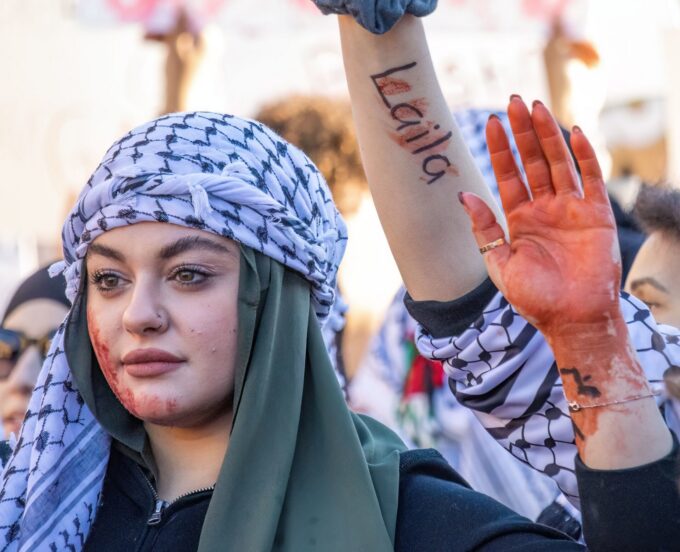
Photograph Source: Becker1999 – CC BY 2.0
With Israel’s genocide in Gaza and the continuing land grab and current killing of Palestinians in the West Bank, we see the shocking support of these atrocities by many feminists, liberals and progressives in the West. The pushback many of us get when we question the inhumane and disproportionate murder of Palestinians is that Hamas started the war and they are using their own civilians as human shields. These objections have now become strawmen and have already started to crumble in the face of reports of human rights violations coming from within Israel, from B’Tselem, from reporting by Haaretz, and more recently shown in the film, Naza.
No more can people call the Instagram videos of Gazans filming their own killing as fabricated. Nor can people continue to ignore the early exhortation in January 26, 2024, from the International Court of Justice that Israel was violating the Genocide Convention. Nor can they ignore the International Criminal Court in November 2024, which stated that Israel intentionally committed war crimes in Gaza, depriving the population of food and medicine vital to their survival, and issued arrest warrants for Israel’s Prime Minister Benjamin Netanyahu and former defense minister Yoav Gallant for crimes against humanity. What’s more, calling pro-Palestinian activists, or, for that matter, anyone who criticizes the genocide as antisemitic is a trope that has lost its zing, for it weaponizes the term to mask censorship of criticism of Israel’s inhumane policy. Most people in the US know that Israel cannot continue its genocidal attack without US support in arms, technology, and ideology.
One of the first articles that came out on why supporting Palestine is a feminist issue was by Maryam Aldossari in Al Jazeera. She says, “Selective silence [of feminists] challenges the universality of feminist solidarity. Especially when it comes from prominent feminists who many others look up to, silence becomes a form of complicity. Do you believe your silence on the tragedy of Palestinian women has gone unnoticed? I hate to break it to you, but your silence is deafeningly loud, and has stripped your work of any credibility in the eyes of many.” This was followed by the Feminist Humanitarian Network, which states, “Women and children are disproportionately affected by genocide, war and conflict. They face not only the direct impacts of violence, but also the compounded effects of patriarchal oppression. Their voices are often silenced, their suffering overlooked, and their rights systematically denied.” As a feminist who applies the principles of intersectionality to my analysis of political and social issues, I have been greatly troubled with the feminists around me who are either silent about the genocide in Gaza or silence those who speak out about it. Many are PEP or Progressive Except for Palestine.
But when I speak to my African American and indigenous peers, or feminists from the Global South, they connect immediately to the situation of Palestinians; no explanations needed. Since the 60s and 70s, Black feminists saw themselves as part of an international black population, which included British and French colonies, and had insight into structural racism and classism. So when liberal feminists fail to see the global nature of our fight for liberation, we are left with a feminism that fails many. As Ta-Nehisi Coates says in his book, The Message, when he saw the barbed wire and the checkpoints in Israel disenfranchising Palestinians, he knew and felt this apartheid in his bones; it mirrored his ancestors who suffered enslavement in the US, in the segregated South.
Liberal feminists fail to connect the current censorship in the US and the illegal arrests of immigrants by ICE agents to the suppression of speech about Gaza in Israel and the livestreamed genocide that is supported by most Israelis. Beinart’s latest report, based on the film Naza, is that it is the liberals in Israel, more than the right wing, who provide the algorithms for killing Palestinians; they say they are only cogs in the system, i.e., the machinery of expulsion and ethnic cleansing. Ring a bell?
These were the same words used by the Nazis when they were questioned about their crimes of exterminating the Jews in concentration camps. Hannah Arendt in her book on the trial of Eichmann, talks about “the banality of evil”—that Eichmann and the Nazis were ordinary human beings who were following orders; they were not monsters but thoughtless functionaries, and this is where we see the banality of evil—their refusal or their inability to critically think about these orders and have agency. In fact, feminists can pay attention to Arendt’s theory that “demands a rethinking of the notion of moral responsibility, by claiming that every human being not only holds the potential to eradicate evil, but has the responsibility to do so, through the power of critical thinking.”
Arendt was criticized for her words, but today her words ring truer than ever. As feminists, we have learned from our history that we create agency and help other men and women become agents and battle against oppression. We learned from feminists from the Global South and from indigenous and African American feminists how to apply the principles of intersectionality to address intersecting and layered oppressions, and have difficult dialogues across differences but never to become cogs in some system, whether patriarchal, capitalist, or any other. We teach our children to be critical thinkers. So why in the world would we fail to question a government’s position regarding the inhumane and unjust acts of a State, or ignore the suffering of men, women and children who are being harmed, whatever nation they belong to, or even if they were stateless?
Right now, many liberal or progressive feminists in the West fail the litmus test of feminism when they erase the crime of Israel’s genocide in Gaza from their position. Then, whatever rights they stand for become meaningless. For example, when we talk about reproductive health for women in the US and about how this should be available to women across the world, but we fail to care about the fact that pregnant women in Gaza were dying during childbirth or were bombed or received C-sections without anesthesia, or we don’t see why Israel’s bombing of IVF clinics in Gaza is relevant to our stance, we fail in our advocacy for reproductive rights. In this manner, all our positions regarding equal work, equal pay, education for the poor and for women and girls, clean water, reducing emissions and so on become fluff when we don’t apply the yardstick of rights to Gaza and the West Bank. Feminism cannot be selective. When the US is supplying arms to a foreign country to kill a population, brokering Israel’s use of advanced technology, which includes highly toxic materials in bombs, to kill humans and vegetation, destroy the water supply, pollute the air with lethal emissions, we are all implicated in this violence. What kind of feminism can be silent in the face of such destruction?
The National Organization for Women, the largest and oldest feminist organization in the US, failed to put out a statement against the genocide in Gaza or call for a ceasefire, even though it put out an urgent statement condemning Hamas soon after the October 7, 2023 massacre of Israelis by Hamas. NOW was clearly selective in its support, revealing that it valued some women’s lives but not all. Meanwhile, the Global Fund for Women and the National Women’s Studies Association put out clear public statements condemning the genocide and appealing for ceasefire. NOW revealed its priority for walking toe-to-toe with the mainstream Democrats. Similarly, Kamala Harris would rather not lose the Israeli lobby’s support when her campaign would not allow a Palestinian to speak at the Democratic Convention, even though it allowed a Republican anti-abortionist to!
In September 2026, when Gloria Steinem died at the age of 92, tributes from around the world poured in praising her as a feminist icon. I admired Steinem for her wonderful feminist work. She was highest in my esteem, for she applied principles of intersectionality (before the word was used) that she had learned from feminists of the Global South, especially India, and from African American feminists, from the Combahee River Project, Angela Davis and bell hooks. I was dismayed that she would support Zionism and not utter a word against the genocide of Gazans. Fatima Bhutto describes Steinem’s support for Zionism since the 1970s. Bhutto mentions that in 1975 at the UN World Conference, Steinem attacked the women who condemned Zionism! Fawzia Afzal-Khan goes further to show how corporate and imperial support to feminist causes is bound to lead to a failure of feminism. While the second wave advocated for labor rights and reproductive rights, it “remained exclusionary,” Steinem did not see Zionism as racist. It is puzzling that she couldn’t discern that apartheid in South Africa, racial apartheid in the US, and oppression for Palestinians were all connected. She did not apply the principles for dismantling apartheid in South Africa to Palestine.
Feminists need to ask themselves if they wish to champion an imperial or a liberating feminism. Afzal-Khan states, “While acknowledging [Steinem’s] role in early visibility of issues like bodily autonomy and labor rights, her structural impact on global solidarity remains profoundly negative.” The answer to why she failed to connect the dots is the same as why NOW and Kamala Harris and other liberals do not speak out against the persistent human rights atrocity in Gaza: they would rather walk toe-to-toe with mainstream Democrats than lose their support of a foreign country and its organizations that support it, that flood money into their campaigns.
But the failure to see these connections is costing us dearly. We now experience iterations of what liberal feminists failed to condemn: we are losing our free press; we have masked federal agents on our streets arresting, shooting, and kidnapping civilians; our voting privileges are severely hampered; the list goes on.
But the tide is turning. We are witnessing our loud voices of protest against Israel’s genocide, ecocide, and scholasticide in Gaza and the illegal land grab in the West Bank becoming mainstream. Witness the leaders who are openly condemning genocide in Gaza and getting elected!!
Progressive feminists like Zohran Mamdani, Noura Erakat, Naomi Klein, Sunita Vishwanath (leader of Hindus for Human Rights), Yashika Dutt (who brought the anti-caste bill to the New York Senate this year), Fawzia Afzal-Khan (who stood up to her college that failed to support the student group, Students for Justice in Palestine), and several others (the list is long and growing) give us hope that feminists supporting Palestine are indeed speaking up for all women and the vulnerable against the forces of military, patriarchal and capitalist oppression. This kind of feminism is not new in the US. James Baldwin, June Jordan, Angela Davis, and other black intellectuals in the 1970s and 80s have spoken volubly on freeing the bonds of oppression of Palestinians from Israel’s imperial policy of apartheid, dehumanizing them.
Whenever people speak out about Palestinian oppression, they are immediately countered with “what about Oct 7th”, as though support for one tragedy cancels out support for the other. Progressives understand that we can hold two truths at the same time. In addition, Jews are not a monolith. They hail from different cultures around the world and do not share the story of the holocaust. For example, my book on the Jews of Kerala describes the unique history of Jewish migration to Kerala in the 3rd century AD and in the 15th century AD and their life within a multicultural tapestry of India where they experienced peaceful coexistence with other faiths.
It is imperative in this climate of political strongmen globally to practice a progressive intersectional feminism. As the censorship of people speaking up against Israel’s genocide in Gaza, brokered by the US administration, became virulent, I realized how difficult it is to be heard. But each of us can find ways to practice our feminist ideals. When I found dialogue with “liberals” impossible, I started a substack newsletter where I wrote about Palestinian writers. This is my way of engaging with the history of Palestine that has been widely suppressed over the decades following 1948. My involvement with organizations such as Multicultural Solidarity, South Asian activists in the academic community, Hindus for Human Rights, and local immigrant groups have helped me find solidarity with Palestinians fighting an oppressive occupation.
A feminism that ignores imperialist-patriarchal-militarist power, that turns a blind eye to civilians being killed, that colludes with the government or a political party to silence women is not feminism. Even if you are not a feminist, if you are a human being, you would not support the genocide of Palestinians, or any people for that matter. You would heed Audre Lorde’s words, “I am not free while any woman is unfree, even when her shackles are very different from my own.”