From my memoir, COUNT TIME:
The toe tag is next. Psychologically for me this is the most difficult part. Now this cold and lifeless body has a name. Up until this point, I have been telling myself that the body is an object that needs to be moved.
I start to ask questions. Who was this person? Does he have a family? Who are his people? I ask myself what if that was me? That’s when I realize that I must respect him. I must respect the dead and finish my job, which is to wrap him and get him to the morgue.
I fill out his information and attach the toe tag to his left big toe.
I was twenty-two years old when I started a job that changed my life, forever. My training to do that job was two shots for hepatitis A and B and an old instructional VHS tape. Between early 2011 and July 2012, I wrapped close to a hundred bodies at Lake Butler, Florida’s Reception and Medical Center.
Of course, I wasn’t paid for my work. Florida is one of seven states that don’t pay wages for the majority of prison jobs (The Guardian). I’ve written about that labor and where it goes, including the unpaid line I worked stripping Florida Highway Patrol cars, and the Army regulation that puts it in plain English, inmate labor “at no direct labor cost to the Army.”
I’ve written about the wrapping of the dead too, and what it did to me, and that’s coming out shortly in Inquest.
This isn’t that essay.
This one is about one body out of the hundred. What the paperwork said, and about who filled out that first piece of paper on a dead man in Florida custody.
It was me.
Unpaid, undertrained, and twenty-two years old.
Remember that, because everything that follows comes down to a question about records. I was the first hand that ever touched one.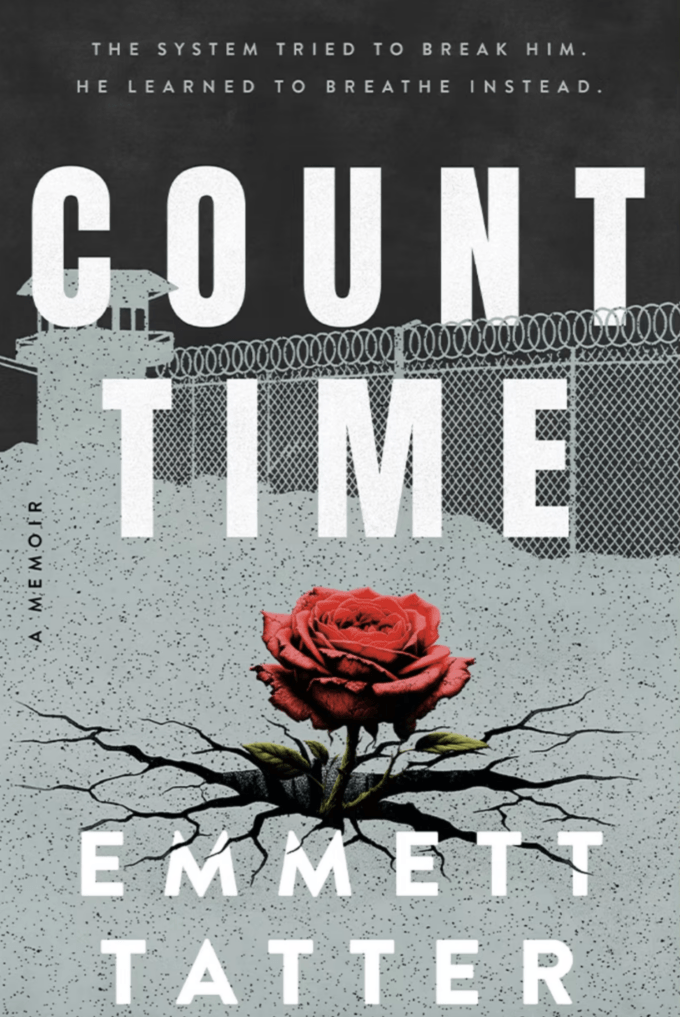
Not all those hundred were suspicious, and I’m not going to pretend otherwise. Lake Butler is the system’s medical hub. Sick men from every prison in Florida get sent there. Plenty of them get sent there to die. Lake Butler treats cancer, heart disease, AIDS, tuberculosis; you name it, and they are there.
A few deaths had me wondering.
The last one I ever wrapped came out of confinement. When the officers told me to wrap him, of course, I asked what happened. They told me he hung himself in confinement. He was a young Black male, who looked healthy and strong. The strangulation marks on his neck were very suspicious. The sheet had been taken off his neck by the time he got to me. The bruise marks were closer to his jugular and weren’t high-up near his cheekbones. It made me wonder if that was how it really played out. Other inmates had told me the officers would kill you that way and make it look like a suicide. Those marks made me shiver.
I want to be careful right now. I’m not a doctor. And I never have been a doctor in any capacity.
But…
Here’s what the forensic literature says about the difference. A 2025 review on telling suicide from concealed homicide in unclear deaths states it directly: “In hanging deaths, usually the ligature mark is angled from bottom to top and front to back (96%) and is positioned above the thyroid cartilage under the jaw (in 62% of the cases) … This pattern is one of the main signs of hanging differentiating it from ligature strangulation, where the ligature mark runs horizontal and often under the thyroid cartilage” (Psychiatry, Psychology and Law, 2025). A study of 166 hanging cases found the mark above the thyroid cartilage in 77.1 percent of them and running at an angle in 97.59 percent (Journal of Medical Society, 2022).
High under the jaw and angled upward is a man hanging. Low and level across the throat is, well, something far different.
That same study is the reason I won’t take it further than wondering. It found the mark sitting at the level of the thyroid cartilage in about 23 percent of hangings and below it in about 6 percent, and the forensic textbook it works from says the mark falls below the cartilage in about 5 percent of cases, and that when it does, it tends to be a partial hanging, a man who never fully left the floor. A low mark isn’t proof of anything. But it’s damn suspect. It’s the reason a death gets called unclear instead of closed.
Which is the only thing I’m asking about him.
Did anybody with training ever look at that young man’s neck?
In Alabama, of twenty-eight closed death investigations, fifteen had no autopsy at all (University of Alabama at Birmingham). In Florida, the same summer I wrapped him, Darren Rainey died in a shower at Dade Correctional Institution (Miami Herald).
I wrapped him, this young, strong looking Black man, I filled out his tag while studying all his tattoos. I wrapped him up with my friend Flaco. I put him in the damn refrigerator.
I’ve wondered about that neck for fourteen years.
A day or two later, and it might have been the same day, this happened.
I wrote an article about a murder with CounterPunch called Clack, clack, clack. I remember one day I was inside the A-1 side’s dorm, which had a view of a sidewalk all us inmates called Interstate 95 that went from one end of the compound to the other. From my dorm you could see J-dorm through the windows. It’s a dorm where they hold psych patients and other medical holds at Lake Butler Main Unit. One day all of us inside the dorm witnessed a man push out of the grasp of officers from J-dorm. This inmate was losing it (it being a psych dorm, that wasn’t a surprise), but what we observed; that was the shocking part. The officers start punching the man and land a clean blow to the side of his head that drops him on his ass. Another officer kicks him in the chest, flinging him back so his head smacks against that unforgiving concrete. You think it would have ended there, but it didn’t. These three officers started to stomp him. One of them was jumping in the air, landing right on the man’s head. Brutal yes, but common, even if it screws with you seeing it, it never doesn’t affect you. At least it always affected me. Sad but true, this is normal inside these walls, and all of Florida’s correctional institutions.
I was transferred for inciting a riot, that was really a peaceful sit-down protest. What caused it was my friend; a great Black friend of mine was brutalized by officers when his family called the prison to report that he was being targeted by officers.
I’ve changed his name here to keep him safe. In COUNT TIME I call him Ringwald, so I’ll call him Ringwald here.
Well, he was being targeted, which was no secret to any of us, but his family made a pretty big mistake calling the prison up to help him. The department sent him to PC (Protective Custody) because of that phone call, and meanwhile all the officers that were reported learned of it, just so happens when they let my friend back out on the compound from confinement, guess where he was heading? He was being sent right back into the arms of his very torturers, and they couldn’t wait to get a hold of him. Three officers waited for him when he got to the officers’ station so he could enter the dorm. They were the ones that must unlock the door to allow him entrance. But that isn’t what happened. I wish it was only that. They blocked his path to that door and stood before him. He put his hands up to his chest as a way someone says, “I don’t want any problems.”
The officers moved closer, and one stood right in front of his face yelling at him. Then out of nowhere he slapped my friend hard in the face, which made him stumble backwards and like sharks smelling blood, the attack was on. They rushed him. They pushed him out from the officers’ station door entrance out into the hallway. Me and about forty other incarcerated men were witnessing this from the dayroom, and probably another forty from A-2 side. My friend was quick and went to run away, but then he realized he was locked in the entire hallway area with nowhere to run, so resigned he turns and puts his hands up, one last time. It was like watching a movie in slow motion. They were upon him like bulls with horns, ripping at him and beating him, and spraying him with their Black Jesus chemical spray. My friend tried to work with the blows and evade others but the pepper spray to his face stopped that. What happened next still messes with me.
The largest of the officers picked him up and slammed him to the ground and the beating continued. All of us were screaming and trying to get the officers to stop, “Y’all motherfuckers are killing him,” but I don’t think they gave one damn about that. Their punching and heavy kicks were getting the best of my friend and his body was beginning to grow weak. What happened next was disgusting. One of the officers jumped high into the air and landed his boots right down on his bald Black head. Once was bad enough, so when more complimented the first, I grew despondent and frantic. I remember screaming at them to stop and marching to the officers’ station door and started to bang on it, attempting with all my might to get them to stop. I was so angry I started to kick that damn door that was blocking my path to help my friend. With each kick, I wailed.
Kick. Kick. Kick. Kick.
My foot was starting to hurt by how hard I was kicking the door.
Kick. Kick. Kick, Ki… and the door flung wide open with a bang.
I was just as startled as the one officer who a second earlier was punching Ringwald. I remember both our eyes locking together.
I didn’t know what to do!
But I couldn’t, not help him.
All of us who were witnessing this were just saying we would help, screaming at the officers to stop, saying we’d kill them as we watched Ringwald’s beating and sure death before our very eyes, made me know in my heart… you have to stop them.
Now Emmett. Go Emmett, now! Right the fuck now!
I lunged forward, but someone behind me put me in a choke hold and all the men who said they would stop this horror were pulling me back into the dayroom and dragging me to the dorm area where the bunks were. I was screaming and crying for them to stop. They kept saying, “they will kill you too Tatter”, and I was broken.
Last thing I remember was the officers getting up from Ringwald’s lifeless form and then, him slowly closing the door. The same officer I had locked eyes with seconds before.
This fucker still held my gaze.
Then the door closes.
Ringwald’s family picked up a phone to protect their son. The prison told the officers who’d been named. Then the prison walked him back to them.
That’s the sentence I’d like people to sit with, because the rest of this article is that sentence with paperwork attached.
Yeah, we protested, and it was the next time those officers came back on shift when everything went down. They worked twelve-hour shifts that rotated with the other squads and with their days off, so it wasn’t the next day, it was their next day. All of us said we wouldn’t lock down during count if they brought those officers back. That night of that beating we raised hell and a captain had to come down to the dorm and talk everyone from the ledge or scare everyone enough with threats, along with his gang of officers ready to hurt someone. Four hundred of us incarcerated planned to protest the incident if they allowed those officers back on shift. But when we saw them walking down Interstate 95 to our dorms, we knew they were still going to work the shift. Time to see where the rubber meets the road. And it was disappointing. Fear is a real motivator for people with great intentions to back down. Out of the four hundred only twenty-five other guys and I refused to lock down for count and the shift change.
That day I learned what torture truly is.
They called it, inciting a riot. Twenty-six men sat down and refused to go back to our bunks for count. That was the riot.
I was transferred out of Lake Butler Main Unit to confinement at the Suwannee Correctional Institution Annex that July, and my job wrapping bodies ended the same month.
I don’t have to ask anybody to take my word for any of that, because the Department wrote it down and later handed me the paperwork.
The printout is titled internal movements and job assignments during incarceration. It shows me arriving at R.M.C. Main Unit on November 15, 2010, for reception and orientation. It moves me to the West Unit, makes me a houseman (even though I never really had a job at the West Unit) that December, and then on January 7, 2011, it lists my assignment for both the morning and afternoon shifts as ORDERLY-INFIRMARY. Same on January 13. Still ORDERLY-INFIRMARY on September 20, 2011.
That was my first real job in the DOC. The infirmary orderly is the one who cleans the blood, moves the patients, wraps the bodies, and fills out the toe tags. Florida typed my title into its own record and kept it on file for thirteen years.
The same page ends my time at Lake Butler. July 25, 2012, Suwannee Correctional Institution Annex, assignment both shifts, CONFINEMENT-ADMINISTRATIVE. July 26, the same. Then August 3, 2012, it changes to CONFINEMENT-DISCIPLINARY.
Administrative confinement is where they hold you while the disciplinary report gets written up and they do a mini-investigation. Disciplinary confinement is where you go once it’s done. Their own paper dates my punishment for the sit-down to July 25, 2012, which puts the beating and the twenty-six of us refusing count the days right before it.
Which means the last body I ever wrapped, the young man whose neck I’ve been thinking about for fourteen years, came through in July 2012, before the twenty-fifth.
Here’s what Florida says about who died at that prison in those weeks.
In September 2014, after the Miami Herald went after them over prison deaths, the Department of Corrections put every death in Florida prisons since 2000 on the internet, listing prisoners by name, prison, race, and manner of death (Tampa Bay Times).
Open the page for the Reception and Medical Center and the oldest death listed is January 2, 2017 (Florida Department of Corrections, facility 209).
Everything before 2017 is off the site. Darren Rainey’s year. Randall Jordan-Aparo’s year. Every single body I wrapped and delivered to the morgue.
The only reason any of it can still be read is that the Internet Archive kept a copy of the Department’s own data file. That copy holds 3,788 deaths, from January 3, 2000, through October 8, 2014, each with a name, a DC number, a date, a prison, a manner of death, and whether the case was closed (Internet Archive capture, October 15, 2014). A later capture of the same file begins in 2013.
Nobody had to sign an order to make 2012 disappear. The Department’s own page said its counts cover “the previous 5 fiscal years” (Florida Department of Corrections, Inmate Mortality). The Incarceration Transparency project at Loyola University’s law school in New Orleans, which tracks deaths behind bars state by state, describes Florida the same way, death information available for “the five prior fiscal years” (Incarceration Transparency, Florida). The page kept only the recent years, so the oldest ones fell to the wayside every summer.
One more line on the archived page is worth reading. A death is listed as pending when the Department hasn’t received the medical examiner’s conclusions, and while it stays pending, in their words, “until such time the name of deceased will be withheld” (Florida Department of Corrections, Inmate Mortality).
The deaths that take the longest to explain are the ones without a name on them.
Crazy, right?
From Florida’s own archived file: 176 people died at R.M.C. Main Unit in calendar year 2012. One prison, one year. Statewide that year Florida recorded 324 prison deaths, which matches the federal count exactly (Bureau of Justice Statistics). Of the 324, the Department called 298 of them natural.
At R.M.C. Main Unit, between July 1 and July 24, 2012, six men died. Florida’s own file dates them July 5, July 18, July 20, July 22, July 23, and July 24.
That last one is the day before the Department put me in administrative confinement at Suwannee.
Every one of the six is recorded as Natural. Each one is recorded as Closed. Their names are in that file and I’m not printing them, because I’m not putting doubt on six families to make a point.
Across the whole stretch from May through August of 2012, fifty-seven people died at that prison, and exactly one is recorded as anything other than natural. That one died on May 27, weeks before the man I carried, and his case is marked closed with an investigative summary that the file says exists. The link to it now sends you to the Department’s homepage.
Twelve years after I left, a man was left paralyzed at that same prison, and the medical examiner ruled his death a homicide. Craig Ridley, sixty-two, had been at the Reception and Medical Center for nine years. In the twelve hours after he was attacked, three RMC nurses and a prison physician all cleared him to be put in solitary confinement rather than taken to a hospital. He stayed in solitary five days, unable to move or eat, until he developed sepsis and was rushed out, and he died in a hospital a month later. His autopsy confirmed he had been paralyzed from the neck down the entire time, reporting by The Florida Trident found (The Florida Trident, republished by WGCU).
The Herald reported that more than 90 percent of Florida prison deaths are deemed natural, at a higher rate than in comparable states, and that “there is no way to glean if the classification is justified” (Miami Herald).
Calling a death natural does more than describe it. NPR reported that federal prisons characterize “at least three-quarters of all federal prison deaths since 2009” that way, and that “by deeming the death natural, prison authorities were not required to conduct an autopsy,” while 70 percent of the people who died in federal prison over thirteen years were under sixty-five (NPR). Washington State has its own word for it. Its corrections department can call a death expected, which skips a public report, and of thirty-three deaths in Washington prisons in 2023, ten were autopsied (The Seattle Times).
I’m not telling you those six men were killed. I have no idea. Most of the hundred I carried died the way the state said they died.
I’m telling you that I was the infirmary orderly, that Florida’s paperwork says so, that one of the men I carried in July 2012 had marks on his throat that didn’t sit where they should have, and that Florida’s paperwork says every man who died in that building that month died naturally.
Both of those documents came from the same department.
There’s a third document, and my mother kept it for fourteen years.
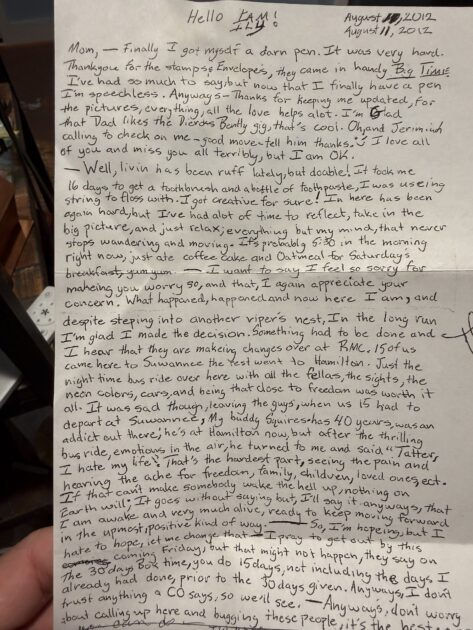
On August 11, 2012, seventeen days into confinement at the Suwannee Annex, I wrote a letter to her. I was twenty-four. I wasn’t a writer yet, I wasn’t building a case, and I had no idea anybody would ever read it but her. The spelling below is mine, exactly as I wrote it that morning, mistakes and all.
It opens with a joke about a pen. “Finally I got myself a darn pen. It was very hard.” Then this:
“Well, livin has been ruff lately, but doable! It took me 16 days to get a toothbrush and a bottle of toothpaste, I was useing string to floss with. I got creative for sure!”
Then it gets to why I was there:
“What happened, happened and now here I am, and despite steping into another viper’s nest, In the long run I’m glad I made the decision. Something had to be done and I hear that they are makeing changes over at RMC. 15 of us came here to Suwannee the rest went to Hamilton.”
Fifteen of us to one prison, the rest to another. They split us up and shipped us across the state.
The letter says what the punishment was, too. “The 30 days Box time, you do 15 days, not including the days I already had done, prior to the 30 days given. Anyways, I dont trust anything a CO says, so we’ll see.”
The part I’d forgotten until I read it again is about the bus. I wrote that the night ride was worth it, the neon colors and the cars and being that close to freedom, and then this:
“It was sad though, leaving the guys, when us 15 had to depart at Suwannee. My buddy has 40 years, was an addict out there, he’s at Hamilton now, but after the thrilling bus ride, emotions in the air, he turned to me and said ‘Tatter, I hate my life.’ That’s the hardest part, seeing the pain and hearing the ache for freedom, family, children, loved ones ect. If that cant make somebody wake the hell up, nothing on Earth will.”
I wrote that at twenty-four in a cell, flossing with string, three weeks after carrying the last body of my life to a refrigerator.
Fourteen years later I’m still asking the same thing, and nobody has woken up yet.
Here’s what I understand now that I didn’t understand then.
Florida knows exactly how to count us.
In 2015, Florida’s own Office of Program Policy Analysis and Government Accountability had the Department of Corrections reviewed. Regarding counting prisoners, the reviewers wrote that the purpose of the count procedure is “to establish guidelines for the uniform inmate count reporting system, ensuring the accountability of the inmate population within the custody and control of the Florida Department of Corrections.” They found that “there are eight formal counts conducted in any 24-hour period. During hours of movement, a formal count is taken within every 4-hour period.” Their conclusion: “Count procedures are detailed and adequate to ensure accountability,” and the procedure “was found to be consistent with national standards and best correctional practice. Count records reviewed at the facilities are properly maintained, and there were no violations of the count procedure observed” (OPPAGA, November 2015).
Eight formal counts every twenty-four hours, and more after that. On the master roster count you hold up your ID, sit upright facing forward, and say your name, your DC number, and your bunk. Mine is V19743. I counted it out once and I came up with something over fifteen thousand counts across my sentence.
Eight times a day, no violations are observed.
Dade Correctional Institution was one of the prisons they reviewed. Dade is where Darren Rainey died in June 2012. The counting was fine there. The dying took almost two years to reach the public, nobody was ever charged (The New Yorker), and his family settled a civil rights suit against the state of Florida and others for $4.5 million in 2018 (Miami Herald).
Twenty-six of us declined to be counted and the answer came in days. A man died in a shower and the answer took years.
My book is called COUNT TIME.
What follows is imagined. I want that clear before you read a word of it.
It’s a tape that doesn’t exist, a conversation that never happened, made of things that did. One serial killer talking to another one in a different state, giving him advice. Every brag in it is followed by the document that proves the brag is available to anybody who wants it. I made up the voice. I didn’t make up a single fact in it.
I’m the one who counts.
Reviewers came and watched me do it, and they wrote that my records are properly maintained (OPPAGA).
When one of them stops breathing, I’m the one who investigates it.
Florida law gives the Florida Department of Corrections its own inspector general and its own investigators, with the authority to investigate inside its own prisons (Fla. Stat. 944.31).
They changed that on me in 2024. Doesn’t matter much.
That’s true, and I’m going to say it before somebody says it to me. In 2024 the Legislature amended the statute to require a memorandum of understanding with the Florida Department of Law Enforcement for suspicious deaths (ch. 2024-84). A department that had been investigating its own dead for decades now has a piece of paper about calling somebody. Watch what that changes and watch what it doesn’t, because changing it up a fraction while continuing the same shit is what these departments are best at.
The same year, Florida made autopsies harder to see. A new law made an autopsy report confidential and exempt from the state’s public records law when the manner of death was suicide, leaving access to a surviving spouse, then surviving parents, then adult children and siblings. The Legislature wrote into it that “the exemptions in this section shall be given retroactive application,” because the exemption is “remedial in nature” (ch. 2024-18). Before it passed, Barbara Petersen of the Florida Center for Government Accountability said of it, “I understand its purpose but am a little worried it might be used as a means of covering up questionable deaths” (Florida Politics).
Suicide is what the officers said those marks on that man’s neck were.
Take long enough and people stop asking.
Rainey died on June 23, 2012, and nearly two years later the medical examiner still hadn’t finished an autopsy, and nobody had been charged (Miami Herald). The state closed it with no charges in March 2017 (NPR).
Do it right and they move you up the chain of command.
In Alabama, a guard named Roderick Gadson was promoted from officer to sergeant six months after a prisoner in his care was beaten to death and promoted again to lieutenant twenty-one months after (The Guardian).
Florida does it too.
The ones who get caught are cannon fodder.
A Florida officer stood trial over the beating of Ronald Gene Ingram, a sixty-year-old diagnosed schizophrenic who was kicked and beaten in a hallway with no cameras until twenty-seven of his bones were broken and his rib cage was crushed. Ingram was found dead in the back of a transport van. The jury cleared that officer on six charges and convicted him of a single misdemeanor count of culpable negligence (Tampa Bay Times). Three other guards admitted to the beating and agreed to twenty years (Miami Herald).
Anybody who tells must go.
After Randall Jordan-Aparo died at Franklin Correctional Institution, the investigators who tried to report it got investigated instead. The day after a state Senate committee questioned the chief inspector general about the case, inspector Doug Glisson was hit with six internal affairs investigations, then demoted, docked pay, moved into a tiny office, and put to work listening to prisoners’ phone calls (Tampa Bay Times). Florida settled for $800,000, paid Glisson, Aubrey Land, and John Ulm $133,333 each, exonerated all three, dropped every pending internal investigation against them, and moved them out of the agency (Tampa Bay Times). Rollin Suttle Austin, the lieutenant on it, went the other way.
“Austin was promoted after the Jordan-Aparo incident, from lieutenant to captain, and received a $3,000 salary bump,” the Herald reported. He wasn’t the only one, because “the commanders and a crew of other officers and nurses involved were never disciplined. Some of them were promoted and given raises” (Miami Herald).
And nobody’s adding it up on top of me.
Congress passed a law requiring states to report deaths in custody. The federal primer on it says that as of its writing the Attorney General had never used the penalty the law provides (Bureau of Justice Assistance). A Senate investigation covering fiscal year 2021 found at least 990 deaths in custody missing from federal data, and 70 percent of the records that did get submitted were missing at least one required category (U.S. Senate Permanent Subcommittee on Investigations). Reporters who got hold of the data later found 681 more missing (The Marshall Project). In August 2024 a federal judge ruled the Bureau of Prisons could keep most of its internal mortality reviews of deaths at two federal women’s prisons out of public view, and part of the reasoning on the record was that a bureau official had credibly established the reviews could be used to “criticize” or “ridicule” the agency, and that the review committee would be deterred “from acknowledging mistakes” if it feared those mistakes would be publicized (Reason). A review of state prisons found the death rate among state prisoners increased 47 percent between 2019 and 2024 (Reuters). As of 2024, nineteen states and the District of Columbia had an external, independent prison oversight body (Prison Policy Initiative). That count came off the national registry’s own map. The registry lists seventeen states and the District of Columbia today. The national registry that those numbers come from puts Florida in a separate group, the entities that “did not meet our criteria for independent external oversight” (National Resource Center for Correctional Oversight).
What does that even mean?
They call it speculation.
They call it speculation because they made it unprovable.
Now here’s the part I could have left out, and I’m putting it in on purpose.
The published record contradicts itself. Not on whether these men died. On the details. Every one of those contradictions is a gift to the department, because a fact that appears two ways in print is a fact a spokesman gets to call unreliable.
The scene where Randall Jordan-Aparo was found got printed two different ways in the same summer. In July 2014, the Florida Center for Investigative Reporting, working from the whistleblower complaint, described him found lifeless with “a Bible next to his head, his body coated with yellow chemical gas” (Florida Center for Investigative Reporting). In August 2014, the Miami Herald, working from the photographs, reported that “a paperback Bible was under his shoulder” and that his hair, legs, toes, torso and mouth “were dusted with a faint orange residue, a byproduct of the gas” (Miami Herald).
Neither outlet got it wrong. One was reading a complaint, and the other was looking at pictures, and both were working from whatever the department had let out of the building by the day they went to print.
On the shower that killed Darren Rainey there are three numbers, and this is the clearest example in the whole piece of what I’m talking about. Witnesses, including a nurse on duty that night, told the Herald the water had been cranked as high as 180 degrees from a neighboring room where the heat controls were (Miami Herald). The prison’s own health and safety inspector, Darlene Dixon, tested that shower two days after he died and got 160 degrees on full hot. The state attorney set her reading aside because she’d used a meat thermometer and because another staff member had measured 120 degrees. The Herald then reported that Dixon actually took her reading first, that the 120 came only after the hot water supply had been adjusted and the water retested, that earlier tests of the same shower had used a digital thermometer, and that Dixon had filed work orders more than once asking for the unsafe water to be fixed (Miami Herald). A 101-page report from the state attorney concluded that the officers who left him in there for nearly two hours committed no crime (Miami Herald).
Sometime around ten at night on September 6, 2013, guards at Mule Creek State Prison in California decided to take action against Joseph Damien Duran, and they sprayed him with pepper spray. He was dead within seven hours. His ashes were scattered at sea off the Marin County coast, and his parents didn’t learn he was dead until a Bee reporter called them four months later (The Sacramento Bee).
In Alabama, the guards’ account of how Steven Davis came to be beaten is that he refused to drop his weapons and tried to conceal another knife while being disarmed. Other prisoners who watched it said Davis had disarmed himself before the first guard ever reached him (Prison Legal News). Davis is the man who died in the case where the guard got promoted twice.
The Florida officer I mentioned above has been described in plenty of places as acquitted. He wasn’t. The jury said not guilty six times and then convicted him of one count of culpable negligence, a misdemeanor, and the judge credited him with the two years he’d already sat waiting for trial (Miami Herald).
I checked every one of those myself and I’m printing the disagreements instead of picking whichever version helps me.
Here’s what I think happens, and the reporters aren’t the problem. Anybody writing about a prison death starts from three things: what the department chose to release, what the medical examiner ruled, and what the writers before them managed to find out. The file is sealed, the people investigating it work for the department, and the witnesses who don’t wear a uniform are the ones nobody believes. Two honest reporters working from that will not come out with the same page. Then a spokesman picks up two of them, holds them side by side, and says the reporting can’t be trusted, when the reason it doesn’t line up is that the department decided who saw what and when they saw it.
There’s one more reason the paper reads the way it reads, and it isn’t the reporters and it isn’t only the department. It’s the officer standing there watching.
Officers who report other officers in Florida get taken apart. In May 2008 John Pisciotta was on a cell extraction team at Charlotte Correctional Institution in Florida, going in after a frail, mentally ill man who’d barricaded his door with his mattress. Pisciotta testified that the officers jumped on him, and that after the man was already handcuffed and in leg restraints another officer kept digging into his eye. Pisciotta said his bosses “wanted us to prepare statements and not say anything,” and he told them he couldn’t go along with it. He told the truth and the other officer was arrested. Somebody sprayed “Coward” in black across the side of Pisciotta’s home, damaged his car’s fender, and cut its transmission wires. After he testified, he was fired and lost almost everything: his home, his friends, his pension and his career. What he told the jury in 2009 was, “I knew once I did the right thing, and I stepped forward… my career would be over.” He kept going: “It’s something you don’t do. You don’t go against other officers. Because my life has been a living hell ever since” (Miami Herald).
The Associated Press found the same thing years later. Mark Caruso, a former Florida corrections sergeant, was fired and reinstated twice for reporting other officers. At his third prison somebody crossed his name off the employee bulletin board and wrote “SNITCH” over it, and another officer spit on his windshield. Officers who want to report a colleague are ostracized and called a snitch, and officers said plainly that they fear retaliation (PBS NewsHour).
Here’s the part of that reporting that goes straight to the paper itself. Officers told the Associated Press that in some Florida prisons supervisors tell them not to email their incident reports, to say it out loud or write it longhand instead, and then a superior officer types it up and picks the language (PBS NewsHour).
That’s what an officer is weighing, and it isn’t whether the thing was wrong. He knows it was wrong. He’s weighing a mortgage and kids at home and a pension he’s years into against what he already watched happen to the last man who said something, and plenty of them don’t like how the report reads and sign it anyway. Nobody has to threaten him. The department only needs to let everybody watch what happens to the one who talks. It isn’t death or injury the way it was for my friend in that hallway. It’s a career killed and a family that can’t pay the bills. They know how quickly the tables turn.
The other half is that fifty states investigate their own deaths their own way, classify them their own way, and report them on their own schedule, and no two do it alike. Getting all of that into one place would take an entire dedicated team.
What some people these days call “The Noise,” and I call “The Bullshit,” is three temperatures for one shower. Two colors for the same residue on the same body. A man printed as acquitted who was convicted. A death recorded as natural with no autopsy behind it. A family that finds out their son is dead because a reporter calls. Almost none of those are lies. Every one of them gives a spokesman something to point their grubby little finger at.
The killer doesn’t need the record erased. He needs that noise to be much louder.
I have to say something about the word prisoner.
Me, prisoner, but is that true? Is that all that I am? No. I am a lover, someone who enjoys nature and all the many creatures within nature. I am a fiancé, a dog and a rescue cat owner. I am a person who sees a hurt animal and will go out of my way to help it. I am a writer, an author, a journalist, a guest lecturer at colleges, a giver, a helper, someone who loves to read, works hard, and never gives up. I build and remodel houses and lay pavers, but if all we’re measured by are the titles others assign us, and if we only believe what others believe us to be, then what does that truly mean?
I admit prisoner is a dirty word. It sounds dirty. Convict, inmate, words that make everyone believe they’re less than literal humans. Less than a mistake that went, way South.
When an institution says this inmate died from natural causes and it isn’t true, when it was really a suspicious death, it only becomes the title of “inmate” the public hears and the desensitized narrative of others that we believe, especially when the investigation is done by the very agency or department that killed him.
These people that I lived with had families, parents, children, you name it, they had it, because yes, they committed a crime to get into prison in the first place, and so did I, but they were real people. I am a real person. Most prisoners made mistakes. They don’t deserve to have their deaths, or the torture endured during their sentence, to be lied about, because half the time and probably more than that it doesn’t have anything to do with them as people.
Tyrion Lannister delivers the famous “ominous they” line while speaking with Podrick Payne in his cell after Joffrey’s poisoning. He suspects his father Tywin, and he’s certain his sister Cersei had nothing to do with it. The true masterminds behind the plot are later revealed to be Littlefinger and Olenna Tyrell. Just because you can’t prove a conspiracy is happening beneath your nose doesn’t mean it isn’t very real and isn’t happening. And that’s what the “ominous they” depends on.
Dammit they’re good at this game.
I’m not advocating for monsters, but if you read my record and you didn’t know my own story most would probably think I was one too, yet I’m not. I love, I care, I have emotions and I also feel suffering.
Prisons across the United States are outside the purview of everything. They write the reports and decide what the story is, and the statistics on death, suicide, overdoses, and homicide are all done internally by the Department. It’s misinformation set to appease the public, and it allows the killer to keep on keeping on.
I never found out what happened to my friend that day.
The door closed and they carried him to confinement. Within days I was on a bus to Suwannee for refusing to be counted, and for years I didn’t know if that beating killed Ringwald.
He lived.
Kicking that door made them pause. The bloodlust broke for a second, and a second was enough, and then they cuffed him up and took him away.
Years later he and I both got transferred, from different prisons, and we ended up at the same facility. He walked up to me.
He thanked me. And he thanked all who stood up for him.
Somewhere in all those years, somebody had told him that twenty-six men wouldn’t stand for count after they dragged him out of that hallway. He’d been carrying that the whole time I’d been carrying not knowing.
He’s alive. There’s no toe tag with his information on it in my handwriting.
I want to do this work properly.
Fifty states, fifty ways of classifying a death, fifty reporting schedules, and a federal law with a penalty nobody has ever used. Somebody must sit down with all of it, state by state, and put the record in one place, including the places where the record fights itself.
That takes a dedicated team and the money to keep it running, and I would love the opportunity to lead it. I know what the paperwork looks like from the end nobody reports from. I filled some of it out.
Until somebody funds that team, this is what I’ve got. A hundred bodies, one neck I still think about, one door, twenty-six men who wouldn’t be counted, and a friend who’s still breathing.
Eight formal counts every twenty-four hours, and no violations observed.
Nobody can tell me how many of us died.