The Taiwan Pavilion fiasco at the 16th Gwangju Biennale made waves through the art world in early September as the Chinese curator and artists announced their withdrawal from the exhibition in protest of the use of the name “Taiwan Pavilion.” While headlines on one of Asia’s largest cultural exhibitions focused on the politics of the withdrawal, the content of the artists’ work went mostly unreported. In this interview, long-time collaborators Wan-Yin Chen and Che-Yu Hsu, two artists of the Taiwan Pavilion, discuss their work, House a, which explores the legacy of the 1960s Taiwanese nuclear program, which was supported by actors from Israel’s covert nuclear program.
Politics of Invisibility: An interview with Taiwanese artists Wan-Yin Chen and Che-Yu Hsu
The Background
The Gwangju Biennale consists of a main exhibition and a series of Pavilion sites located throughout the sprawling Jeonnam-Gwangju Special Metropolitan City in South Korea. This year’s Bienniale, curated by Singaporean Artistic Director, Ho Tzu Nyen, is entitled “You Must Change Your Life,” after the final line from a 1908 sonnet, “Archaic Torso of Apollo” by German poet, Rainer Maria Rilke. An emphasis on change—from the molecular and atmospheric, to the psychological and political—formed the ideological foundation for the exhibition, which opened on September 5.
Prior to the opening and without informing Taiwanese artists, exhibition organizers had used the acronym, “NTMoFA,” on the exhibition poster to represent the National Taiwan Museum of Arts, instead of the previously agreed-upon “Taiwan Pavilion.” In response, exhibiting Taiwanese artists, including Chen and Hsu, released a statement on social media: “Gwangju Biennale, rooted in democracy, human rights, and the spirit of Gwangju, has a responsibility to explain why participants’ right to name and identify themselves is subject to political restrictions.” Supporting South Korean artist collective, Artists’ Solidarity Against Censorship, released their own statement condemning the Biennale Foundation for their “political censorship.”
In the end, Taiwan was able to keep their name, and the China Pavilion withdrew from the exhibition, claiming that the use of “Taiwan” violated China’s One-China Policy. Jeonnam-Gwangju Special Metropolitan City then released an apology statement emphasizing that the name was “merely an expression entrusted to the participating artists within the realm of art” and did not mean that the city itself recognized Taiwan as a nation. In short, “Taiwan Pavilion” was simply a facade—an “artistic” layer that did not truly represent the diplomatic relations between South Korea and China. Biennale Foundation president, Youn Bum-mo apologized publicly and maintained that, “Art is art, and politics is politics. We urged everyone not to overlap the two and emphasized that this is a pure art event.”
On May 18, 1980, a peoples’ uprising broke out in Gwangju against the military coup of Chun Doo-hwan and installation of martial law. Korean military paratrooper units were deployed to crush the uprising, beating and massacring students and civilians in the street. Citizens organized, took up arms, and fought against the military in a multi-day street battle, running ad hoc mutual aid stations and blood banks while thousands were injured and arrested. Students ran printing presses in the street and burned down the television stations streaming state propaganda. In the aftermath of the uprising, citizens won several legal battles that led to imprisonment of the military leadership that ordered the massacre. This history is crucial to Korea’s democratic identity and has been thoroughly preserved in the May 18 Democratic Uprising Archives, now a UNESCO heritage site, in the center of Gwangju on the same boulevard where the massacres took place. This year, artists in the Philippine Pavilion exhibited their highly political works inside the 5.18 Archives.
On the opening night of the Biennale, kids were skipping rope, cruising on pedal-less training bikes, and grandparents were strolling with dogs to the sound of electronic DJs in the plaza, while artists chattered over a sushi buffet. In the background, James T. Hong’s video work, Apologies, featuring 11 hours of footage of state figures showing public remorse, was projected onto the building facade. As the global neoliberal art world descended on Gwangju, televisions were running news of Trump pushing Seoul to send troops to the Strait of Hormuz, which the Korean people vehemently protested, with president Lee Jae Myung refusing deployment by mid-September. It was with this political backdrop of names, apologies, and tense alliances that the Taiwan Pavilion opened the exhibition, “Instance Dungeons: Gray Zone,” with the aim of showcasing: “Taiwan’s tangled historico-political context and its geostrategic significance amid the global turmoil of the New Cold War structure.”
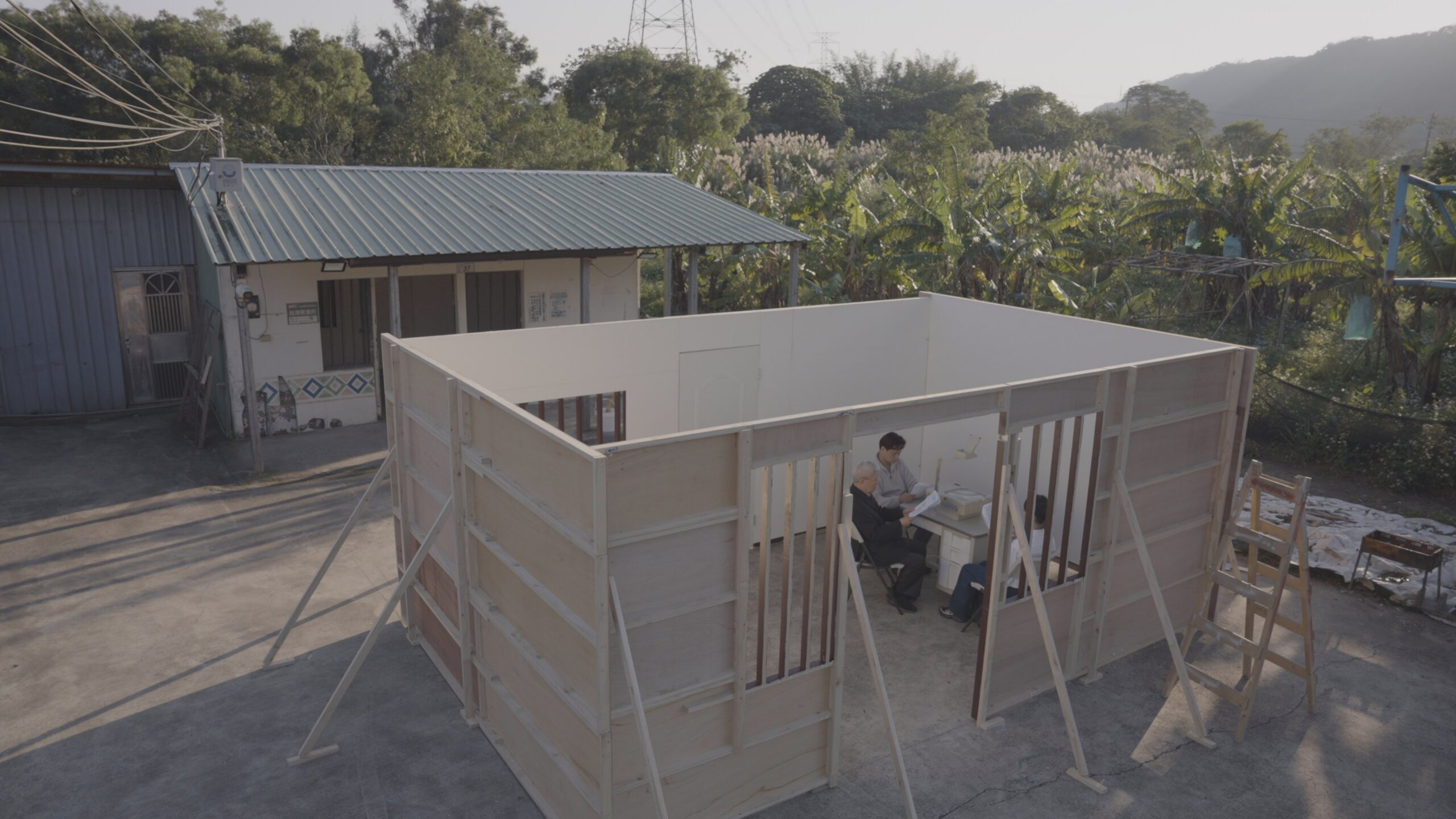
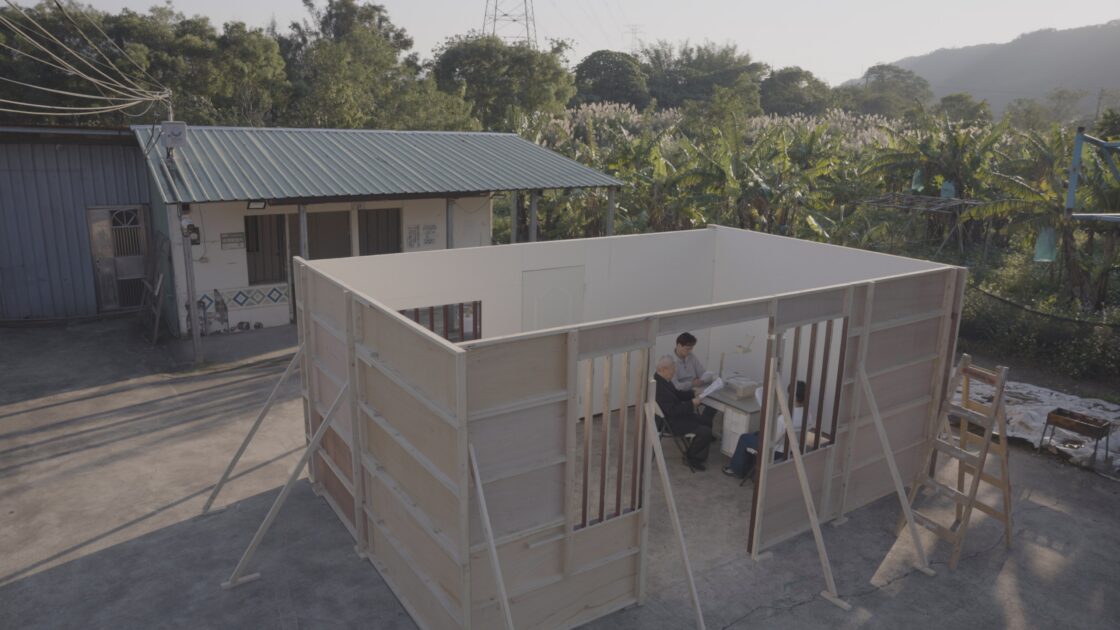
Still from House a, courtesy of the artists.
House a
Walking into the exhibition, the viewer is in the dark. In a room to the right, several screens play Po-Yuan Juan’s Grinding_tw, AI-generated first-person shooter gaming footage produced from scraped data from Taiwan’s military archives, including Chiang Kai-shek’s underground command post, and online forums and photos. Entering the gallery to the left, a massive spotlight tracks and follows your movement through the hall in Hsien-Yu Cheng’s Traced, an AI-powered, immersive commentary on surveillance employing computer vision and motion tracking. Screens of all sizes dominate each of the galleries, with viewers navigating a maze of video installations exploring war, technology, memory, resistance, queerness and the intertwining ethics of it all. AI is a central theme and tool for artists in the show, with Taiwan at the epicenter of the semiconductor battle unfolding across Asia. The rush to control not only all aspects of chip production, but all processes related to the AI supply chain, including the mining of rare earth minerals and construction of nuclear power plants to fuel data centers, is defining global politics.
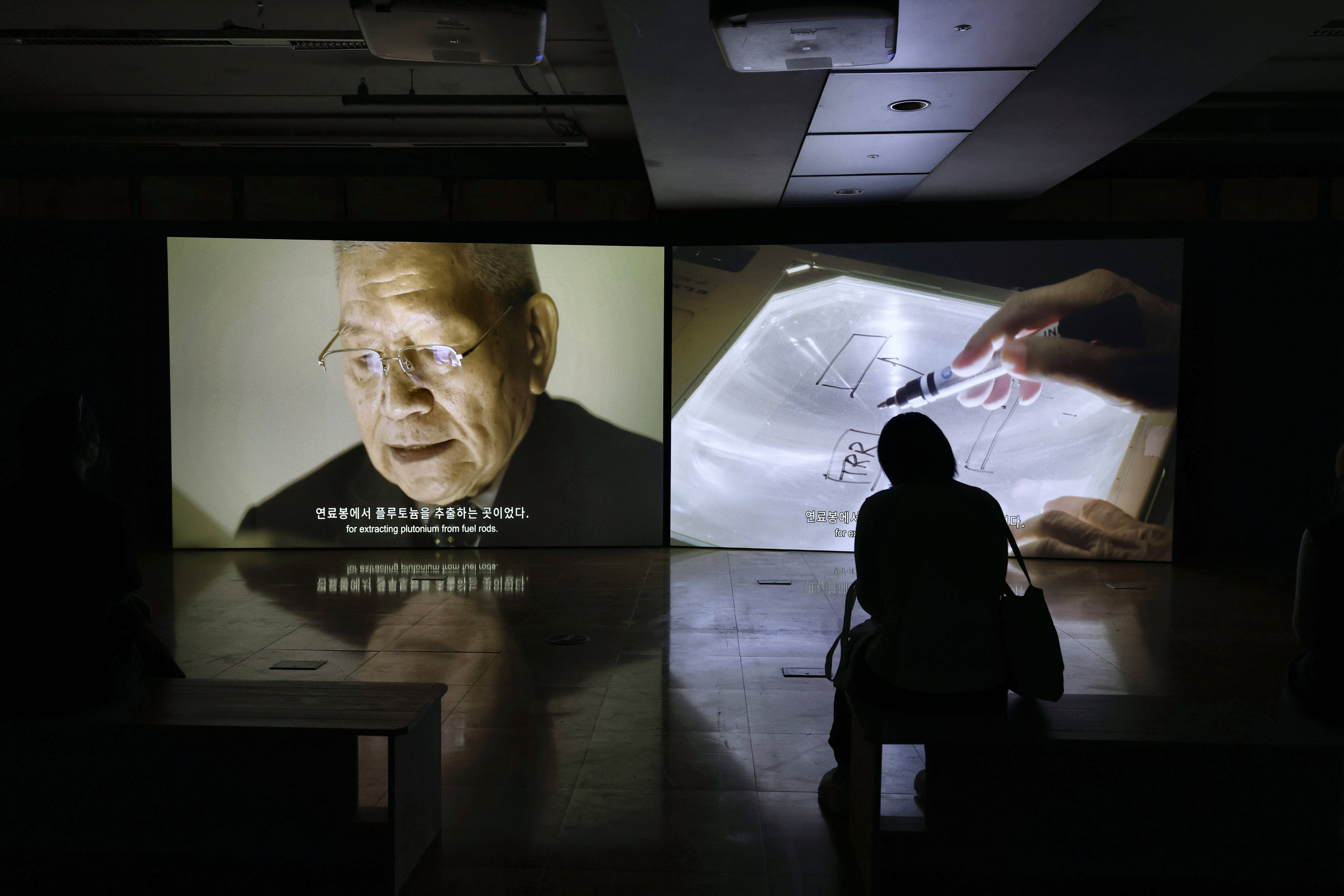
In the third chamber, Chen and Hsu’s film on Taiwan’s nuclear program, House a, appears. The film features various characters doubling and tripling their script, a constantly shifting camera perspective, and the deconstruction and reconstruction of a structure inside another structure. The characters move through scenes and across a large double screen, their words repeating, disorienting the viewer in space and time. The film is both dizzying and strangely mundane in its presentation of multiple realities. We move through the drawn and spoken memories of a nuclear scientist along with acts of celebration and protection by the Indigenous community that has been contaminated by the plutonium separation facility. Using AI, the artists visualized the scientist’s recollections of the facilities, now buried under thick layers of concrete. Haunting images of a plutonium-plant-that-was-but-was-never-exactly-like-this expose the highly classified nature of the nuclear industry and its ongoing and historical covertness. If a plutonium processing plant is made in the forest, but buried before we know about it, can it still hurt us? The impacts of long-term community radiation exposure are the same—terrifying, but imperceptible.
Through their research on Taiwan’s nuclear program, Chen and Tsu unearthed the relations between the Israeli nuclear weapons program and Taiwan’s nuclear development. “What interested us was that Taiwan’s reference to Israel’s nuclear program” they shared, “was not only about the technical or engineering aspects of nuclear facilities, but also about how a nuclear weapons program could remain concealed. In that sense, it also points to underlying political dynamics structured around a form of ‘invisibility,’ which is one of the themes we try to explore in the work.”
Wan-Yin Chen and Che-Yu Hsu responded to my questions via email:
Your film includes the participation of a former nuclear scientist recalling his
memories of the facilities and performing his narrative experience. Based on his
recollections, you generated AI images of what the entombed facility might look like
after it was filled with concrete. What was the process of your collaboration with the
scientist(s), from the concept to the filming? How did you conceptualize the script,
the multiple narrators and doubling and tripling of voices and characters?
Do you consider this an anti-nuclear work?
During the development of the work, we interviewed three scientists who had participated in Taiwan’s nuclear weapons program. At the time, they were respectively responsible for calculating atomic bomb explosions, nuclear waste disposal, and plutonium separation. One of them was David Ho, who also appears as a performer in House a. It is worth noting that although he holds a PhD in Nuclear Engineering, his postdoctoral research focused on expert systems, an early form of artificial intelligence. His work at the time involved using such systems to calculate and simulate nuclear explosions. His experience happens to resonate in a strangely coincidental way with the development of AI today, and this was one of the reasons we brought narratives concerning AI into the work.
To add some background to the piece. After leaving the nuclear weapons development program, David Ho became involved in the anti-nuclear movement. We were very interested in this shift from being a nuclear weapons developer to becoming an anti-nuclear public figure. The other two scientists, by contrast, continued to work for Taiwanese government agencies, where they were involved in the commissioning and
operation of nuclear power plants. In fact, during the period when we were filming,
the three scientists were serving as advisers to opposing pro-nuclear and anti-nuclear
camps at Taiwan’s Legislative Yuan, where they debated one another. In addition to
David Ho, the two younger performers who appear in the film had also been involved
in anti-nuclear cultural activism.
So yes, the work was indeed conceived from an anti-nuclear position. At the same
time, we felt that the complexity of the issue could not be reduced to a single position.
This is why we chose to bring together three different perspectives, the memories of
nuclear weapons scientists, members of the Indigenous community living on the once
contaminated land (who appear in the film building and dismantling the house) and
the younger performers, and allow their narratives to mimic, echo, and enter into
dialogue with one another.
The reason we chose to reenact memories of Taiwan’s nuclear weapons history at a
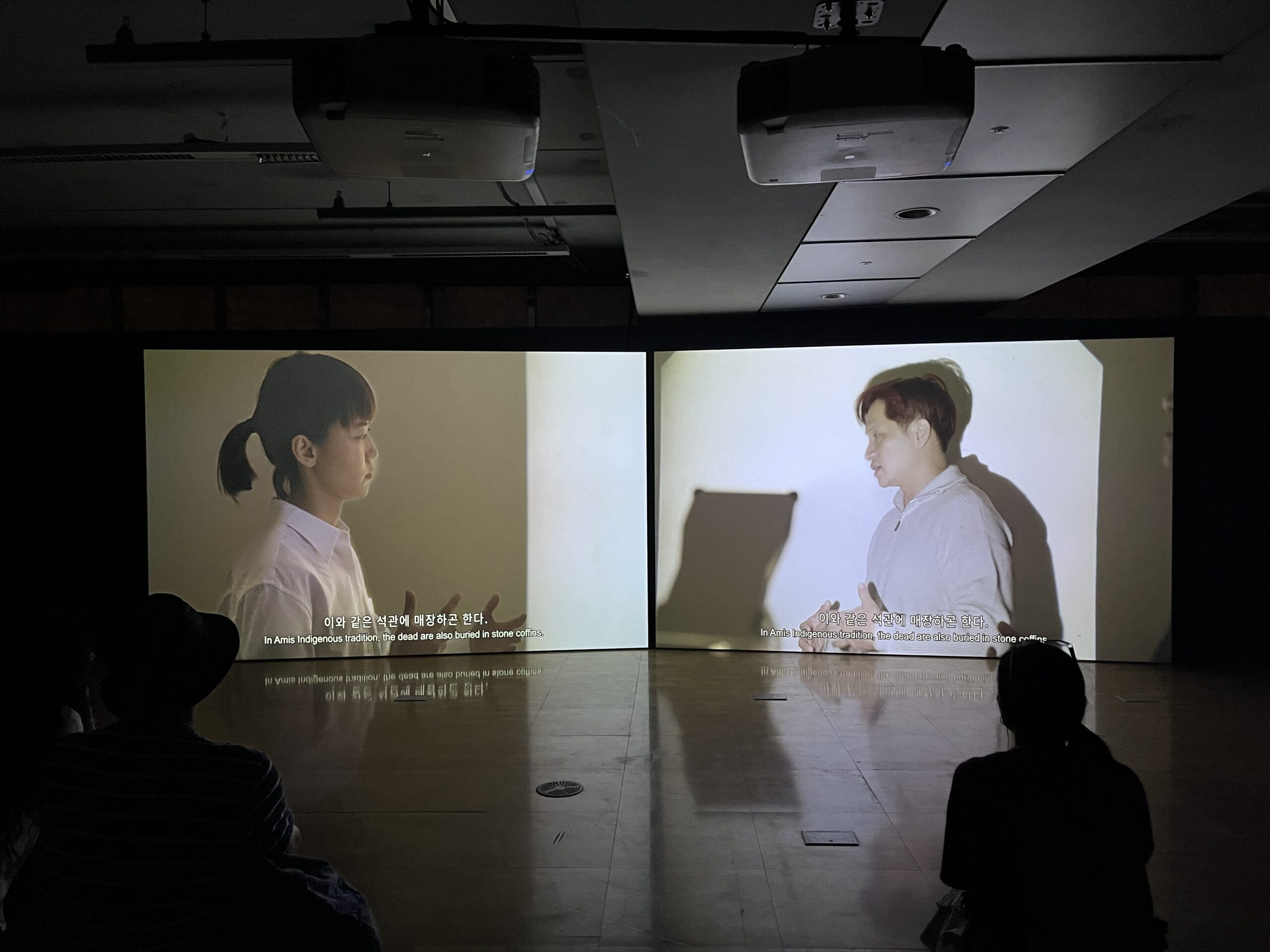
Still from House a, by the author.
gathering in the Amis Sawuazhi community, an area affected by contamination associated with the program, was also because this history emerged from the ideals of scientific modernity, while at the same time carrying profound reflection, trauma, and lasting scars.
House a is a structure that you built inside the Amis Sawuazhi community assembly house to “hold” the historical memory of the nuclear scientist. In what forms does the community’s collective memory and experience of irradiation appear in film?
The Amis Indigenous community appears in the film is based in an area that was affected by Taiwan’s former nuclear weapons program and exposed to radioactive contamination. It is also worth noting that, years later, this assembly house became one of the places where local residents organized protests and advocacy directed at the Taiwanese government over the issue of radioactive contamination.
As a site directly affected by nuclear contamination, the assembly house was originally built by members of the community in the 1980s. It was later renovated by the residents themselves, who constructed and overlaid a new wooden structure directly inside the existing building. In this work, we invited members of the community to once again build and replicate the interior space within the house, creating a third layer.
In the work, several community members, including the former chief of the community who had participated in its original construction, dismantle the completed third layer, “House a,” move it out into the square in front of the assembly house, and reassemble it there. Through this process, we are thinking about deconstruction and reconstruction of both the nuclear scientists’ memories and this particular history.
The question arises: “If a piece of land is covered with new soil, is it still the same
landscape?” Can you speak more to the theme of metaphorical and literal “encasing”
or “entombing” that you explore?
The plutonium separation plant was sealed in 1988 by being filled with concrete, turning it into a “negative space.” This immediately reminds us of Rachel Whiteread’s 1993 work House, in which she similarly used concrete to cast the interior space of a house. Cement and concrete themselves have many associations with nuclear technology. As mentioned in the film, concrete was used to encase the Chernobyl nuclear power plant after the disaster, and cement is also commonly used in the containment and immobilization of nuclear waste. We are interested in this material transformation from a malleable state to a solidified one, particularly in the associations between negative space, sculptural techniques such as encasing and entombment, and catastrophe.
In another video work of ours from 2023, Zoo Hypothesis, we looked at the incident during World War II in a zoo in colonial Taiwan, where they killed its large animals to avoid the chaos due to constant U.S. air bombing. Some of the animals were preserved as taxidermy specimens. In that work, we discussed the sculptural technique of hollowing out an animal’s body and then filling it again, connecting this process to the eruption of Mount Vesuvius at Pompeii, where victims were suddenly covered in volcanic ash and their bodies eventually left behind hollow cavities, the negative spaces associated with death.
In House a, we attempt to connect these sculptural techniques to political techniques of concealment. Whether through sealing a facility with concrete, or through excavating contaminated soil after an accidental explosion involving nuclear materialand then covering the site with new soil, these processes can be seen as techniques that make the memory of disaster invisible.
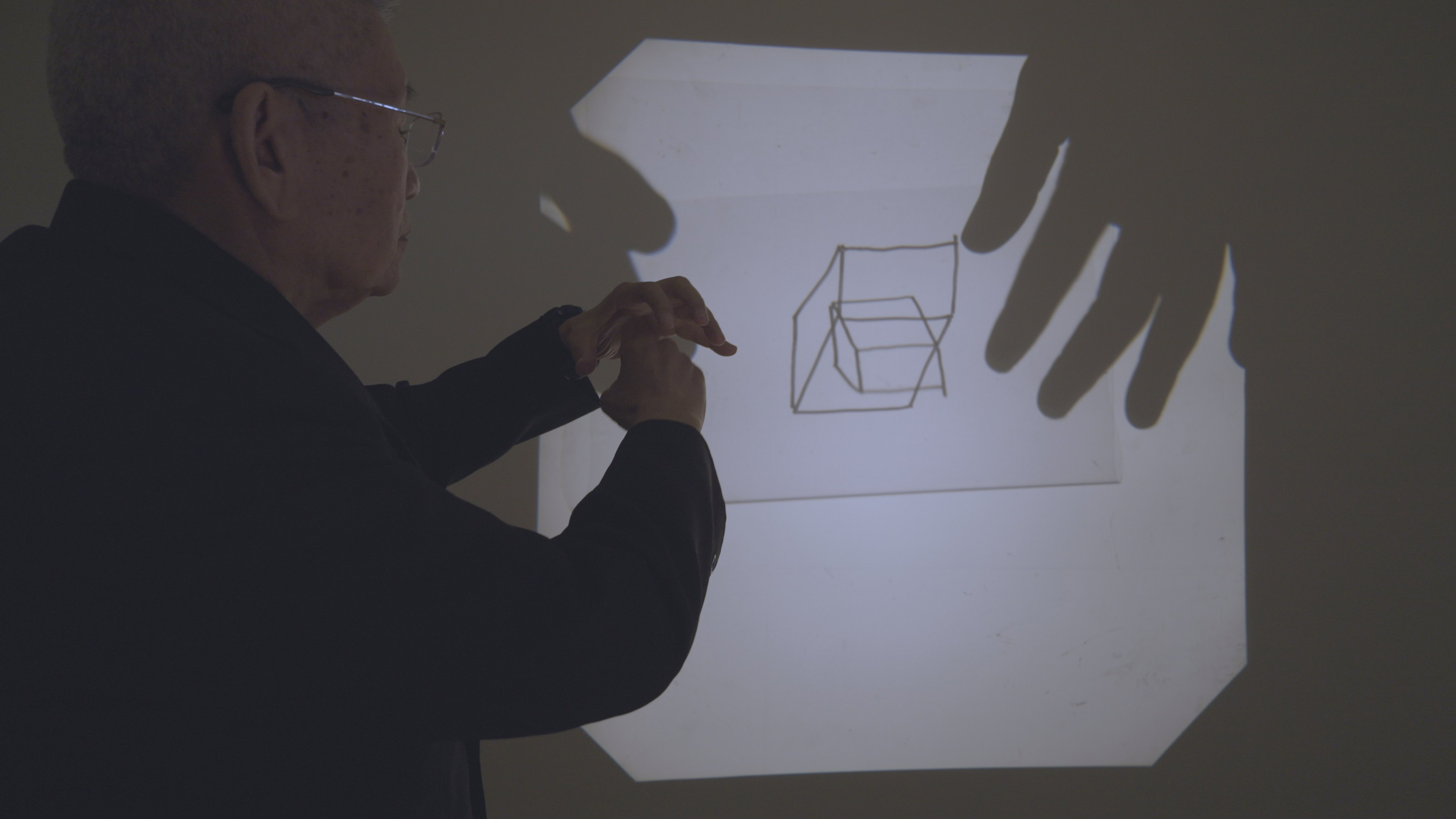
Still from House a, courtesy of the artists.
What are you thoughts around the tandem growth between AI and the renewed push
for nuclear technological development? As artists, what are your considerations
around “ethical” use of AI? Is such a practice possible?
The scientist we collaborated with on this project had already been using an earlier generation of AI tools at the time to simulate nuclear explosions. Artificial intelligence is a form of “speculation,” but at the same time it can also involve “fantasy” or “hallucination.” “Speculation” belongs to the rationality of modern science, while “fantasy” and “hallucination” appear irrational. Yet when such hallucinations are presented under the guise of scientific objectivity, it can still shape the direction of the world. For this reason, we find it difficult to regard AI as inherently compatible with ethical principles.
In addition, as the scientist recounts in the work, at that time, the simulation and calculations related to Taiwan’s nuclear weapons development required the secret purchase of supercomputers, something that Taiwanese scientists were not permitted to have by the United States. Access to computational power was therefore already structured by hierarchy. It was something controlled and unevenly distributed. This also made us aware that the ethics of technologies are themselves shaped by external political and material realities. In this sense, even the power to define what counts as “ethical” can become part of a hierarchical system.
Learn more about Wan-Yin Chen and Che-Yu Hsu and their work at chen-wanyin.com and hsucheyu.com. The Gwangju Biennale, including the Taiwan Pavilion, runs through November 15, 2026.