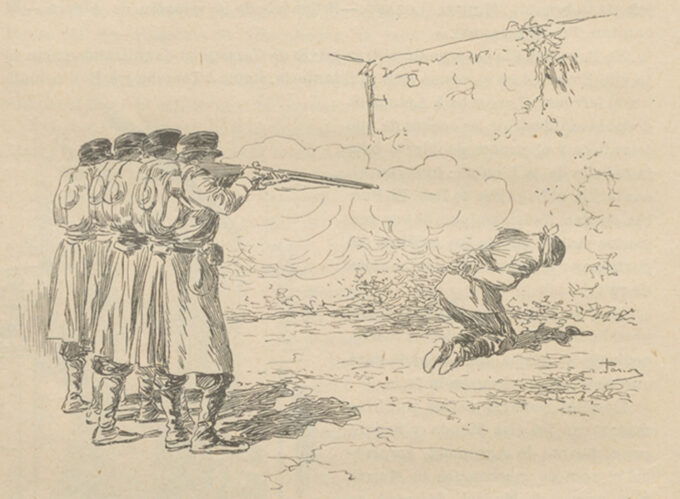
1902, Historia de España en el siglo XIX, vol 5 – Public Domain
On October 8, the U.S. Secretary of Defense, Pete Hegseth, announced that the Pentagon will livestream the Fort Hood shooter’s military execution by firing squad. “Because people need to understand that there are serious consequences for these types of things,” he said.
This is what happens when a country is run by veterans of reality TV and morning talk shows. Hegseth’s unspoken message: Spectacle brought us to power. Spectacle will keep us here.
An impoverished political imagination is reduced to simple formulas: Spectacle equals power. State violence equals spectacle. Therefore, state violence equals power.
If “Make America Great Again” invokes nostalgia for a glorious past, public hangings and racial lynchings belong to that past, too. Then there is the war in Iran, which did not deliver the promised swift triumph. It has dragged on for months, bleeding billions, exposing the limits of military might and diplomatic influence. With midterm elections fast approaching, faith in American supremacy must be restored through political theater. Enter the firing squad.
On the walls of Plato’s cave, the shadow play keeps captives fixated on images, unable to turn toward the light. It does more than entertain. It narrows perception. Dulls imagination. Pins people in place. In autocratic regimes, this hardens into what Henry Giroux calls a “culture of cruelty.” He writes, “What emerges is a carnivalesque politics in which humiliation is rewarded, submission is celebrated, and dissent is disciplined through spectacle.”
In the face of humiliation, submission, and endless spectacle, it is easy to lose heart, easy to fall into despair. Critical thought is stifled. The will to resist is worn down. Patience and trust are hard to sustain. But surrendering to fatalism is the greater danger. That is exactly the point of livestreaming an execution by a firing squad: to make you feel that your own hands are tied, that you, too, are blindfolded. To leave you in the dark, afraid and helpless, with nothing to do but wait for the bullets to hit.
But no. They can’t blindfold an entire nation.
While spectacles stream online, roots keep growing underground. From the civil rights and labor organizing to feminist and LGBTQ+ liberation movements, progress has never been linear or immediate. Social and political transformation takes time, sometimes decades, sometimes generations. There may be setbacks along the way, and what seem like insurmountable obstacles. Amid disillusionment and deep uncertainty, collective aspirations can feel out of reach, even impossible. In those moments, Rebecca Solnit warns against the slippery slope of fatalism and pessimism. She reminds us of “the indirect, the unpredictable, the immeasurable, the slow, and the subtle” that are always part of social movements. Courage is not measurable, nor is compassion or moral imagination. And love, of course. Their presence may be subtle, their effects slow to unfold, but their life force moves us to act. They make solidarity possible and strengthen our resolve, so we can commit to long-term visions and struggles for change.
When choreographers of power issue threats at yet another press conference, when they stage yet another “pseudo-event,” when they circulate yet another AI fantasy, all flexed muscles and exploding bombs, we will remember our roots, all those movements that have come before, and recite the words of American jazz poet Gil Scott-Heron:
The revolution will not go better with Coke
The revolution will not fight the germs that cause bad breath
The revolution WILL put you in the driver’s seat
The revolution will not be televised
WILL not be televised, WILL NOT BE TELEVISED
The revolution will be no re-run brothers
The revolution will be live
And we will do so with courage and love. Because people need to understand that feeling alive with courage and love is the antidote to the politics of cruelty and hollow spectacle.