Photograph Source: The White House – Public Domain
The Pentagon has its old name back, and the men who sell the wars will have the briefs for the next ones. On September 5, 2025, Donald Trump signed Executive Order 14347 and let the department call itself the Department of War again. Congress has not changed the statute. The Congressional Budget Office put the cost of the rebrand at as much as $125 million. Pete Hegseth took the title of Secretary of War anyway, swapped the sign on his door, and pointed the website at war.gov. On September 30, 2026, at Quantico, he handed the next phases of American war to the contractors who already profit from them.
There is a second rename, and it is the one that matters. The same circle of lunatics and sycophants has decided that artificial intelligence is no longer the name. It is Super Intelligence now. A system that does not yet fully exist, sold under a name that pretends the product is already the world’s most powerful mind.
Musk has spent years warning that the thing will end the species, and the same years building the company that now sits on the military’s classified network. The warning and the invoiceare one product. Calling a chatbot a Super Intelligence does not makeit one. It makes the room easier to profit from. Empire always needs a cover story for the killing. This one calls the program that picks the targets a Super Intelligence, then bills the Pentagon as if that mind already exists.
Hegseth has said what kind of department he wants. In his State of the Force address the generals who clung to the “Woke Department” were already gone, about 10 percent of the flag officers with them, and the rest were given the memo. No fatties. No trannies. No beardos. No weirdos. No wimps. No radicals. Just warriors. Diversity, he said, is not our strength. On July 15, 2026, he ordered testosterone screening for every service member over 30, women included, replacement therapy optional, and titled the video “The High T Department of War.” He has banned transgender troops, blocked women already selected for general and admiral, and called the mission lethality restored. He announced the hormone screen while American forces were in a shooting war with Iran. The ideology is a out of a locker room. The budget is an empire. The new faith is that the locker room will be run by a god-like machine. What could go wrong?
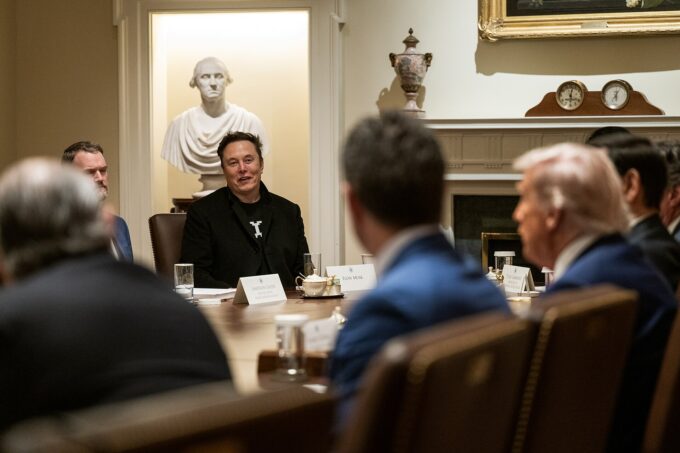
Elon Musk will co-lead Project Meridian. Palmer Luckey, founder of Anduril, and Newt Gingrich sit with him, under Emil Michael, the department’s chief technology officer. They have 120 days to map “the trajectory of wars, domains and technologies,” from under the earth to the space between earth and moon, and to come back with a public report and a classified annex. The same week Hegseth stood up an Autonomous Warfare Command,a four-star outfit for drones, artificial intelligence, robotics, and biotechnology. Two of the department’s largest contractors, and a former speaker with dystopian fantasies of Armageddon, have been asked to design the next phases. Those phases are not a mystery. A kill chain with the pilot edited out. A sensor net with a contractor at both ends. A language that calls the arrangement intelligence.
This is not a think tank. SpaceX already holds the launch book and the satellite book. In May it took a $4.16 billion Space Force contract for satellites meant to track and target airborne threats, days after a $2.29 billion award for a military communications network. It is
inside the Golden Dome scheme. xAI has a deal letting the military run Grok on classified systems. Anduril sells the autonomous weapons, the interceptors, the electronic warfare, the uncrewed jets. Politico reported that current and former Pentagon officials are already warning that the commission can steer requirements toward the companies sitting on it. Wes Bryant, who until last year led the department’s civilian-harm assessments, called it oligarchy in the open. A vendor writing the shopping list is not advice. It is a bid. An A Ivendor writing the list for an AI war is a bid that names itself the requirement.
The wars are not waiting on the report. On February 28, 2026, Trump ordered strikes on Iran. The fight moved to the Strait of Hormuz and stalled there, a war the White House now cites, under names like Midnight Hammer and Epic Fury, as proof that Hegseth is succeeding. Russia is the older file. Ukraine is in its fifth year. Starlink has been inside that war from the start, switched on for Kyiv, throttled when Musk decided the front had gone far enough, treated in Washington as if a private constellation were a public weapon. The man who can darken a battalion’s map has been asked what the next phases of a war with Russia, and a war with Iran, require. NATO’s answer has been more spending. Meridian’s will be a model.
Musk has already auditioned. On November 27, 2023, he landed in Israel, toured Kfar Aza with Benjamin Netanyahu, watched the October 7 footage, and said the killers had taken joy in murdering civilians. On the live broadcast he agreed there was “no choice” but to destroy Hamas, compared the aftermath to Germany and Japan, and called civilian casualties unavoidable while insisting Israel was trying to avoid them. He told President Herzog there was “no choice but to kill those who insist on murdering civilians,” then stop the propaganda and rebuild. He offered to help. Ten days earlier he had written that “from the river to the sea” and “decolonization” necessarily imply genocide, and that accounts using them would be suspended. The man now asked to design the next phases accepted the Israeli account of this war, and put the platform he owns at the service of that account. Gaza is the proof of what the customers want: a faster kill chain, a public language that calls the other side genocidal, and a contractor willing to say the civilian dead were the price. Three years of genocide, armed and shielded by Washington, are the field test. The machine is supposed to make the next version cleaner. Iran is already the larger version. Russia is the version with the other nuclear arsenal.
The same department has already taken the president and the oil. On January 3, 2026, U.S. forces raided Caracas, seized Nicolás Maduro and his wife, Cilia Flores, from their home, and flew them to New York. They are held without bail on narcoterrorism charges. He has pleaded not guilty. His lawyer is challenging the seizure. The interim government left behind, under Delcy Rodríguez, has cooperated. In September, Marco Rubio and Pete Hegseth signed the deal Trump calls the largest oil agreement in history: a hundred-year concession over seventeen fields and about 65 billion barrels, handed to a private company, with the Pentagon taking a 35 percent stake, a veto on the board, and the first claim on the crude. The White House says it is not a deal with the Venezuelan government. It is a deal with the government that remained after the president was taken. Before that, the Coast Guard had already boarded sanctioned tankers and Trump had said the oil would be kept or sold, the ships kept with them. Caracas called it piracy. The drug-boat strikes run beside it, crews killed in the Caribbean and the eastern Pacific, and the USS Gerald R. Ford sits in Southern Command. Cuba is the next island on the same map. Trump has talked of taking it, told the General Assembly that freedom is coming, and had Rubio warn Havana to change or learn the lesson the hard way. He now says a deal will do. The threat is the policy. The raid and the concession are the method.
The enthusiasts talk as if the machine were a staff college that never sleeps. Meridian’s brief isdominance “on the next-generation battlefield,” and Hegseth has said the pointis weaponsthat let the United States prevail “from under the Earth to beyond the moon.” None of that charter says tactical nuclear war. The rename to Super Intelligence is the tell. Super Intelligence is a marketing name for a system that predicts, ranks, and recommends. Put it inside the warning loop of a nuclear force and the recommendation arrives before the human has finished the last one. The bomb does not have to be trusted to the model. The clock does.Against Iran that clock is already running. Against Russia it has run since the first week of the Ukraine war, and both sides keep arsenals large enough to end the argument.
The United States already fields the low-yield option. The W76-2 went on submarines as a “limited” warhead, built so a president could answer a limited strike without reaching for a city-killer. The B61-12 can be dialed. The doctrine is the old one: a smaller weapon makes nuclear use thinkable, and a thinkable weapon gets planned. Russia has the same doctrine and a larger stockpile. Iran does not have the bomb, and the men who just struck it talk as if that fact were a window rather than a reason to stop. Artificial intelligence does not have to hold the launch code to shorten the planning. It compresses the warning. It multiplies the targets. It tells a commander the window is measured in seconds, and that the other side’s machine is already inside it. A man who sells the machine, asked what the next phases require, does not need to be Strangelove to arrive at the smaller bomb. He needs a metric. Dominance. Latency. A classified annex no one outside the building will read before the requirement is written.
Luckey has made a fortune on weapons that do not ask a pilot to fly them. Gingrich has spent forty years arguing that American power is a destiny rather than a choice. Put them in a room with Musk for 120 days and ask what winning looks like against Iran, against Russia, against anyone who will not clear a strait or a front on a timetable. The sane answer is that some weapons are not for winning. The room is not built for that answer. It is built for a list, written in the language of a Super Intelligence that does not exist, by men who will invoice for it as if it did.
A low-yield detonation is still a nuclear detonation. It throws the fallout where the wind takes it. It invites the reply. It ends the taboo that has held, badly and with exceptions, since Nagasaki. Hegseth said the United States has not won a major war since the name changed in 1947, as if Korea, Vietnam, Iraq, and Afghanistan were lost in a typeface. The rebrand is the theory. Meridian is the procurement. The Super Intelligence talk is the sermon. A government that cannot tell a title from a statute is a poor custodian of the difference between a conventional war and a nuclear one, and it is already in a conventional war with a state that sits next to a nuclear one.
Israel runs a nuclear arsenal outside the treaty, with American cover and no inspection. The same Washington that will not enforce an International Criminal Court warrant has spent three years arming a genocide and calling the arming defense. Musk nodded through the first chapter of that story in a kibbutz, on camera, with the prime minister not yet under warrant beside him. A department that puts its contractors in charge of the next phases will not grow a scruple in Gaza, in the Strait, off Venezuela, or over Cuba that it lacks at Quantico. The machine does not keep the human from the mistake. The machine is the mistake if the human who owns it is the human who invoices it, and the invoice now says Super Intelligence.
They are not crazy. They are consistent. They have renamed the department for the act, renamed the software as if the rename were a mind, staffed the building with a secretary who thinks the problem was testosterone, and given the next phases to the men who profit from them. They have stood up a command for war without a crew. They are already killing people from boats in the Caribbean, already taking Venezuelan oil and threatening to take Cuba, already arming the killing in Gaza, already striking Iran, already wired to the war with Russia through a satellite network one man can dim. The step from a faster kill chain to a smaller nuclear weapon is the next line on a list, written by people who believe a war they can win is a war they shouldhave. The classified annex will not say tactical nuclear strike in the first paragraph. It only has to say the window is closing, and that the tool for closing it is already in the arsenal, waiting for a S I to say that the time to act is now.