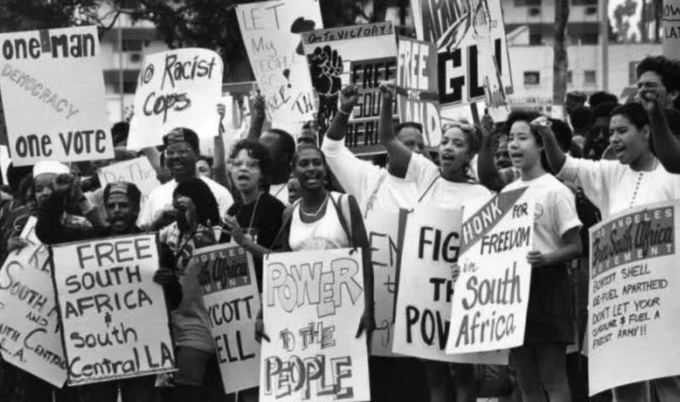
Free South Africa protest in South Central, Los Angeles 1986 | Source: UCLA Archives
On July 3, 1986, Los Angeles marked a historic moment for the city and the international community, going beyond a statement of solidarity. The L.A. City Council and then-Mayor Tom Bradley decided that standing up to racism and discrimination was a priority and leveraged their political power by cutting economic ties with the apartheid government of South Africa.
Bradley signed the city’s landmark anti-apartheid ordinance, also known as the L.A. divestment ordinance against the apartheid government of South Africa. This local law strictly restricted city commerce by banning municipal contracts and purchases from any company or bank doing business with apartheid South Africa. It also required companies bidding on city contracts to sign an affidavit certifying that they had no commercial ties to the white ruling nation on the African continent.
The action placed the nation’s second-largest city among U.S. municipalities that used their contracts, purchasing power, and investments as tools of foreign policy pressure. As a result, then-President Ronald Reagan opposed the law, saying it would cause an “economic war.” Therefore, he placed the economy above how Black people were systemically discriminated against in South Africa.
Four decades later, with two mayoral candidates fighting over who is more progressive, that history raises a question for L.A. voters:
Would the next mayor be willing to use its economic and political power today in response to Israel’s treatment of Palestinians? And call for ending its apartheid system against Palestinians? Would the city cut ties with Israel economically to pressure it to end its genocide?
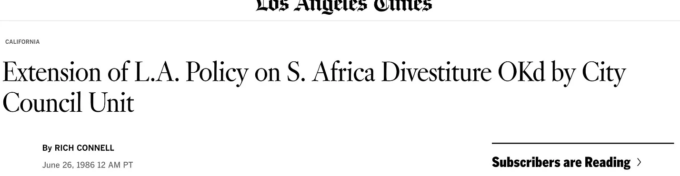
Screenshot of L.A. Times articles | Source: L.A. Times archives
L.A.’s anti-apartheid movement in the 1980s
The city council and mayor’s move to support the anti-apartheid movement didn’t happen overnight. In 1948, the apartheid system in South Africa officially started following the general election victory of the Afrikaner National Party. As a result, the anti-apartheid movement was born and later spread worldwide in solidarity with the people of South Africa.
In 1984, the Los Angeles Free South Africa Movement (LAFSAM) campaigned against apartheid in South Africa. L.A. called for the release of African National Congress (ANC) leader Nelson Mandela. In addition, LAFSAM opposed the awarding of the lifetime achievement award by the L.A. chapter of the National Association for the Advancement of Colored People (NAACP) to New Jersey-born Frank Sinatra because they performed in South Africa. Sinatra’s performance violated the cultural boycott artists were leading, much like today, when artists are denied invitations to perform in Israel.
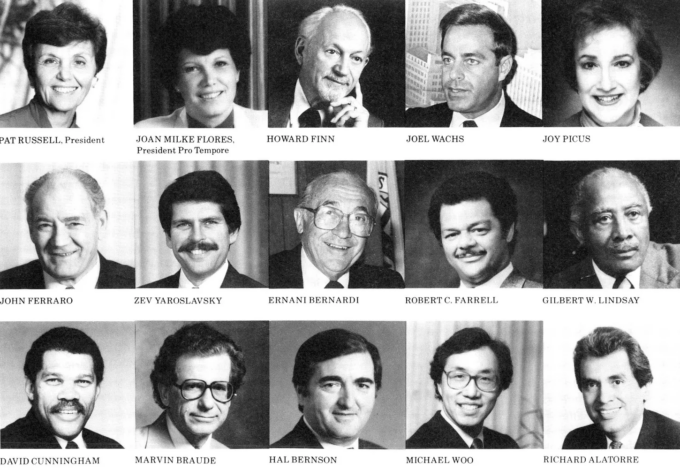
L.A. City Council 1986 roster | Source: Wikipedia
In 1985, several thousand students protested at the University of California, Los Angeles (UCLA), calling for divestment from South Africa. This is similar to today’s movement, in which thousands of students across the country have urged their universities to divest from Israel because of its apartheid system against Palestinians, the Gaza genocide, and its colonial zionist movement.
As people in L.A. mobilized to end apartheid in South Africa, elected officials were forced to take a stance as the pressure grew. Much like today, anyone running for office is forced to have a position on the Gaza genocide and Israel’s occupation of Palestine.
Bradley argued that American corporate investments were helping sustain the apartheid system and that Los Angeles should not participate in it.
The pressure intensified.
In July 1986, the City Council approved an expanded anti-apartheid policy that prohibited the city from purchasing certain goods and services from companies with South African business ties. The bill had been under consideration for roughly a year and passed unanimously on its final vote. According to the L.A. Times, it affected contracts worth about $107 million, or about 13% of the city’s contracts in the previous fiscal year.
Bradley called for a $1 billion divestiture from South Africa. The city targeted financial investments in companies, municipal purchasing contracts, and currency sales.
The divestment and selective purchasing ordinances restricted the following types of goods, services, and assets:
+Computer parts and technological hardware.
+Vehicles, specifically fleet pickup trucks.
+Industrial equipment, including vacuums and building materials like concrete.
Maintenance supplies, such as commercial paint.
Banned financial assets and currency.
+Krugerrands: The city cracked down on the local sales of South African gold coins. It did so by imposing local fees designed to stifle their trade and fund anti-apartheid initiatives and movements.
+Corporate stocks and bonds: The city’s pension funds liquidated holdings in prominent multinational corporations doing business in South Africa. They targeted sectors like petroleum (e.g., Shell Oil) and heavy manufacturing.
+Banking services: The city barred doing business with or depositing funds into financial institutions that extended loans or credit to the South African government.
The policy shift was significant because Los Angeles was not merely asking the federal government to act. The city was saying that its own contracts and investments could become instruments of political pressure.
The City Council played a critical role that reached far beyond statements of support or calling a genocide a genocide. This was not lip service to show support for the people of South Africa, but an active movement.
Fluor Corp., an Irvine-based engineering company, was slated for a major role in expanding the Los Angeles Convention Center, but it also maintained significant operations in South Africa.
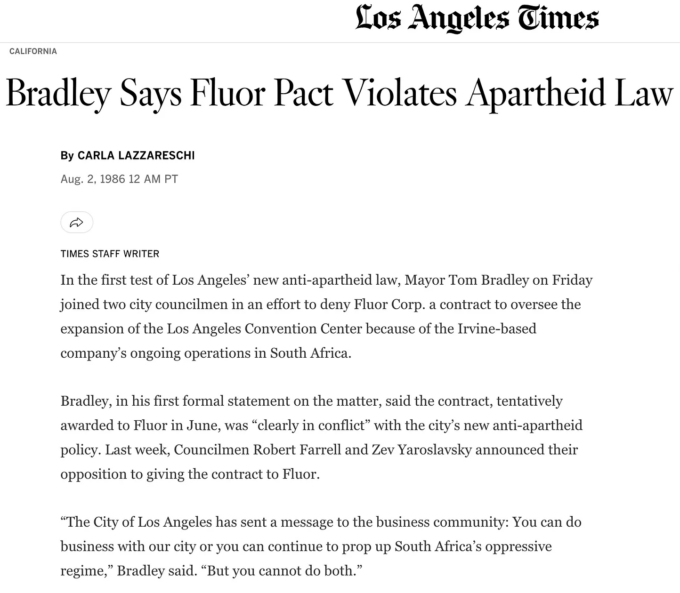
Screenshot | L.A. Times article from August 2, 1986
In August 1986, the mayor said the proposed Fluor contract was “clearly in conflict” with the city’s new anti-apartheid policy. The L.A. Times reported that Bradley and Councilmembers Robert Farrell and Zev Yaroslavsky opposed awarding the contract because of Fluor’s continued operations in South Africa.
Bradley’s and the councilmembers’ message was blunt: companies doing business with Los Angeles could not simply ignore the city’s new policy.
The move showed the ordinance was not merely a ceremonial gesture or for clicks, but had consequences for companies seeking public business that normalized South Africa’s apartheid government.
Los Angeles was not isolated in their decision. The city was part of a broader international movement against apartheid that included students, churches, labor organizations, civil-rights and anti-apartheid organizations. Pressure on American companies had been building for years.
South Africa’s apartheid system legally and politically enforced racial segregation and white minority rule. By the mid-1980s, images of police violence, mass arrests, and resistance inside South Africa, much like what we’ve seen in Gaza and the West Bank, had made the government of South Africa an international political issue.
In L.A., the movement intersected with the city’s own history. Bradley, the first Black mayor, emerged from the city’s civil-rights movement and understood the political significance of Los Angeles taking a position against a government whose system was based on racial domination.
Bradley is known as a supporter of Israel. In 1985, he publicly stated his support for the “legitimate rights of the Palestinian people.”
The city ultimately voted unanimously in 1993 to end its anti-apartheid policy, concluding that political changes in South Africa had altered the circumstances that produced those sanctions.
In other words, the city established a new precedent by deciding that where companies do business matters when those companies support human-rights violations, and that the city can use its power to cut ties with governments that are killing people.
Is Israel an apartheid state?
Apartheid means “separateness” or “apartness” in the Afrikaan language, in reference to a former official system of institutionalized racial segregation and discrimination. Under international criminal law, apartheid is classified as a crime against humanity, defined by systemic oppression and domination by one racial group over another.
Apartheid has a long history of being used to describe the situation facing Palestinians living in historic Palestine.
Palestinians face apartheid in the West Bank and in the now-destroyed Gaza Strip, but also inside the Israeli state as well. In addition to navigating a system based on religious and racial supremacy, Israel makes it nearly impossible for most Palestinians to get permits to build new homes or apartments and destroys those that are built without permission.
The apartheid system that exists today in Palestine is beyond questionable. Anyone who goes to the West Bank or Gaza immediately sees with their own eyes the blatant suppression of the Palestinian under Israeli occupation. Occupation and its attendant racist practices hit every aspect of life. In 2008, a delegation of South African veterans of the anti-apartheid struggle visited the West Bank. They concluded that the apartheid system imposed on the Palestinians is even more brutal and shocking than what had existed in South Africa.
On July 10, 2008, Ha’aretz published an article about the delegation, entitled “Worse than apartheid.” In it, South Africa’s Sunday Times newspaper editor, Mondli Makhanya, is quoted:
“When you observe from afar, you know that things are bad, but you do not know how bad. Nothing can prepare you for the evil we have seen here. It is worse, worse, worse, than everything we endured. The level of apartheid, the racism, and the brutality are worse than the worst period of apartheid.
The apartheid regime viewed the Blacks as inferior; I do not think the Israelis see the Palestinians as human beings at all. How can a human brain engineer this total separation—the separate roads, the checkpoints? What we went through was terrible, terrible, terrible — and yet there is no comparison.
Here [Palestine] it is more terrible.”
You will find around 700,000 to 750,000 Israeli settlers living in relative luxury in the occupied West Bank, including East Jerusalem.
As of December 2019, 1.9 million Palestinians held Israeli citizenship. Most Palestinian citizens live in three areas: the Negev desert (Naqab to Palestinians) in the south, the so-called “Little Triangle” in the country’s center, and the Galilee in the north.
There are more than 60 Israeli laws that discriminate against Palestinian citizens in Israel. For example, the “Stop-and-Frisk” law expands police powers to stop and frisk anyone they deem reasonably suspicious. Plus, the “Mandatory minimum sentences for convicted stone-throwers Amendment.” The law states, “The law imposes mandatory minimum prison sentences on persons convicted of stone-throwing or similar acts. The minimum sentence is set at one-fifth of the maximum sentence — either 10 or 20 years, which equates to either two or four years.”
According to the United Nations Office for the Coordination of Humanitarian Affairs (OCHA), there are 925 to 942 movement obstacles and checkpoints across occupied West Bank and East Jerusalem. The factsheet highlights 80 to 91 fully staffed checkpoints operating 24 hours a day, 7 days a week. It also notes 114 to 118 linear closures, such as trenches, earth walls, and road barriers.
To preserve the Jewish demographic majority established by the 1948 ethnic cleansing, Israel has enacted a series of laws to restrict the growth of the remaining Palestinian population and their towns and villages, as well as to limit them politically. In 2018, the Israeli Knesset (parliament) passed the “Jewish nation-state” law as one of the country’s quasi-constitutional Basic Laws, which was widely condemned as racist and as entrenching apartheid in Israel.
Some of the text of the Jewish Nation-state law makes settlements a “national value and will act to encourage and promote its establishment and consolidation.”
Israel’s Basic Laws also bar political candidates and parties from advocating a secular democracy in which all citizens are equal, regardless of religion or ethnicity, by calling for an end to Israel’s system of Jewish privilege. A Knesset advisor explained the bill was rejected because it included several articles meant to change the character of the State of Israel from the nation-state of the Jewish people to a state in which Jews and Arabs have equal national status.
Roughly 3.3 to 3.4 million people live in the West Bank, and 2 million in the Gaza Strip; that is, roughly five million people who live under harsh military occupation. Their cities, towns, and villages are isolated from each other by hundreds of Israeli military checkpoints. The Israeli apartheid wall has annexed large chunks of Palestinian territory to Israel and separated many Palestinian villagers from their schools, jobs, farmlands, and family.
The killing, harassment, and wounding of Palestinians by the Israeli occupation forces is a daily routine.
With tens of thousands of Israeli troops and armed Zionist settlers resembling the Ku Klux Klan, like paramilitary groups and the early settlers of the territory we now call the United States of America.
In 2009, then-Israeli Education Minister Shulamit Aloni published an article in the Hebrew newspaper Yedioth Ahronoth, titled “Yes, There is Apartheid in Israel.” Initially, it was published only in Hebrew, not on its English-language site. Later, you could find the English version on Counterpunch. Aloni described what it’s like in the West Bank regarding their roads: “Wonderful roads, wide roads, well-paved roads, brightly lit at night — all that on stolen [Palestinian] land. When a Palestinian drives on such a road, his vehicle is confiscated, and he is sent on his way.”
Since 1948, Israel has used various laws, such as the British Mandate-era Land (Acquisition for Public Purposes) Ordinance and the Absentee Property Law, to confiscate millions of acres of Palestinian land for the use of Jewish Israelis. This allowed the government to take land from Palestinians, including Palestinians with Israeli citizenship, who were ethnically cleansed of their ancestral land and prevented from returning.
After ethnically cleansing hundreds of thousands of Palestinians, destroying their land, homes, and towns, and taking everything they have to establish the State of Israel for Jewish settlers, Israel made it extremely difficult for them to build or expand homes. As a result, in 2020, the Human Rights Watch organization published a report titled, “Israel: Discriminatory Land Policies Hem in Palestinians.” It states:
“Decades of land confiscations and discriminatory planning policies have confined many Palestinians citizens to densely populated towns and villages that have little room to expand. Meanwhile, the Israeli government nurtures the growth and expansion of neighboring predominantly Jewish communities, many built on the ruins of Palestinian villages destroyed in 1948.”
In 2022, Amnesty International published a report stating, “Amnesty International’s new investigation shows that Israel imposes a system of oppression and domination against Palestinians across all areas under its control: in Israel and the OPT, and against Palestinian refugees, in order to benefit Jewish Israelis. This amounts to apartheid as prohibited in international law.”
In that same year, the United Nations Special Rapporteur, Michael Lynk, for the situation of human rights in the Palestinian territory occupied since 1967, stated that “Apartheid is not, sadly, a phenomenon confined to the history books on southern Africa.”
In 2024, the World Court, the International Court of Justice (ICJ), found Israel responsible for apartheid. The ruling placed responsibility on all states and the United Nations to end these violations of international law.
Today, the political question is different; it is always, ‘Do you believe there is a genocide in Gaza?’ and rightfully so, but we must also address the condition in all of historic Palestine and ask if the next mayor will lead the charge to end the apartheid system in Palestine by using their political power as a tool.
The question facing Los Angeles today
The mayoral question is particularly significant.
Voters are preparing to choose the city’s next mayor as questions about the city’s role in international conflicts are debated nationally and locally.
The candidates’ positions should be examined on their own terms rather than assuming that either would reproduce Bradley’s policy.
But the historical comparison is worth making.
Would a future L.A. mayor support restricting city contracts with companies involved in Israeli settlements or other activities that the city determined were inconsistent with its human-rights standards?
Would city councilmembers consider divesting municipal investments from companies connected to Israel? Would it examine pension investments, procurement, or financial relationships?
Those are different policy choices with different legal, economic, and political implications, and they can be discussed. The 1986 precedent, however, demonstrates that L.A. has previously rejected the argument that international human-rights questions are automatically outside city hall’s jurisdiction.
In fact, the L.A. City Council will need to begin by reversing Assembly Bill 2844 (AB 2844), widely known as an anti-BDS (Boycott, Divestment, and Sanctions) measure. The Los Angeles City Council supported AB 2844 in 2016, a bill originally intended to restrict government contracts with companies that took part in boycotts of Israel. The bill was later amended and signed into law as Chapter 581, with the final version applying to discriminatory business practices in contracts of $100,000 or more.
Would Los Angeles do it again?
The most important legacy of the anti-apartheid movement, and the ordinance it created, may not be the policy itself. It is the precedent it left.
Los Angeles showed the world what a municipal government could do by leveraging its political and economic power and asked the question: What does our money support?
Four decades later, activists and the movement for a Free Palestine have put politicians in a position where they need to take a stand on Palestine and are asking councilmembers and the next mayor to confront that question again: Are we going to support apartheid?
Evidence on the issue is available from international human rights organizations, and video evidence is available across social media platforms. The question now is whether Los Angeles should once again use the economic power of City Hall to respond to what its leaders and residents regard as serious human rights violations abroad.
In 1986, Los Angeles did not wait for Washington to settle the question before acting. The question for a new generation of L.A. leaders and activists is whether that precedent still means something. And if it does, what would it look like for the city to apply the same principle today against apartheid Israel?