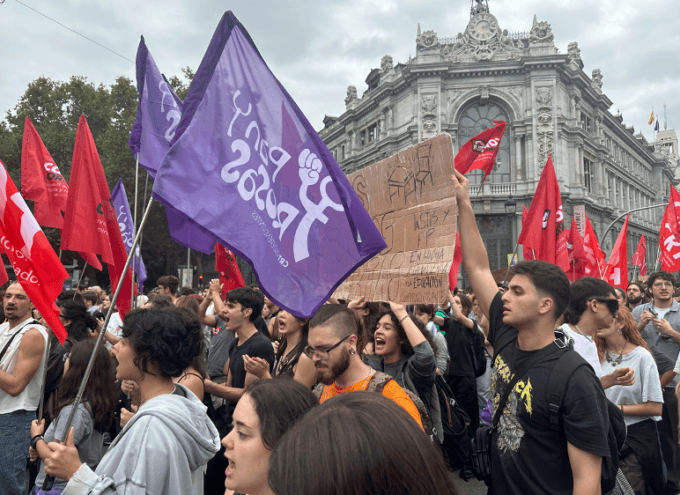
Housing protest, Cibeles Plaza, Madrid, October 3, 2026. Photo: The author.
A busman’s holiday
My wife Harriet and I arrived in Madrid Friday afternoon, October 2 for a long-planned holiday. We went to bed at 11, when sophisticated Madrileños sit down to dinner. Early next morning, the street outside our hotel on the Calle del Prado – near the Gran Via, Madrid’s combined Broadway and Oxford Street – was as quiet as a rural lane in Norfolk, the English county where we live. By nine it was loud with cars, buses and trucks. People in Spanish cities used to get up late and take siestas. Not anymore – now they go to bed past midnight and wake tired.
We started the day by visiting the Thyssen Museum, with its collection of old master and modern paintings. Then we met the chief curator of the Banco de España for a tour of the collection; after that, we joined tens of thousands of housing protestors in nearby Piazza Cibelas. In the late afternoon, we visited the tent city set up by housing activists in Puerta del Sol. Then at 8 p.m., it was dinner with academic friends Juan Albarran and Olga Fernández and discussion of the current political crisis. It’s been a busman’s holiday.
Thyssen Museum
Seeing the Thyssen collection is a mixed pleasure. There are great works in the collection, but there’s a problem with provenance. For a museum, provenance – the history of ownership of artworks — is everything. The best provenance is when you can trace ownership back to the artist’s easel. The worst is no record at all – the artwork just appears for sale one day and buyers are on their own to determine if it’s real or fake. It’s an open secret that fakes comprise ten percent or more of most museum’s holdings. The problem is they don’t know which 10%.
There’s another kind of provenance problem that receives less attention but bothers museum directors more: That’s when an artwork has been stolen, looted, dispossessed of its owner in a forced sale, or acquired with dirty money. Most museums have this problem to some extant; the Thyssen has it completely. All 775 artworks bought by the Spanish state in 1993 to establish the museum were acquired by Heinrich Thyssen-Bornemisza with profits generated by Nazi industry, much of it dependent upon slave labor. Some of the artworks were acquired though forced sales, in which Jewish collectors or art dealers had to quickly dispose of their prized possessions to raise money to escape with their lives. Such sales were often futile; people sold their artworks for a pittance but were murdered anyway.
Instead of 15-foot-tall portraits of two generations of Thyssens in the entrance hall of the museum, there should be a memorial plaque, honoring their victims. The Thyssens have not, with a few exceptions, accepted responsibility for what their family did in the Nazi era. Indeed, they have fought artwork repatriation tooth and nail. None of this, I must admit, stopped me from visiting the museum several times over the years and twice giving public lectures there. Though the quality of the collection is mixed, many artworks – from Carpaccio to Kitaj – are stunners. What else can we do than admire them and discuss their provenance?
The Bank of Spain (1782)
The Bank of Spain collection presents its own ethical questions, the most important of which is why it took so long for the institution — founded in 1782 as the Banco Nacional de San Carlos — to commit to publicly exhibiting the more than 4,500 artworks in its collection. But now it has, and a fully-fledged museum, open to the public is in the works, with completion expected by 2029. A few galleries are already open limited hours. Chief curator Yolanda Romero Gómez, along with her husband Manual Borjas-Villel, former director of the Reina Sofia museum (and a friend), took my wife Harriet and me to see the prizes of the collection: a group of eight portraits of the bank’s late 18th C. founders, painted by Francisco Goya.
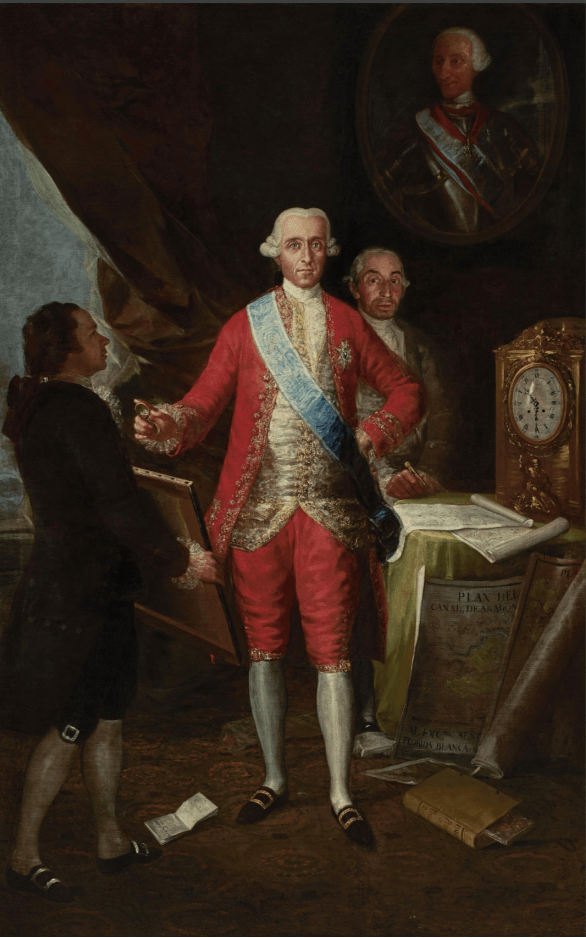
Francisco Goya, Portrait of the Count of Floridablanca, 1783. Collection: Bank of Spain.
Among them is The Count of Floridablanca (1783). As prime minister under King Charles (Carlos) III, Floridablanca championed the bank’s creation. In the portrait, he stands resplendent in the center, wearing a suit of red satin crossed by a blue sash, the latter signifying membership in the Royal and Distinguished Order of Charles III. In his right hand he holds a pair of eyeglasses indicating that even though it’s 10:30 p.m. according to the clock at right, he’s working on important business and mustn’t be disturbed.
The king’s himself, shown in an oval portrait-within-the portrait at upper right, gazes down kindly. At left, Goya assumes a subordinate posture, presenting the count with an artwork, subject unseen. The third man in partial shade, visible near the count’s left shoulder, has not been identified, but he holds a protractor, suggesting he’s an architect or engineer, instrumental in creating plans like the one for the Canal of Aragosa, visible on the floor at right. The picture generally conveys the idea that enlightened royal governance, supported by men of talent, can accomplish great things. The Bank of San Carlos was established to encourage that progress by stabilizing the value of currency, managing debt, and issuing bonds.
The economic, industrial and cultural modernization of Spain promoted by Floridablanca and Goya, proceeded apace until the French Revolution of 1789 stopped it in its tracks. The French and Spanish monarchs were blood relations and had a longstanding mutual defense pact. As war approached, the bank issued bond upon bond, with higher and higher interest rates, undermining their value. (As you hear every day in market reports, the value of a bond is inversely related to its interest rate.) Fearing to antagonize its natural allies, the monarchy resisted taxing wealthy aristocrats and clergy, thus allowing the state and the Bank of San Carlos itself to become bankrupt.
The current crisis
The fundamental problem with the system described above is that unless bond revenue is invested in a way that increases productivity and raises tax receipts, the government issuing them will eventually be forced to spend all its income paying back principal and interest to bondholders. The government might be able to buy back some of the bonds to lower interest rates (“quantitative easing”), but that only reduces market confidence in future bond sales. At that point, the government must either cut its public investments (for example on infrastructure, education, housing and healthcare) or tax the rich. And since most capitalist regimes from King Carlos to King Donald — are far more closely aligned with the rich than the poor, it’s the latter that gets the haircut.
The current economic and political crises in Spain is like that experienced in the late 18th century. Instead of taxing the wealthy to limit rents and build public housing, the Spanish government and European Central Bank issue bonds. But fearing insolvency, they don’t issue very many, holding to a policy of austerity, allowing the housing crisis to fester. More than that, they allow bond holders to freely sell their own bonds with higher interest rates than the government offers, forcing the latter to raise interest again to attract new bond purchases. And on it goes.
In Spain today, investment firms and hedge fund use their vast stores of cash to buy up and hoard land and housing, and then resell them to other investors and hoarders, who then again resell them for a profit. All the while, many properties are kept empty to make it easier to resell them or tear them down. People and businesses who speculate this way are called fondos buitre (vulture funds) for their habit of sweeping down and buying heavily discounted real estate portfolios and then finding ways to maximize profit at the expense of low-income renters and home buyers.
At the housing protest on Saturday at Cibeles near the Palace of Deputies, an artist collective called Serigrafía Ambulante (Roving Screenprinters) printed and distributed hundreds of images of a buitre exhibicionista (exhibitionist vulture) with little houses on its wings to symbolize the greed of housing scavengers. As with much Spanish art with satiric content, the source for the image was Francisco Goya, who knew a thing or two about popular prints and vultures – Spanish and French, aristocratic and capitalist. His etching and dry point titled “The Carnivorous Vulture,” plate 76 from his series The Disasters of War (c. 1820), shows a vulture with missing tail and battered feathers, harried and tormented by a crowd of peasants and workers while invading French soldiers flee in fear at right.
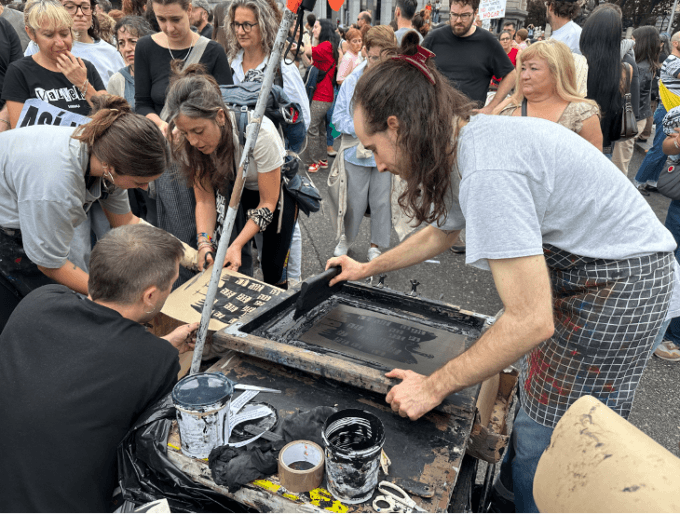
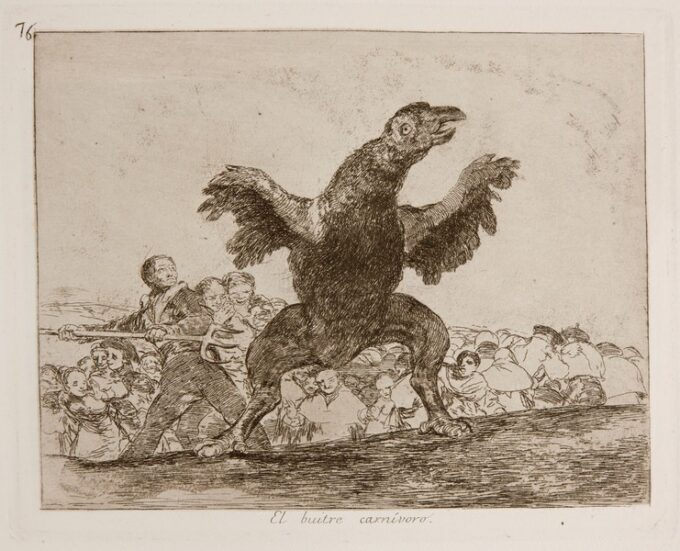
Top: Serigrafía Ambulante making screenprints, Cibeles Plaza, October 3, 2026: Photo: The Author; and “The Bottom: Carniverous Vulture,” plate 76, The Disasters of War (c. 1820). Coll: Fundacion Goya en Aragon.
The protesters in Madrid, led by the Sindicato de Inquilinas (Tenant Union) and supported by dozens of other groups, hope to chase the vulture funds from Spain. Their Decreto Maricarmen (Maricarmen Decree), named for the 87-year-old woman who died on Wednesday weeks after her eviction from an apartment she occupied for 70 years, includes demands for 1) automatic renewal of rental contracts; 2) a ban on evictions of vulnerable people; 3) state seizure of vulture-fund properties; 4) a reduction of rents nationwide to bring them in line with wages; and 5) a nationwide housing general strike on November 11, organized in coordination with key unions. To get a better sense of how the most committed of the protesters felt about these plans, I walked to the Puerta del Sol to talk to a few of the 10,000+ residents of the tent city.
Sol
To a retired academic and sometime (amateur) organizer, the tent city at the Sol violated every rule in the book. The tents are crammed together in the middle of the vast plaza, closed to the outside but open to the inside. To a visitor, it feels more antagonizing than welcoming. Spectators are mostly prevented from walking through the encampment and forbidden from taking pictures when they are permitted inside. There are few outwardly facing few tables or information booths. Passersby will sometimes see residents standing together or lounging on the perimeter of the encampment, smoking, chatting, and eating pizza. Nobody in other words, is recruiting, organizing or taking contact information from the tens of thousands of potentially sympathetic daily visitors.
My new comrade in the tent city, Iker (last name withheld), a member of the Coordinadora Juvenil Socialista, told me on Saturday afternoon his group had a sign-up table and done some recruiting, but I didn’t see it. He articulated the case of the protestors (in English) and argued correctly that the plight of renters in Madrid was similar to that of others in London, Paris, New York and elsewhere. He described how the vulture funds operated and the nature of the current, political impasse. (A new, national election has been called.) Unfortunately, his group is a relatively small, communist group unlikely to attract a broad following. I failed at finding at Sol any leaders or spokespersons for the Tenant Union.
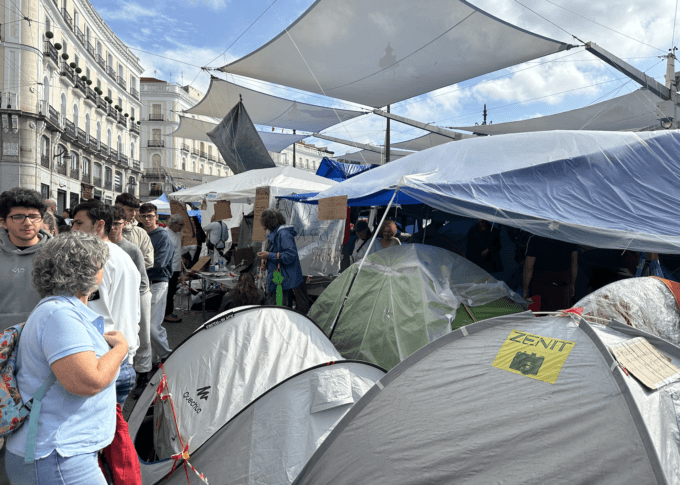
Tent city at Puerta del Sol, Saturday, October 3, 2026. Photo: The author.
Inside the sanctum, I met and chatted with several other individuals and groups. Stepping cautiously, I came upon five, undergraduate sociology students, three women and two men, aged about 20, sitting in a circle smoking and talking. I introduced myself and refrained from telling them smoking was bad for them. They said they all lived — until the protest — in shared accommodations, that their rent was more than they could afford and they were uncertain of the future. They had only been in their tents a few days, they said, but liked it just fine. They used toilets in nearby restaurants and offices, shared simple meals cooked there or brought in, and were prepared to remain in their tents indefinitely. They expressed little concern about forced clearance from the Sol encampment, saying that the federal police would never allow the regional cops to do such a thing. I told them that no matter what federal officials say, the state is the state and eventually, it will assert its monopoly of violence and clear the site; they need to have a plan of escape. No reaction.
The group shared their confidence that the General Strike planned for Nov. 11 will bring the conservative legislature to its knees, and force change. I told them about the failure of the 1926 British General Strike but conceded the effectiveness of the 1905 Russian General Strike and the strike against the Kapp Putsch in 1920. Spanish unions are strong, despite their diminishing membership, but would they really sustain for more than a day a strike that would disorder the lives of millions? And what about the public, many of whom (perhaps a majority) support right wing parties that preach law and order? Were they going to join in such an enterprise, I asked? Again, silence.
What I saw and heard on the streets was tremendous energy and enthusiasm but little politics. As the national election campaign heats up, that may change: alliances between a splintered left may form, and the right may continue to misstep. New leaders may emerge, new demands may be articulated, and mass mobilization may follow – all unknows. What I can say with confidence is that the model of austerity that has prevailed for more than a generation in Europe and the Americas has failed miserably and that fact is not a secret. More people than ever recognize that their governments have offered handouts to the rich and a closed fist to the poor. Whether it’s the housing crisis in Spain, the education crisis in France, the health care crisis in the U.K., or the cost-of-living crisis in the U.S., the center – the model, the system, the regime — cannot hold.
That night at dinner, me, Harriet, Juan and Olga talked excitedly about their art history research, the current crisis and the prospects for significant change. As the hours advanced, I found myself wider awake and alert than when I got up in the morning. These are not days for early dinners.