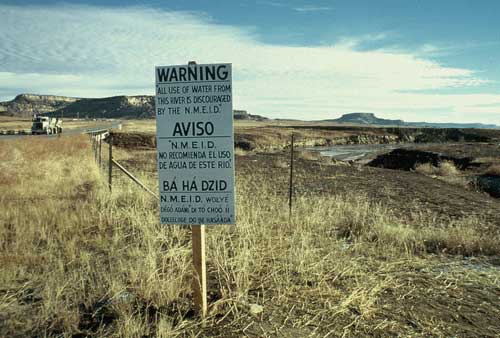
A warning sign placed by the Puerco River by the New Mexico Environmental Improvement Division after the Church Rock uranium mill spill on July 16, 1979. Photo: EPA.
A Native anti-uranium mining activist once told me how she felt sometimes at the conferences she attended around the country and beyond. Occasionally, she said, she felt surrounded by “well-educated old white men.” I got the sense from something in her tone that she meant important environmentalists of narrow, legalistic focus who were committed to a clean environment without thought or care for the people like hers who had mined uranium and lived in the damage those mines caused to their land, how their environment had been polluted with radioactive waste from now abandoned mines, and how the federal government, the only buyer of uranium during the boom, had never told her people about the dangers of radioactivity. And so, nuclear power did not seem as clean to her as it did to the learned authorities she met at conferences.
I didn’t really know why, in the last several years, I had gotten involved in the struggle against resuming uranium mining and had read a dozen books and talked to many people about the uranium boom between the 40s and the 70s. I had learned about the cancer, diabetes, asthma, kidney and other diseases among miners and nearby residents, about the radioactive waste lying in such abundance on the Navajo Reservation and near it, about polluted groundwater, and about the horror of the Church Rock Spill, worse than Three Mile Island yet ignored to this day by the information sources that cater to well-educated old white men.
This evening, recovering from my annual autumn flu, I realized that my mind had been floating half the day over creeks, fields, canyons, hills and the Sierra Nevada Range, the pastures and redwoods of the north coast of California, and the pastures of the Diablo Range, as well as the high desert terrain of the Colorado Plateau, seeking a healing in nature I could not find in my small apartment somewhere in a Southern California suburb surrounded by strip malls and gated “communities.”
It was an odd, silly day in which I did no studying, refused to read the latest reports on the growing political conflict on the Colorado Plateau between the US government, Canadian mining companies, their gringo PR agents and local compradors, and resistance from the local public and local, state, and federal officials and politicians.
I spent the early part of the evening cleaning and resharpening a Swiss Army knife so old I could find no reference to it on the Internet. But it was the knife in my pocket the first time I went to the Southwest and happened one weekend to spend some time working on a greenhouse on the Hopi Reservation. I ended up camping on Second Mesa with the most interesting, low-key group of tourists I have ever met, people from different parts of the US who had only one thing in common: serious devotion to Hopiland. I stayed for three weeks, attended several all-day ceremonies, and met the astounding Grandfather David Monongye and other elders.
Late in the evening, after watching episodes of the “Rockford Files,” (I said it had been a silly day), I was searching on my computer for a John Wayne movie and some logger jeans when I realized the Colorado Plateau was sacred, personally to me, and that I could well understand where determination to protect Mt. Taylor from uranium mining came from because it had just welled up from a new depth within me. The revelation that that land is sacred, despite its huge wounds and sacrifice zones, had just been permanently planted and in my mind.
The revelation I experienced stopped me cold. It appeared as a profound form of incalculable knowledge transcending both thought and feeling, both my evolving knowledge of the moral rot of National Security ideology and nuclear scientism and all their works, and my growing empathy for victims of this insane hubris and my solidarity with their resistance.
I don’t remember Professor Sherman Powell 2 . ever saying a word about Native property rights, and I took his course on property law twice. And how many times had I heard in how many social science lectures about the role of private property rights in John Locke’s theory of liberty for all? Nor, during the two decades I spent working on conservation easements and mitigation banks for ranchers, did land ever rise above the status of a commodity for either owners, bureaucrats or environmentalists.
None of the infinite quantity of law and commentary on the theory and practice of private property rights bestowed upon me by well-educated old white men made sense once it had occurred to me that land is sacred and that I was too old and well-educated a white man to deny it. I realized that, as the Taoists say, valleys contain spiritual guides, and as the Navajos say, mountains are relatives.
Sacred places are not private property and, with regard to tribal reservations, they should not automatically be considered federal government property either.
I used to meet the spirits in my valley on the river at dusk in summer while watching the bobber on my fishing line while muskrats play in the reeds, or in a ring of curious white-face calves surrounding a group of biologists studying fairy shrimp in vernal pools, or from the glance of a rehabilitated red-tailed hawk before he’d fly off my gloved hand into a Eucalyptus grove, or at the site of an immense, ancient North American beaver sitting on a drain pipe sticking out of a creek bank in the middle of a city of 90,000 people. Where I came from, after a rain I could see Half Dome and El Capitan, always there, always familiar, shining in sunlight.
1. In environmental law, few phrases are as morally loaded as sacrifice zone. It describes a place where governments, industries, and permitting systems concentrate pollution, extraction, and health risk in communities that are often poor, racially marginalized, or politically disempowered. The term is not just rhetorical. It captures a recurring pattern in U.S. land use and environmental regulation where some communities are effectively treated as acceptable places to absorb harm. —
2. Sherman Powell: Author of Powell on Property: Cited More Than Any Other Treatise on Real Property Law, and cited multiple times by the U.S. Supreme Court over the last decade.