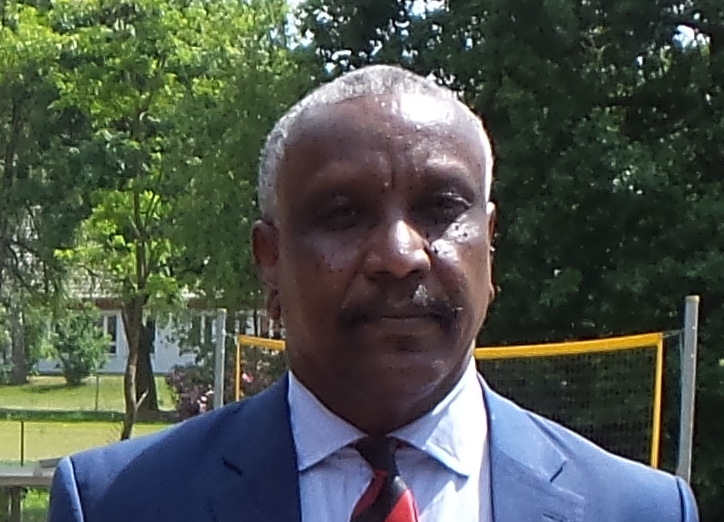
Yasir Arman, 2018. Photograph Source: RomanDeckert – CC BY-SA 4.0
They had decided to make the gathering at Chatham House on the record. The Chatham House Rule—speak freely, but don’t identify who said what—would not apply, which meant I could write about what was happening in the room. “Creating the conditions for a durable end to the war in Sudan” was the theme.
Guest speaker was Yasir Arman. We had met again on Piccadilly a few days earlier, though our first encounter had been far from London, on a sun-slapped afternoon in Nairobi, drinking fresh mango juice in a modest but very clean hotel foyer. There I asked him how, nearly forty years earlier, he had left the Sudanese Communist Party and joined John Garang’s Sudan People’s Liberation Movement. Garang, the longtime rebel leader who became Sudan’s first vice-president after the 2005 peace agreement, died in a helicopter crash three weeks later.
There was something rare about Arman’s journey. He was a northern Sudanese Muslim who had thrown in his lot with a movement rooted in the predominantly non-Arab south, becoming, in Garang’s ranks, an unusually prominent northerner. In 2010, he ran for president against Omar al-Bashir, withdrawing shortly before the vote amid concerns over electoral irregularities and the continuing conflict in Darfur.
But in Nairobi we also talked about John Lennon.
Somewhere between Lennon and revolution, Arman explained that Garang had believed Sudan could be remade around equal citizenship rather than Arab or African, Muslim or Christian, northern or southern identity.
Decades later, it strikes me that the same idea still sits at the heart of Arman’s politics. Now, with Sudan still torn apart by war, he had come to London to talk about what might survive it.
He reminded those around the Chatham House roundtable that the present war did not come from a vacuum and was “an extension of Sudan’s recurrent conflicts since August 1955.”
Arman looked not too far removed from the soldier he had once been. Beside him sat retired senior diplomat Dame Rosalind Marsden, now an Associate Fellow of Chatham House’s Africa Programme, who was chairing the discussion.
“Any attempt to address the situation in Sudan must begin by tackling the humanitarian crisis,” Arman said.
Ending the fighting, necessary as it was, would not be enough. The harder task was to alter the political, military and economic incentives that made another war possible.
He gave a warning. The Islamists, he reminded everyone, were still trying to regain control of the levers of power. “A genuine end to this war and a path to sustainable peace are in direct contradiction with the return of the Islamists, given their infamous résumé.” Yet he insisted that the spirit of the December Revolution—the civilian uprising that helped bring down Bashir—was still alive. Any durable peace, he argued, would have to reckon with what the war had done to ordinary Sudanese, beginning with restitution for its victims.
“The shortest possible route to peace,” he outlined, “given the current complicated circumstances and regional and international polarisation, is to adopt the African Peace and Security Council’s resolution calling for an immediate humanitarian ceasefire in Sudan.” This pressure, he believed, should be tabled before the United Nations Security Council as an African proposal rather than from powers outside the continent.
Around the table was an intriguing cast. A diplomat from the SAF-led Sudanese Embassy—just around the corner—was filling sheets of Chatham House notepaper, his pen rarely resting. A representative, I believe, from SOAS University of London was doing much the same. Also there was Dr Husam Taha El-Mugamar, a consultant microbiologist and director of Sudan’s Doctors for Human Rights.
Then Arman changed gear.
He called for the Sudanese army and the anti-war movement to meet: “A genuine dialogue between the anti-war movement and the Sudanese Armed Forces [SAF] is needed.” It was a startlingly simple proposition: bring everyone together, including the paramilitary Rapid Support Forces (RSF), the army’s principal adversary, and do it as soon as possible. He said it should begin immediately on neutral ground outside Sudan. Later, he even floated London as a possible venue.
It was the first time I had heard anyone propose something so direct that, listening to him, it began to feel almost obvious: get them into a room. Arman acknowledged that this would be difficult “under current circumstances”. But the desire to try was unmistakable.
SAF and the RSF, alone, would never be enough. In fact, smaller armed groups, including the SPLM-N and Darfuri factions, also have a stake in the conflict. Sudan’s crisis runs deeper than a war between two armed forces. Most importantly, any sustainable settlement would require civilians in the room too. At its heart, after all, is the unresolved question of who should wield political power, and on what terms. A peace negotiated only by those with guns risks reproducing the very system that helped generate the war.
It was in this regard that Arman repeatedly returned to what he called a “paradigm shift”: away from simply negotiating an end to the present war and towards changing the political arrangements that had allowed armed power to dominate Sudan.
He reminded us, too, of Sudan’s extraordinary diversity—what he described as 570 tribes or nationalities, grouped into 57 ethnic groups.
Much diplomatic attention in recent weeks had been directed towards Washington and New York. Here, in a corner of London, another conversation was taking shape.
As for bringing Russia or China into the conversation: “Are they ready to talk to us?” he questioned, before moving on.
And all the while, the war continued. Beyond Sudan’s borders, renewed fighting in northern Ethiopia was a further reminder of how closely the country’s crisis was entangled with the wider conflicts and political upheavals of the region.
That same day, reports were also emerging from the Nuba Mountains of fighting between the SPLM-N and members of the Otoro community. One Otoro traditional leader claimed that more than 500 people had been killed there over the previous six months, though the figure had not been independently confirmed.
Meanwhile, the wider war had shifted decisively towards Kordofan: the SAF held Khartoum and much of the east, the RSF much of Darfur, while North Kordofan—especially around El Obeid—remained a major battleground.
Against news like this, talk of a “paradigm shift” could easily have sounded academic. In the room, it did not. More than 33 million people now need humanitarian assistance. Arman recalled, too, how women had been among the first to bear the brunt of Bashir and Islamism. “Women must impose their will,” he later agreed, in a respectful exchange with a former female UN adviser.
At one point Arman took off his spectacles and rubbed his eyes. Perhaps it was deep concentration: the effort of a man still turning over the same immense problem—how to end this war without preparing the ground for the next.
I thought of his return to Khartoum after Bashir fell in 2019, despite a death sentence imposed on him under the former regime. Two years earlier, he had called in his writing for a political dispensation built around “peace, democracy, equal citizenship without discrimination and social justice.”
All these years later, the vocabulary has hardly changed: peace, democracy, equal citizenship, social justice.
Nor, perhaps, has the fundamental problem.
Outside the room, as we have established, the war continued.
Inside it, people were trying to imagine the political arrangements that might one day make another war less likely.
But Arman had also offered something much more immediate.
Get the army, the RSF and the anti-war movement into a room.
Perhaps even a room in London.