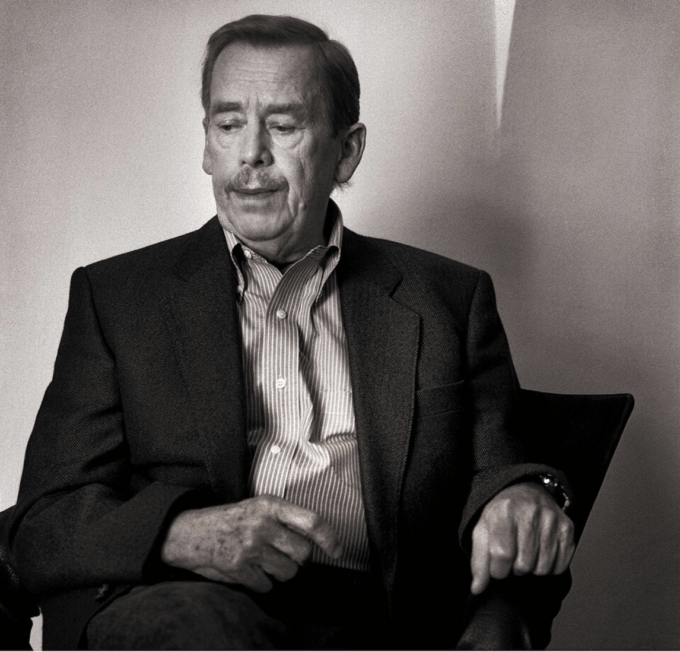
Václav Havel. Photo: Jiří Jiroutek. CC BY-SA 3.0.
In 1991, I met Václav Havel—who would have turned 90 this October—at Barcelona City Hall. That’s where I worked as an interpreter between then-Mayor Pasqual Maragall and the president of what was then Czechoslovakia and later became the Czech Republic. Maragall introduced me to Havel as the translator of his plays and philosophical works, including Letters to Olga, the correspondence Havel wrote to his wife from a communist prison over the course of more than four years. Upon hearing the title of this book, Havel forgot about those around him and took an interest in the linguistic challenges of certain passages. “How were you able to translate those letters—I wrote them to deceive the censors and prison guards—how could they have been made understandable to Spanish readers?” Havel exclaimed his questions in Czech while the mayor of Barcelona, who didn’t understand a word, smiled in bewilderment. I listened, thinking that for Havel, the most important things were ethical, philosophical, and linguistic issues. His entire body of work is filled with his concerns for social justice, individual responsibility, and changes in language.
My earliest memory of Havel dates back to 1968, when, as a little girl, my parents would go and see his plays and then discuss them with their friends at home. In August of that same year, the Warsaw Pact armies occupied Czechoslovakia. Havel then engaged in a public debate with the writer Milan Kundera that was closely followed by Czech society as a whole. Kundera asserted that the heroism of the Czechoslovak people during the Prague Spring would forever remain a model of a small nation rebelling against a greater power. Havel disagreed, emphasizing that his fellow citizens had failed because, in carrying out their political reforms, they should have anticipated the violent reaction of a state as aggressive as the Soviet Union.
Years passed. Thanks to the dissident movement, which Havel led in Czechoslovakia, the Berlin Wall fell in 1989, and following the collapse of the totalitarian regimes in Central and Eastern Europe, those of us who had gone into exile to escape totalitarianism were able to return to our home countries, which were beginning to enjoy democracy.
In 1995, I appeared at Prague Castle for one of the many interviews I conducted at that time with the democratically elected Czech president for the Spanish and international press. Upon entering the sumptuous neoclassical halls that house the presidential offices, I noticed that large contemporary paintings had transformed the president’s meeting room into a modern art museum gallery. He remarked, “I am the avant-garde and the absurd.” And in the interview, he stated that the end of communism, like the end of fascism, serves as a warning to humanity: “Society has once again borne witness to humanity’s rejection of manipulation and the rebellion of human individuality against its imprisonment within a unifying ideology.”
This statement also sheds light on our own era.
That same year, I had the opportunity to speak with Havel after a dinner hosted by the Queen of England during his trip to Great Britain, where I had been invited as a journalist and translator of his work. While we were dining at Balmoral Castle, I learned that the Queen, a close friend of Havel’s, had played a decisive role in supporting the Czech Republic’s entry into the European Union. After dinner, during the trip to Aberdeen, our next stop, we were able to chat informally. Havel opened up, saying that, as president, his role often ended up bothering him: “It annoys me that a president can’t go against the establishment, because that’s who I am—I’ve been a dissident my whole life!” And he reflected on his dissident stance: “You get drawn into it by your sense of responsibility; they expel you from the existing structures. It starts as an attempt to do good for society and ends with them branding you an enemy of society,” he laughed.
As early as the 1950s, during the era of the dictatorship of socialist realism in literature, he was writing theater of the absurd, because everything he saw around him seemed incoherent and preposterous: they were Kafkaesque plays about mankind lost in the incomprehensible dilemmas of bureaucracy and about the loss of individual identity under the pressure of power.
The next day, as the Czech president read his acceptance speech for an honorary doctorate at the University of Oxford, I thought of him as an eternal rebel. His words about the salvation of the world—that it “lies nowhere else but in the human heart, in the capacity for reflection, and in ever-present and active responsibility”—stuck with me.
My last meeting with Havel, who was already very ill, took place in October 2011 in Prague, at the party celebrating his 75th birthday. He confided in me then that, as president—not being an expert in economics—he had believed that economists knew what they were doing: “That was a huge mistake; I should have trusted my instincts.” “Why?” I asked. He told me that, today, all over the world, the economy and financial power take precedence over political power, and not the other way around; a politician should guide the behavior of the economy and the world of finance, influence society, and set priorities.
“In today’s international arena, where populist leaders are springing up like mushrooms in the forest, there is a lack of true leaders because the Western world is going through an extremely delicate period of change.” And, above all, he was concerned about the gaping chasm between politicians and the people. “A person’s responsibility does not match the level of his knowledge. We must act against the pressure of economic and financial power. We cannot tolerate dictatorships of any type. A kind of existential renaissance of our civilization is necessary, and I hope that a cataclysm will not be required for its realization.” This was my last conversation with Václav Havel. Shortly afterward, he retired to his country home, where he passed away two months later.
Havel still has much to say to the contemporary world, especially to the West, where wars, authoritarianism, and police states have reemerged.
Canadian Prime Minister Marc Carney delivered a speech at this year’s World Economic Forum in Davos based on one of Havel’s allegories. The allegory tells of a fruit vendor who, during the communist era, places a sign in his shop window bearing the slogan “Workers of the world, unite.” He does so not out of conviction but out of submission to the totalitarian regime. Havel called this behavior “living in a lie.” Carney used this allegory to warn that the rules-based world order has collapsed and that those countries that turn a blind eye to this reality “live in a lie,” just like Havel’s fruit vendor.
One day, at his favorite café in Prague, the Café Louvre, I asked Havel what place hope held in his thinking.“Hope,” he replied, “is not the conviction that something will turn out well, but the certainty that something has meaning, regardless of the outcome.” This phrase can guide us in these turbulent times.