
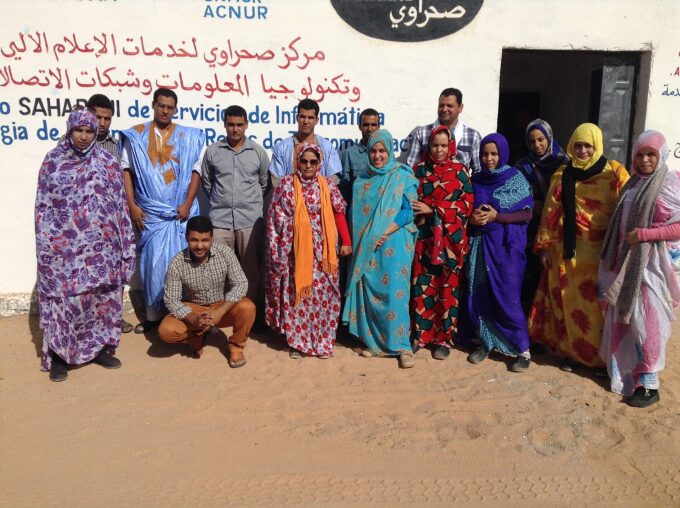
Photograph Source: Saharaui-wiki – CC BY-SA 4.0
UNSC Draft Renames MINURSO and Removes Referendum from Western Sahara Mission
In this exclusive interview for CounterPunch, Stephen Zunes, a professor of politics and international studies, discusses recent events surrounding the UN vote and the future of Western Sahara. Zunes looks at the political challenges posed by Morocco’s claims to the territory. He also talks about UN peacekeeping and the role of U.S. foreign policy. Further, he describes how international solidarity can support Sahrawi self-determination.
Daniel Falcone: Recently, the UN General Assembly’s Fourth Committee adopted the Western Sahara resolution with 152 votes in favor. The resolution references SC Res. 2797. Could anything change for the Sahrawi people’s right to self-determination?
Stephen Zunes: While it is disappointing that the resolution referred to UN Security Council Resolution 2797, which provided qualified support for Morocco’s autonomy proposal as a basis of negotiation, the General Assembly resolution continues to recognize Western Sahara as a non-self-governing territory and thereby a decolonization issue. It also reaffirms the right of self-determination. The fact that Israel and the United States were the only two countries to vote against the recent General Assembly resolution is indicative that these two major proponents of the right of conquest were concerned about that language.
Ironically, Morocco and its Arab allies supported the resolution since it is the first time the Fourth Committee has referenced UNSC 2797. They are therefore pushing the line that this constitutes a major victory in supporting Morocco’s illegal annexation of the conquered territory.
However, the resolution specifically reaffirmed “the inalienable right of all peoples to self-determination” and that “all available options for self-determination of the Territories are valid as long as they are in accordance with the freely expressed wishes of the people concerned.” It would appear, then, that the Fourth Committee is nonetheless holding firm to the primacy of international law.
Furthermore, while referencing UNSC 2797, the General Assembly resolution also referenced no less than 33 previous UN Security Council resolutions, including those calling for a free and fair internationally supervised referendum by the people of Western Sahara.
It is also important to note that UNSC 2797, passed last year, did not require the Polisario to accept the autonomy proposal by emphasizing the need for a “mutually acceptable resolution.” It also called for a resolution that was “consistent with the UN Charter,” which prohibits the expansion of territory by force. And it maintains reference to a “genuine autonomy,” which the Moroccan proposal does not provide.
Daniel Falcone: The idea of Moroccan autonomy has gained traction with support from the U.S. (and other influential Security Council members). Can Moroccan sovereignty satisfy international legal principles?
Stephen Zunes: The Moroccan plan for autonomy falls well short of the international legal definition of autonomy and what is required in bringing about a peaceful resolution to the conflict. Moreover, it seeks to set a dangerous precedent that threatens the very foundation of the post-World War II international legal system.
To begin with, the proposal assumes that Western Sahara is part of Morocco, a contention that has long been rejected by the United Nations, the International Court of Justice, the African Union, and a broad consensus of international legal opinion. To accept Morocco’s autonomy plan would mean that, for the first time since the founding of the United Nations and the ratification of the UN Charter more than 80 years ago, the international community would be endorsing the expansion of a country’s territory by military force, thereby establishing a very dangerous and destabilizing precedent.
If the people of Western Sahara accepted an autonomy agreement over independence because of a free and fair referendum, it would constitute a legitimate act of self-determination. However, Morocco has explicitly stated that its autonomy proposal “rules out, by definition, the possibility for the independence option to be submitted” to the people of Western Sahara, the vast majority of whom — according to knowledgeable international observers — favor outright independence.
Even if one takes a dismissive attitude toward international law, there are several practical concerns regarding the Moroccan proposal as well.
One is that the history of respect for regional autonomy on the part of centralized authoritarian states is quite poor, and has often led to violent conflict, as witnessed by the tragic results from the Ethiopian decision to revoke Eritrea’s autonomy in 1961 and the Serbian decision to revoke Kosovo’s autonomy in 1989. And Chinese promises of autonomy to Hong Kong and Macau have already been severely compromised.
Based on Morocco’s record of breaking its promises to the international community regarding the UN-mandated referendum for Western Sahara and related obligations based on the 1991 ceasefire agreement, there is little to inspire confidence that the Kingdom would live up to its promises to provide genuine autonomy for Western Sahara.
Indeed, a close reading of the proposal raises questions as to how much autonomy is even being offered. Important matters such as control of Western Sahara’s natural resources and law enforcement (beyond local jurisdictions) remain ambiguous.
In addition, the proposal appears to indicate that all powers not specifically vested in the autonomous region would remain with the Kingdom. Indeed, since the King of Morocco is ultimately invested with absolute authority under Article 19 of the Moroccan Constitution, the autonomy proposal’s insistence that the Moroccan state “will keep its powers in the royal domains, especially with respect to defense, external relations and the constitutional and religious prerogatives of His Majesty the King,” appears to afford the monarch considerable latitude of interpretation.
There appears to be a growing consensus within the international community that some sort of compromise, or “third way” between independence and integration, is necessary to resolve the conflict and that a “winner take all” approach, such as a referendum on independence, is unworkable. While encouraging such compromise and trying to find a win-win situation is certainly the preferable way to pursue a lasting peaceful settlement regarding secessionist movements, ethnic conflict and many international disputes, Western Sahara is a clear-cut case of self-determination for a people struggling against foreign military occupation.
The Polisario Front has already offered guarantees to protect Moroccan strategic and economic interests if allowed full independence. To insist that the people of Western Sahara must give up their moral and legal right to genuine self-determination, then, is not a recipe for conflict resolution, but for far more serious conflict in the future.
Daniel Falcone: Initially I wanted to ask about MINURSO’s mandate up for renewal on October 31, 2026, and touch on its future role. Could you explain and elaborate on the October 20, 2026 Security Council zero draft on Western Sahara? To what extent does it terminate MINURSO’s peacekeeping mandate in April 2027 in favor of a special political mission? In your estimation, does this draft weaken the international mechanisms designed to protect Sahrawis?
Stephen Zunes: The U.S. draft resolution to effectively impose Morocco’s autonomy plan is one of the most serious attempts to undermine international law since the founding of the United Nations. It has several glaring problems.
There is a contradiction in the text, which claims that Morocco’s autonomy plan is the “only framework to negotiate a mutually acceptable solution.” Clearly, denying one of the parties their legally guaranteed right of self-determination can never be “mutually acceptable.”
By removing MINURSO’s mandate to conduct a referendum, long supported by the international community, it is negating the right of self-determination that has long been the basis of decolonization under international law.
It praises “President Trump’s leadership on conflict resolution in Western Sahara” despite his being the first world leader to recognize Morocco’s illegal annexation of Western Sahara. It also misleadingly refers to “the recognition by a growing number of Member States of Moroccan sovereignty over Western Sahara” when, in fact, only two additional states—the far-right governments of Israel and Colombia—have done so.
It refers to “genuine autonomy” when the Moroccan proposal falls well short of the international legal definition of autonomy.
The clause insisting that funding refugee services should no longer go through UN agencies or the Polisario, which has done a generally admirable job of administering the refugee camps for fifty years, and instead go to “individual, voluntary” solutions will likely result in a humanitarian crisis.
It also seeks to bypass the Polisario, the internationally recognized representatives of the people of Western Sahara and focus on what it calls “a broad range of Sahrawi constituencies and interlocutors, including those outside the negotiating parties,” presumably meaning collaborationists chosen by the Moroccan government.
This is referred to as a “zero draft,” meaning it is up to other members of the Security Council to suggest changes. (The United States currently has the rotating position of “penholder,” which is why this first draft came from Washington.) The Trump administration could potentially play hardball and veto any renewal of MINURSO’s original mandate, using the excuse that U.S. recognition of Morocco’s annexation of the territory means that the conflict is settled and/or that it was a waste of money due to the UN peacekeeping force not accomplishing anything.
The reason MINURSO hasn’t accomplished much is that Morocco, with U.S. and French support, has refused to allow for the referendum on self-determination that MINURSO was supposed to have organized and overseen to move forward. The breakdown of the ceasefire has compromised that mission as well. And Morocco has maintained strict prohibitions on independent oversight—MINURSO is the only modern UN peacekeeping mission lacking a mandate to monitor human rights violations, which are among the worst in the world, due to opposition from Morocco and veto threats from the United States and France.
Despite the legal fiction that there is an ongoing process towards a referendum or a ceasefire to monitor, most nations see its continuation as important to underscore that the conflict remains unresolved.
There will certainly be objections from Pakistan, China, Russia, and perhaps some other countries as well to the zero draft. However, with Washington’s willingness to run roughshod over international legal precedent, and the failure of even democratic nations to consistently stand up to Trump’s bullying (particularly on what are considered less-consequential issues), it is hard to predict. Even if the full text isn’t accepted, the Trump administration may succeed in its primary goal to make Morocco’s autonomy proposal recognized by the United Nations as the only basis of future negotiations.
Daniel Falcone: In our previous interviews, you’ve looked at the relationship between U.S. foreign policy, the Moroccan government and the Sahrawi struggle for self-determination. Can solidarity campaigns and/or diplomatic pressure change the current path?
Stephen Zunes: The diplomatic path has been at a standstill for decades, particularly with the United States blocking the United Nations from assuming its role as a defender of international law, including the right of self-determination. Like Israel, the Moroccans recognize that they have no reason for territorial compromise if they have the diplomatic, economic, and military support of the world’s major superpower.
There is no military path to liberation either. The low-level Polisario guerrilla campaign, which resumed in 2020 after many years of Moroccan ceasefire violations, has made no progress. Drone warfare has made their desert fighters vulnerable, and the separation barrier constructed in the 1990s keeps them out of the Moroccan-occupied 80% of the country.
The only realistic path to self-determination, then, is international solidarity.
The case of East Timor, which bears striking historical and legal parallels with Western Sahara, is an important model for such grassroots action. Pressure on states to recognize the Indonesian-occupied, non-self-governing territory’s right to self-determination came primarily from nongovernmental actors. They eventually influenced the policies of the U.S. government and those of other Western powers, which in turn helped force the Indonesian government into serious negotiations and offered some protection to the East Timorese against abuses. As late as the mid-1990s, however, East Timor appeared to be as hopeless a cause as Western Sahara is today.
Indeed, on several levels, the East Timorese situation was worse. Whereas up to eighty-four countries at one time or another have recognized Western Sahara, only three governments formally recognized East Timor. Whereas Western Sahara has had the strong support of the African Union, the Association of Southeast Asian Nations (ASEAN) backed Indonesia’s claim. Unlike Western Sahara, there was no UN peacekeeping presence, and it had been dropped from the United Nations’ decolonization agenda. World maps made no distinction between East Timor and Indonesia, unlike most maps of Western Sahara, which show it either as a separate country or some other indication of its distinct status. Both the armed resistance in the countryside and the nonviolent resistance in the cities were weaker than in Western Sahara.
However, a number of factors — the awarding of the Nobel Peace Prize to East Timorese Archbishop Carlos Belo and Foreign Minister-in-exile Jose Ramos-Horta, a massacre of hundreds of peaceful protesters filmed by Western journalists, an award-winning documentary, and a campaign finance scandal involving Clinton’s re-election campaign — brought East Timor to wider public attention globally. Small solidarity groups in the United States and elsewhere were emboldened, becoming more visible in the media, in the streets, and lobbying in the halls of government, eventually leading to major policy shifts in the United States and other Indonesian allies, forcing the Jakarta government to allow for a referendum on self-determination in 1999.
Similarly, in Western Sahara, it is important for the small and scattered solidarity efforts that currently exist to prepare for unexpected events (e.g., the Nobel Peace Prize to Sahrawi activists like Aminatou Haidar) which could serve as a catalyst to grow into an international movement which could similarly change their governments’ policies, especially those within countries currently backing Morocco.
Increasing world attention on the Israeli occupation and war crimes provides an opening to address the Western Sahara issue as well. Western Sahara is the only other case besides Palestine where there is clear legal and political recognition within the UN system that one country has belligerently occupied another with the clear intent to prevent the achievement of self-determination. Linking the growing movement for boycotts, divestment, and sanctions targeting the Israeli occupation could extend to Morocco’s occupation of Western Sahara as well. Indeed, Trump’s recognition of Morocco’s annexation of Western Sahara and its entanglement with the Abraham Accords might have the unintended effect of more closely associating occupation of Palestine and Western Sahara. The United Methodist Church, one of the United States’ largest Protestant denominations, voted to divest from Moroccan government bonds, along with Israel and Türkiye’s, due to these governments’ ongoing occupations.
Such a movement could also link Trump’s increasing support for Russia’s irredentist ambitions in Ukraine, which face widespread opposition in the United States and elsewhere, to his support for Morocco’s conquest of Western Sahara. Even Ukraine hawks like Michael McFaul, who held major foreign policy positions in the Obama administration, noted how Biden’s failure to reverse Trump’s recognition of Morocco’s annexation of Western Sahara hurt U.S. efforts to defend the “rules-based international order” against Russian aggression.
In whatever way such a movement may coalesce, it must press the United States, the Europeans, and other powerful nations to recognize their shared interest in upholding international legal norms, even if the violator is an ally. The failure to do so in Western Sahara since 1975 has not only prolonged and, more recently, exacerbated the bitter conflict, but it has also contributed to undermining the decades-long global struggle to create, maintain, and strengthen the international liberal order that emerged after World War II. As a result, the stakes in Western Sahara are not simply about the future of one small country ensnared in a forgotten and frozen conflict; it is a question as to which principle will prevail in the 21st century: the right of self-determination, or the right of conquest? The answer could determine the fate not just of the Western Sahara, but that of the entire international legal order for many decades to come.


