
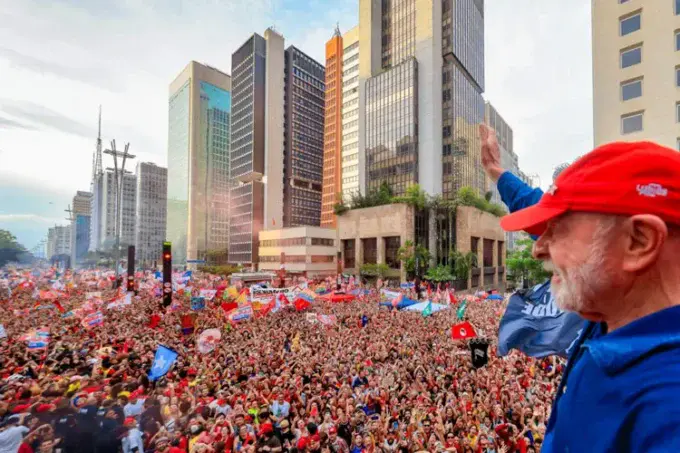
Lula greets one million supporters in Sao Paulo on October 24th. Photo: Ricardo Stuckert.
President Luiz Inácio Lula da Silva won reelection to a fourth term by gaining ground in Brazil’s largest cities while keeping his strong support in the Northeast. His geographic base is shifting and this change is clearest in Brazil’s 200 largest cities. There, Lula’s share of valid votes rose from 47.1% in 2022 to 49.57% this year, an increase of 2.4 percentage points. In smaller cities, his share fell from 54.6% to 53.9%.
The Northeast is still the core region of Lula’s support. Lula won 69.37% of valid votes in the region, nearly the same as the 69.34% he won four years ago. He also won in the same number of municipalities as in 2022.
Outside the Northeast, Lula won more votes in fewer cities than in 2022. His share rose from 43.9% to 44.8%, yet the number of cities he carried fell from 1,349 to 1,101. Nationwide, he won in 2,875 municipalities, down from 3,123. That is a loss of 248 cities, and all of them were outside the Northeast.
The capitals show Lula’s urban strength most clearly. Across the 27 state capitals, his share of valid votes rose from 49.7% in 2022 to 52.8%, an increase of 3.1 percentage points. He won in 13 of Brazil’s 26 state capitals, compared with 11 in the last election.
Rio de Janeiro shows how much has changed. Jair Bolsonaro beat Lula there in 2022 by 52.66% to 47.34%. This year, Lula reversed that result and won the city with 51.54%.
Lula also widened his margins in capitals he had already won. In São Paulo, his share rose from 53.54% to 55.50%. In Porto Alegre, it rose from 53.50% to 55.84%. In Macapá, the capital of Amapá, Bolsonaro won with 54.92% in 2022. This year, Lula won with 50.99%.
The split between large and small cities also shows in the count of municipalities won. Outside the 200 largest cities, Lula lost the lead in 255 municipalities, falling from 3,062 to 2,807. Among the 200 largest, he went from leading in 61 to leading in 68.
The results continue a long recovery of the Workers’ Party’s urban vote. In 2002, when Lula won his first presidential election, the party took 66.3% of valid votes in the 200 largest municipalities. That share fell to 59.6% in 2006, 53.6% in 2010 and 46.8% in 2014. It hit its lowest point in 2018, when Fernando Haddad ran against Bolsonaro and the party won 38.1% in those cities. The recovery began in 2022 at 47.1% and has now reached 49.6%.
The capitals follow the same pattern. In 2002, the Workers’ Party won all 27 capitals, with 66.9% of valid votes across them. By 2018, it won only six, with 40.4%. It then won 11 capitals in 2022 and 13 this year, with a combined share of 52.8%.
A breakdown by electorate size shows where the growth is concentrated. The analysis split the 5,570 comparable municipalities into ten equal groups, ranked by total valid votes in 2022. Lula gained only in the top group, which contains the 557 largest municipalities. His share there rose from 47.6% to 49.6%, an increase of two percentage points. In the other nine groups, which include 5,013 cities, his share fell by an average of 1.4 percentage points. The steepest drop came in the 557 smallest municipalities, where his vote fell 3.9 percentage points, from 50.6% to 46.7%.
This article originally ran in Brasil 247, was translated by PanAmerican dispatch with express authorization by the editor-in-chief, and can be read in its original Portuguese here.


