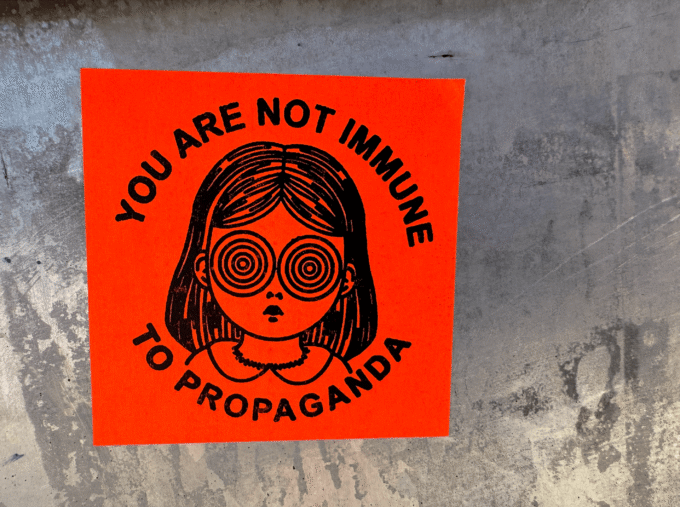
Photograph by Nathaniel St. Clair
America, you got fooled. Again.
For starters, the war on illegal immigration was never just about illegal immigration.
If you fell for that, chances are you’re still falling for the government’s oldest trick: manufacture a crisis, identify an enemy, frighten the public, declare an emergency, and then use the resulting fear to justify another expansion of government power.
Terrorism. Crime. Drugs. National security. Illegal immigration.
Different threats. Same playbook.
Take a legitimate problem—or inflate it into an existential menace—and suddenly constitutional safeguards become inconveniences, extraordinary powers become necessities, and anyone who questions the government’s methods can be accused of siding with the enemy.
Immigration is a perfect example.
A highly charged issue that pushes all of the knee-jerk, polarizing buttons when it comes to deep-seated fears and prejudices, immigration has been the perfect vehicle for the Trump administration’s political fearmongering and authoritarian power grabs.
Trump has repeatedly described illegal immigration in the language of invasion, criminality and national-security emergency.
Yet a closer look suggests a far more complicated reality.
A 2026 Cato Institute analysis of Census data found that both legal and undocumented immigrants are less crime-prone than native-born Americans.
So, what is the government’s end game?
We’ve been so fixated on the overt cruelty, unapologetic authoritarianism, thuggish brutality, and blatantly unconstitutional abuses of the Trump administration’s immigration crackdown that we missed the larger menace taking shape behind it.
While the country fights over who should be allowed in, who should be kicked out, and who can participate in a pay-to-play scheme that benefits the oligarchy, the government continues building the infrastructure of a prison state.
This is the real power grab.
Immigration is the testing ground.
The precedent being established and the tactics being trotted out and normalized are the real danger. Because once the government establishes that it can suspend the Constitution’s safeguards for one disfavored group, there is nothing magical that keeps those powers confined to that group.
We are all at risk.
Be warned: the machinery being built to find, track, identify, seize, detain and disappear immigrants can just as easily be redirected toward the population at large.
That is how a police state becomes a prison state.
Immigration enforcement is the dress rehearsal in anticipation of the government’s ultimate muscle flex.
We are watching the infrastructure of a prison state being assembled in plain sight.
Surveillance, however, is only the beginning. The real power comes when the government takes everything it knows about youand acts on it.
Find you. Seize you. Detain you. Move you. Cut you off from the people who might intervene on your behalf. Eventually, make it difficult for anyone outside the system to determine where you are at all.
This is where ICE becomes particularly instructive.
As historian Timothy Snyder warns, “If you accept that non-citizens have no right to due process, you are accepting that citizens have no right to due process. All the government has to do is claim that you are not a citizen; without due process you have no chance to prove the contrary.”
Once due process ceases to be a non-negotiable right for one disfavored group, it becomes an optional privilege for everyone.
This is the slippery slope that eventually allows the government to make everyone disappear—citizen and immigrant alike—whenever they become inconvenient, or disfavored, or no longer useful to the powers-that-be.
This is precisely why due process matters.
Due process is not a privilege. It is not a legal loophole. And it is not a technicality reserved for people the government considers deserving of special treatment.
Due process is what stands between accusation and punishment, between suspicion and imprisonment, and between government power and individual liberty.
At the heart of that protection is habeas corpus, which translates to “you should have the body.”
Dating back to the Magna Carta of 1215, habeas corpus allows someone imprisoned by the government to challenge that detention in court and demand that the government make the case for why they should be held.
The Founders considered habeas such a fundamental and necessary ingredient in guarding against government tyranny that they included it in Article I, Section 9, Clause 2 of the Constitution. As the Brennan Center explains, habeas “was conceived to guarantee protection from the king arbitrarily disappearing subjects to secret dungeons without just cause or due process.”
In 1935, Sinclair Lewis published It Can’t Happen Here, imagining authoritarian government taking root not in some distant dictatorship but in America.
Those four words capture one of the most dangerous assumptions a free people can make.
It can’t happen here. Not in America. Not to citizens. Not to innocent people.
Not to me.
Perhaps not. Perhaps the government will never put you on a rendition flight to a country you’ve never visited. Perhaps you will never disappear into a detention center. Perhaps masked agents will never come to your door.
But there are other ways for a free people to disappear.
Privacy disappears. Anonymity disappears. The freedom to move about without being tracked disappears. The freedom to associate without creating a digital trail disappears. The freedom to protest without being identified, catalogued and entered into a database disappears. The presumption that government should leave you alone unless it has legitimate cause to investigate you disappears.
Bit by bit, the boundaries separating a free citizen from a prisoner begin to disappear, too.
You are watched. Tracked. Catalogued. Scanned. Recorded. Flagged. Followed.
Your movements become data. Your associations become data. Your face becomes data. Your life becomes searchable.
All that remains is for someone in government to decide what the data means.
This is how “We the People” disappear.
We disappear when we cease to live as a people presumed free and begin living instead as inhabitants of a country-sized surveillance state—watched constantly, tracked everywhere, our movements and associations increasingly subject to monitoring, cataloguing and government scrutiny.
That is the larger danger concealed by the immigration debate.
As I make clear in my book Battlefield America: The War on the American People and in its fictional counterpart The Erik Blair Diaries, eventually the prison built for someone else can become the prison imprisoning all of us.