
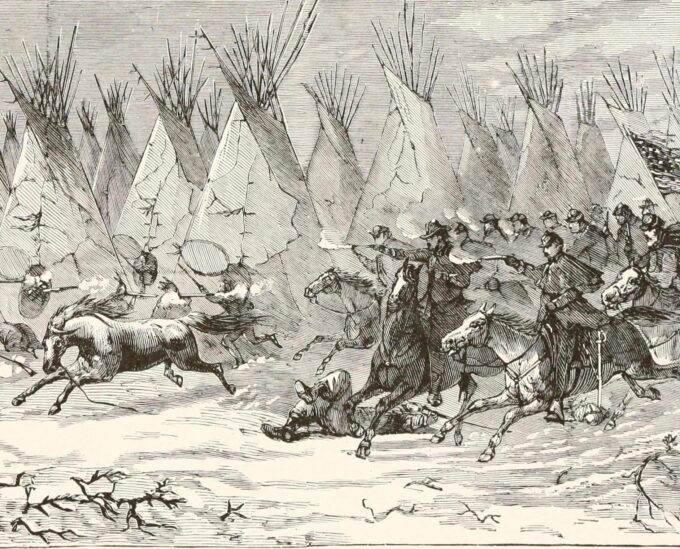
1919 illustration of a U.S. cavalry attack on a village – Public Domain
The violence perpetrated by the colonial powers – the extermination of the Aztec and Inca civilizations in the New World to seize their gold and riches, the extermination of indigenous populations in North America, Australia, New Caledonia, Algeria and Argentina to appropriate their lands, the massacres perpetrated by Europeans in Africa, India, Southeast Asia, and Oceania to usurp their natural and mineral resources, the trafficking of Black individuals to serve as slaves on the plantations of white colonists in the Americas – under the guise of glorious conquests, which are actually military expeditions devoid of bravery given the technological advantage of the invading and occupying armies, are inseparable from the current issues of restitution and reparations.
They are successive milestones on the path leading to the Holocaust, a phenomenon also European in nature. A “slippery slope” that culminated in that tragedy, to echo the phrase coined by Auschwitz survivor Hajo G. Meyer in his book The End of Judaism (2013). These transgressions against all ethics go far beyond the traditional spoils of war.
The distinction that historians in Germany seek to make between colonialism and the Shoah, in France between French colonization in Algeria and the Vel’ d’Hiv roundup, in the Netherlands between the massacres committed in Java and the deportation of 75% of the country’s 140,000 Jews between July 1942 and September 1943, in the United Kingdom between the infamous Boer War and the occupation and exploitation of India, in the United States between the Westward Expansion and the massacres committed in the Philippines, North Korea, Vietnam, Iraq, and Afghanistan, are they pertinent?
“Vernichtungsbefehl” (extermination order), the watchword of General Lothar von Trotha in German South West Africa, was the expression of a policy of annihilation. It was not fundamentally different in its exterminatory intent from Hitler’s “Vernichtungskrieg” (war of extermination) waged in Eastern Europe between 1941 and 1945. Only four decades separated these two campaigns. And less time still elapsed before the first massacres of Palestinians, which can be viewed in the context of territorial ambitions associated with the vision of a “Greater Israel.”
The concentration camp experiences of Spanish General Valeriano Weyler in the Spanish-Cuban War (1895-1898),  of Admiral Louis Adolphe Bonnard (1861-1863) in the hell of Poulo Condor in Vietnam, of Lord Kitchener in the Boer War (1899-1902), of General Graziani in the Nokra prison camps on the Dahalak Islands during the invasion of Ethiopia (1931-1943), and of General Lothar von Trotha in the Shark Islands of Namibia (1904-1908), are they not the preludes that will be brought to their climax in the Nazi camps and in the Gaza Strip?
Adolf Hitler referred in his speeches to the extermination of Native Americans and their forced relocation. “The Volga will be our Mississippi,” he declared in October 1941, referring to the Slavic and Jewish populations (1). The war against the Soviet Union was waged as a predatory war of plunder and destruction that was closely aligned with the ideology and methods of colonial warfare “The territory of Russia is our India, and just as the English rule India with only a handful of people, so we will govern this colonial territory of ours”, Hitler declared on September 17, 1941 (2).
At Sand Creek (1864), Col. John M. Chivington’s militia used the expression “nits make lice” to justify indiscriminate killing, including of children, in a massacre of Cheyenne people. This phrase was widely reported in period accounts and later history as part of the rhetoric of extermination against Native Americans. Comparable arguments—framing the killing of women and children as a means of interrupting biological reproduction— also appear in colonial contexts in Australia. Similar logic was later articulated during the Nuremberg trials, where commanders of the Einsatzgruppen sought to justify their mass executions. Variants of the same rhetoric have likewise been reported in contemporary extremist religious discourse concerning Palestinian populations More recently, on 9 October 2023, Israeli Defence Minister Yoav Gallant, announcing a “complete siege” of the Gaza Strip, declared: “We are fighting human animals and we are acting accordingly.”(3). Although made in reference to the fight against Hamas, the statement accompanied the announcement of measures affecting Gaza’s entire civilian population. And 23,000 palestinians children have been killed in the Gaza Strip over the course of three years.
The vision of the “Promised Land” and of the white settler colony—imagined as an empty tabula rasa—helped to produce a willingness to commit mass violence when deemed necessary. The belief in belonging to a “chosen race,” expressed for example in the doctrine of Manifest Destiny (4), was accompanied by a readiness to classify Indigenous peoples as “non-believers,” or even to dehumanize them as “parasites” (Volkskörper). Such assumptions formed a central component of a genocidal ideology.
At certain moments within the expansionist process, the impulse to regard the original inhabitants as less than human (Untermenschen) and to eliminate them, rather than merely dispossess them, became explicit. These dynamics were especially evident in the settler colonies of North America, Australia, New Zealand, New Caledonia and southern Africa. This pattern was not accidental: it emerged most clearly in regions where replacing Indigenous populations with a new settler population appeared both feasible and desirable. Within a broader European project of “ethnic disentanglement” (ethnische Entflechtung), populations classified as German were to be resettled in occupied territories from areas such as Baltic states, South Tyrol, Volhynia, Galicia Bessarabia, and Bukovina, where they had previously lived as minorities. The objective was not only to gather ethnic Germans (Volksdeutsche) from minority enclaves across Europe, but also to implant them as settlers in conquered Eastern territories after the removal, deportation, or killing of local populations.
The most radical consequence of conquest and settlement policies grounded in notions of “race” and “space” is genocide. When the Nazis plundered art in Germany and in the occupied and collaborating countries, seizing treasures from Jewish librairies, Jewish families and Jewish collectors, this was also part of a sinister agenda to eradicate all forms of Jewish memory. Similarly, under colonial rule, national identities were suppressed, resistance was quashed, and valuable heritage was transferred to Europe for “preservation” in so-called “universal museums”.
The term “preservation” took on a cynical connotation in these contexts. This echoes the experiences of African communities coerced into accepting “protection treaties” (Schutzgebiet) imposed in Africa, and the detention of Jews in Germany in 1938 under the guise of “protective custody” (Schutzhaft). These “universal museums” would later serve as inspiration for Hitler’s absurd and megalomaniac project of the “Führermuseum” in Linz, his hometown.
The history of European colonization—a chronicle of repression, massacre, plunder, and the destruction of cultural and religious heritage—finds a logical continuation in the advent of Nazism. Just as colonizers dehumanized Black, Asian, Indigenous, and Kanak peoples to appropriate their physical and spiritual wealth, the Nazis and their collaborators sought to dehumanize European Jews, seizing their assets and attempting to annihilate their faith through extermination. There is no difference in horror between these two moments of human history, whose kinship escapes only those who refuse to see it.
The restitution of works looted by colonizers in Africa, Asia, and Oceania should have been imposed on all – states, museums, collectors, gallery owners – in the wake of African and Asian independence movements, given the horror that accompanied these plunders, just as the restitution of works stolen from Jewish families victimized by Nazism under atrocious conditions should have been imposed on all in the aftermath of World War II.
Except for the remarkable work done in 1948 by the Allied Commission for the Recovery of Allied Property, this obligation was not honored. However, the insistence of Jewish associations and the US Department of State, albeit often obtained through strenuous efforts or costly legal recourse, is now acknowledged regarding the return of looted Jewish property to their descendants. As for the looted property from African, Malagasy, Oceanian, and Asian colonies, they still stand as trophies in major European and North American museums and collections.
Many former colonial powers have adopted policies or laws that restrict the deaccessioning of artworks from public collections. Those states have made slow and incomplete progress toward postcolonial justice. They have agreed to return certain objects, preferably those they have selected, and have apologized for specific colonial atrocities, although not for colonialism in its entirety, which nevertheless forms an inseparable couple.
Various social pressures from within, stemming from the cultural diversity of a more open European society, as well as external pressures such as lawsuits by victim groups and official demands for apology and restitution, are compelling authorities and legislators toward a more open engagement with colonial pasts.
In 2017, the French president publicly pledged, in a speech in the capital of Burkina Faso, to return looted objects to former African colonies “within 5 years”. However, the law he submitted to the National Assembly in April 2024 was rejected by the Council of State (the French Supreme Court). The Court argued that only “a higher public interest, an imperative reason” could justify a derogation from the inalienability of public collections. But the government carefully avoided mentioning the slave trade, colonial violence and spoliations. As justification, the bill refers to “international relations” and “cultural cooperation”.It was ultimately in April 2026 that the French Parliament adopted a law concerning the restitution of cultural property acquired illicitly between 1815 and 1972. While presented as a significant development, the law remains a limited derogation from the principle of the inalienability of public collections and is framed by substantial restrictions.
When the President of Portugal, Marcelo Rebelo de Sousa, declared on April 18, 2024, in Geneva during the third United Nations Forum for People of African Descent, that apologies are not enough and that former colonies should be compensated, and artworks plundered should be returned, we see the progress made (3). However, when we observe the sharp criticism that this statement arouses in the Portuguese political class, we also gauge the distance that still needs to be covered.
On March 25, 2026, the United Nations General Assembly adopted a resolution proposed by Ghana, qualifying the transatlantic slave trade and the enslavement of Africans as “the most serious crime against humanity.” One hundred and twenty-three states voted in favor (nearly all African states, along with South American and Caribbean countries); three voted against (the United States, Israel, and Argentina); and fifty-three abstained, including all former colonial powers.
Contemporary memory politics remains fragile and contested because it constantly coexists with counter-discourses grounded in strategic interests, national prestige, or imperial nostalgia. While several number of European States have engaged in symbolic gestures of repentance — through restitution policies, acknowledgments of colonial violence, or debates on reparations — these movements are regularly confronted by political narratives that privilege civilisational continuity, national pride, or geopolitical cohesion over historical self-criticism. This contrast illustrates how the recognition of historical injustices often encounters resistance whenever it appears to challenge national narratives, strategic legitimacy, or inherited structures of power. In this sense, debates on restitution and colonial memory are never solely about the past: they also reveal contemporary struggles over identity, sovereignty, and the political uses of history.
From the colonial conquests of past centuries to the tragedies unfolding today in Ukraine, Gaza and Yemen, history reminds us that the destruction of human lives is too often accompanied by the destruction of cultural heritage and collective memory. The circumstances may differ, but the consequences endure long after the weapons have fallen silent.
Notes.
(1) Ian Kershaw, Hitler: A Biography, Norton & Co., 2008; Adolf Hitler, Reden, Schriften, Anordnungen, 1925-1933 (Adolf Hitler, Writings, Speeches, Instructions), Institut für Zeitgeschichte, De Gruyter, 1994.
(2) Heinrich Heim, Adolf Hitler, Monologe im Führerhauptquartier, Werner Jochmann (Ed.), p.60-64, Orbis Verlag, Hamburg, 1980.
(3) Emanuel Fabian, “Defense minister announces ‘complete siege’ of Gaza: No power, food or fuel,” The Times of Israel, 9 October 2023.
(4) Ashifa Kassam, “Portugal needs to pay the costs of slavery and colonialism, says president”, The Guardian, April 24, 2024.
(5) John L. O’Sullivan (traditionally attributed), “Annexation,” The United States Magazine and Democratic Review, vol. XVII, no. 85, July–August 1845, p. 5 ( “our manifest destiny to overspread the continent allotted by Providence for the free development of our yearly multiplying millions.”)


