In the final paragraphs of the newly released book titled Sanctuary in America: How Activists Defied the Government and Defended Immigrants—And Why It Still Matters, lies the sentence, “And finally, sanctuary is still powerful because migration itself is a human right.” The authors of the text, Lloyd D. Barba and Sergio M. Gonzalez precede those paragraphs with a concise, honest and partisan history of the sanctuary movement in the United States since the 1980s. Written from the perspective of those who see the provision of sanctuary as the humane response to war, economic depression and turmoil and its hardships, the authors describe a movement based in the concept described by the Greek word agape and guided by a compassionate reading of spiritual and religious scriptures that demand that the stranger in the country be welcomed, the refugee be granted asylum and one love one neighbor as themselves.
The reader is introduced to the plight of those fleeing the war zones of Central America in the 1980s with a description of thirteen Salvadorans found dead in the desert in Organ Pipe Cactus National Monument. Thirteen other Salvadorans were found alive not far from the dead. The thirteen were deported back to El Salvador after they were released from the hospital. As the story unfolded in the media it became known that the migrants were escaping a bloody civil war in El Salvador—a war where most of the blood being shed was that of opponents to the US-sponsored regime then ruling in San Salvador. For most US residents, the fact of the war was news; the fact that the US government was paying for the death squads, the military and the repression being carried out by the El Salvadoran regime was not even on their radar. The movement’s history tells us that three men in Arizona were responsible for instigating the sanctuary movement. Two of them, with the last names Corbett and Dudley, had separately picked up two Salvadoran men hitchhiking along a desert highway near Tucson. Both Salvadorans were in desperate straits and both Corbett and Dudley gave them refuge in their homes. Both men were also Quakers and, as they watched the men, they had picked up hitchhiking be detained by the Border Patrol, they decided they needed to create a more organized means to take care of those fleeing war and repression made in the United States. The text continues, relating the rapid growth of the movement from Tucson to California, Chicago, and many other cities and towns across the United States. The narrative also describes the growing repression of the movement by the US government. This repression began with a refusal by the Immigration & Naturalization Service (INS) to accept the claim of political repression from those fleeing the military and paramilitaries of the governments the United States was funding to its south. Instead, the migrants were classified as economic migrants and their request for asylum were rejected. Then, federal agencies turned their focus to the sanctuary movement itself, spying, harassing, threatening and ultimately arresting several so-called leaders on federal charges. Those working in the sanctuary movement did not back down and neither did most of their supporters.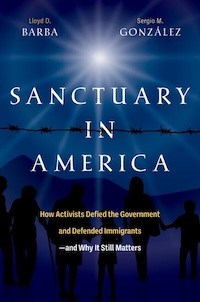
A similar narrative exists regarding what the authors call the new sanctuary movement, begun in response to the ongoing intensification of the deportation and detainment arm of the US government that began with the creation of the Department of Homeland Security (DHS) after the events known as 9-11. This new agency incorporated all existing elements of the immigration bureaucracy under its umbrella, while increasing its enforcement sections dramatically. In 2026, there is no other US agency more feared than that known by the acronym ICE—Immigration and Customs Enforcement. This agency is now one of the biggest police agencies in the world and is better funded than all but a few of the world’s national militaries. Once ICE began its activities in the early 2000s staging workplace raids, dragnets of immigrant neighborhoods and unconstitutional detention, those who worked with migrants and those who ministered to them realized that a new sanctuary movement would be required. Although more focused on providing services and keeping migrants, especially the undocumented, safe from the government forces out to grab and deport them, the foundation of those offering and organizing this new version of the movement were acting in the name of the same radically humane spiritual insistence to welcome the stranger.
Sanctuary in America does not sugarcoat what the US government has done and does in the name of immigration control. Democratic presidents and their deportation and detention policies are not excused any more than the immigration policies of Republican administrations. In its narrative, the voice on hears is the voice of the sanctuary organizer, the sanctuary provider and the immigrants themselves. It is an important text for this time and a clear and concise reminder that the religious in the United States are not all as full of hate and pride as their preachers and their presidents. In fact, they are its opposite, recalling and acting in the name of compassion for and solidarity with their fellow humans; in resistance to those in power who refuse the immigrant and the refugee, either out of political expediency or demagogic hatred.