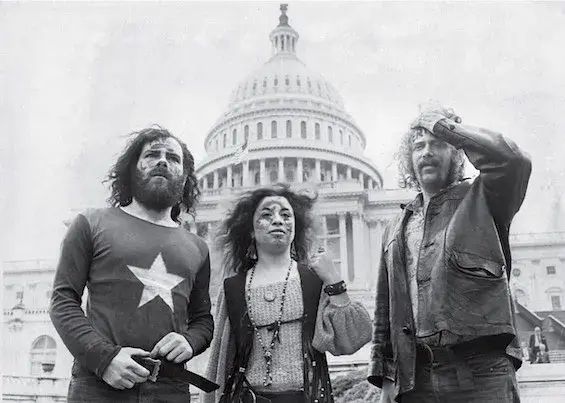
Jerry Rubin, Judy Gumbo and Stew Albert in front of the US Capitol, 1971. Photo: D.C. Public Library Washington Star Collection.
Described in her FBI file as “the most vicious, the most anti-American, the most anti-establishment, and the most dangerous to the internal security of the United States,” the late Judy Gumbo Albert’s life was marked by a fierce tenacity for justice. While Gumbo was living with dementia towards the end of her life, her daughter Jessica Epstein described her mother — who’d been an expert in communication — of having lost much of her ability to communicate with one glaring exception. “She was perfectly lucid when talking about her hatred of Trump.”
The lifelong activist was born in Canada, but spent most of her life in the states. After moving to Berkeley, California in 1967, she worked at underground newspapers the Berkeley Barb and Berkeley Tribe and became involved in the People’s Park protests.
Along with her partner (and later husband) Stew Albert, Abbie Hoffman, Anita Hoffman, Paul Krassner, Ed Sanders, Jerry Rubin, Nancy Kurshan, Jonah Raskin, Phil Ochs, Bob Fass and others, she was one of the original Yippies — co-founders of the Youth International Party in 1968 that blended revolutionary politics, hippie counterculture and media manipulation via public happenings.
Her trial by fire was at the Festival of Life counter-convention held in the streets of Chicago during the Democratic Convention in August of 1968, designed to call out the political party that had escalated the bloodbath that was the Vietnam War. That slaughter was micro-mirrored by the Chicago Police Department, who treated Yippie skulls like piñatas. (This led to “The Trial Of The Century” known as the Chicago 8. Gumbo later co-edited the definitive book about the events called The Conspiracy Trial.)
Judy would write about locating her nerve in Chicago in her memoir Yippie Girl while recounting the sight of Chi-town coppers goose-stepping towards protestors with billy clubs held aloft: “They looked to me like robots marching in lockstep, illuminated by globules of white light like landing lights on an alien spacecraft. I did not feel afraid. Just the opposite, I reveled at the thrill of being in a live action anti-war documentary. A sense of power surged through me, to deliver to me that moral courage I needed to do my part. My hatred of injustice had triumphed over fear.”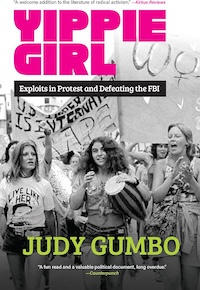
Black Panther leader Eldridge Cleaver dubbed her “Gumbo” — her boyfriend being the similarly named “Stew” — as in Stew Albert. She became active in the emerging Women’s Liberation Movement and joined the Women’s International Terrorist Conspiracy from Hell (W.I.T.C.H.), a group that combined feminist ideology and Yippie theatricality. Along with Nancy Kurshan and Genie Plamondon, she visited North Vietnam in 1970.
In 1975, she discovered an electronic listening device planted in her and Stew Albert’s car. (And a second one elsewhere.) They sued the U.S. government in 1979 for illegal surveillance and a laundry list of other offenses and won $20,000 — equivalent to $75,000 in 2020 and considerably more than revolutionaries usually make. Of equal importance, the feds (as Gumbo gleefully put it) “surrendered” and any more surveillance was officially “placed in a pending inactive status.” Found in an F.B.I. file was this note about Gumbo and Stew: “It is felt that further active investigation of the subjects at this time would serve little purpose except to cause an embarrassing situation should it be detected.”
After breaking up with Stew, they reunited and married on Mayday 1977 and soon afterwards she gave birth to daughter Jessica. She continued various work as an activist, notably as a Planned Parenthood fundraiser. (As Jeffrey St. Clair notes, both Gumbo and Stew also wrote for CounterPunch.) Stew died in 2006, while her following husband, community leader David Dobkin, passed away in 2014. Judy Gumbo Albert died in a memory care facility on Monday, September 14th of this year. She is survived by her last husband, historian and retired professor Arthur Eckstein and of course her beloved daughter Jessica Epstein (who works in the field of public affairs), son-in-law Dan Epstein and grandson Simon Epstein.
Jessica Epstein wrote this to friends the following day:
She was comfortable when she passed and had what she would call ‘the good drugs’…My mom was fire, hustle, warmth, passion, style, and a stubborn determination. A thoughtful and loving mom and an absurdly indulgent grandmother. She is with Stew now and forever but will always exist with other loves too…Her fire never dimmed.
Jessica goes on to note that
She told her story best: Judy Gumbo…Judy’s funeral will be in Portland very soon, and there will be a memorial celebration in Berkeley down the line…I know she would appreciate a donation in her honor” to any of the organizations listed below. ”Judy always specified her donations to Panned Parenthood were for direct abortion services.
I became friends with Gumbo and Stew at a memorial for Yippie co-founder Jerry Rubin in 1995, a year following his death. We stayed close and they spent a weekend with me in Los Angeles where we indulged in buckets of Chinese food, hung out with actor Donal Logue who played Stew in Abbie Hoffman biopic Steal This Movie! and went to see my pal and singer-songwriter John Stewart perform at McCabe’s Guitar Shop. But my most powerful memory of Gumbo is the film clip that seems to be in every 1960s documentary of her standing outside the Capitol in D.C. after the Weather Underground bombed it in 1971. (No one was hurt.) With her long hair flowing in the wind and her face exuberantly painted like a psychedelic canvas, she defiantly points to the Capitol dome and declaims “We didn’t do it…but we dug it!
Judy Gumbo, Judy Gumbo, Judy Gumbo — we dug you!