Warren Haynes playing at Guitar Center. (Screen capture of video posted to X.)
The Japanese author, Haruki Murakami, writes in his novel, Hard-Boiled Wonderland and the End of the World: “Music brings a warm glow to my vision, thawing mind and muscle from their endless wintering.” His surreal tales of love and existential crisis create portals of entry into a dreamscape world where the rules and routines that so often dictate our lives no longer apply. All that matters is life of feeling; a hazy establishment of emotional reality. Given the schematics of his imaginative universe, it is hardly a surprise that music plays a critical part. In his conversation with conductor Seiji Ozawa, the two artists, despite their divergence of experience in the field of music – Ozawa was one of the world’s great conductors, Murakami is not a musician – agree that an “open mind” is essential to any musical experience. As Murakami puts it, one must “open the ears to wonderful passages and simply take them in.”
Warren Haynes, the legendary singer/songwriter and guitarist who founded the band Gov’t Mule, and played in The Allman Brothers Band for 25 years, has created his own portal into a world of dreams, both of his own and those that color a universally accessible plane of emotion and imagination, with his new live career retrospective, Dreams and Songs. Recorded in 2019 in Haynes’s hometown of Asheville, North Carolina with the 64-piece Asheville Symphony Orchestra, its passages move the listener through the various stages of Haynes’s prolific career: His solo albums, his intense work with Gov’t Mule, his years touring with the Allman Bros., his time playing with The Dead and leading a symphonic tribute to Jerry Garcia. It was the latter experience in 2012 that was Haynes’s first collaboration with an orchestra, the musician told me when we talked on the phone about Dreams and Songs. As the shows honoring Garcia multiplied, Haynes said that he “grew more comfortable in that musical environment.” It was then an alluring twist in an already diverse career when a representative from the Asheville Symphony Orchestra contacted Haynes with the suggestion that they work together. After deliberation, Haynes determined that a career retrospective, especially appropriate in his hometown, was the best approach
Thomas Wolfe, Asheville’s most famous native son, famously titled a novel, “You Can’t Go Home Again.” Playing in the Thomas Wolfe Auditorium, Haynes travelled home from New York, where he’s lived for most of his adult life, to revisit, and with symphonic support, reinvent many of his musical milestones.
Gov’t Mule has a song that does not appear on the new live record, “Million Miles from Yesterday.” The soulful rock song amplifies Haynes’s blues-inflected voice as he sings,
Born on the edge of a lonely town
Searching for something no one had.
The song charts a trajectory of success, finding that “something” one million miles away from the “lonely streets” where “time rolls by like a midnight train.”
Returning to the lonely streets, Haynes makes another song central to his new live record, the eponymous “Dreams and Songs.” During our conversation, he said it is his most “autobiographical.” Unlike the sense of deliverance that animates “Million Miles from Yesterday,” “Dreams and Songs” is full of melancholic longing. Paraphrasing Wolfe in the chorus, Haynes sings,
Is there any comfort to be derive
From knowing that most of our lives
We can never be the same
We can never go back home
Those that can are lucky, I guess
To somehow escape from this mess
Me, I can only do it in dreams and songs…
Don Was, the producer of the original Gov’t Mule version of “Dreams and Songs,” and the co-producer, along with Haynes, of the new live record, said that he felt sadness when watching Haynes sing the ballad for the first time. In its reimagined version on the live record, it opens the show, and in reprise mode, offers an emotional conclusion. What happens in between is a musical memoir, the documentation of many movements in a life of dedication to art and craft. It is beautiful, but also acts as a subtle protest, or in the spirit of “Dreams and Songs,” a biographical chronicle of a journey that juxtaposes against what now passes for “culture” in the United States.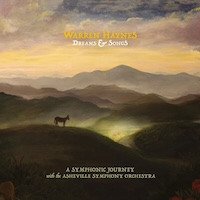
The late anarchist philosopher, David Graeber, wrote the following broadside when assessing a culture that imposes on nearly all inhabitants a suffocating combination of financial dictates and bureaucratic regulations: “As for the eccentric, brilliant, and impractical: it would seem that society has no place for them at all.”
Warren Haynes had two impractical dreams – the first was to eke out a living through a life dedicated to the pursuit of artistic excellence and expression, as a songwriter, singer, and guitarist, while the second added an element of eccentricity even within that fearsome challenge. That was to combine his influences of rock and roll, blues, jazz, and soul into the creation of a musical catalogue that isn’t exactly “radio friendly,” as the old phrase of an analog time would have it. In his own words, he was “bit by the improvisational bug.” The scar is still visible every time he leads his own band, Gov’t Mule, through a ten-minute-plus rendition of a familiar or novel song. The “jam band” ethos, for lack of a better term, allows Haynes and his musical allies to make spontaneous discoveries, giving the audience the wonder of surprise in the process. Haynes has likened his career to “getting away with murder.”
The amplification of an individuated artistic imperative is murderous in a consumer culture, even if it creates product for people to consume. Like the best of art, music with genuine imagination and soul cuts through the cacophony of cash registers, demands for “efficiency,” calls for “outcome maximization,” and the reduction of life, whether it is education for youth or management of adult workers, to that which is “practical,” meaning profitable.
Of course, a teenager of average means in North Carolina in the 1970s would have faced tremendous obstacles when attempting to cultivate a life of songs and dreams, even if the deadening of culture and the narrowing of options for the eccentrics is worse now. Dreams and Songs arrives in one’s aural perception like documentation of subversive possibility. Its music pays tribute to individuality in a society that erases the individual, while also honoring the majesty of collaboration in a society that encourages isolation.
Of course, none of the contextual story would mean anything if the music wasn’t good. Edgar Allan Poe wrote that the first duty of the writer is to give the reader “pleasure.” The Poe principle would apply to those who not only write with a pen, but also a guitar. When Haynes decided to rehearse, perform, and ultimately record a live album with the Asheville Symphony Orchestra, he hoped to make it as pleasurable and artistically viable as possible, but fascinatingly enough, he had little to no interest in the mini-tradition of rock bands recording with orchestras. When I mentioned Deep Purple, Metallica, The Who, and Yes – all bands for whom Haynes has expressed admiration – he indicated that had not listened to their records in preparation for making his own symphonic venture.
“I never really paid attention to those records,” Haynes said, “I like the Elton John symphony record from way back, but if I could point to anything as an inspiration for this it would be Thelonious Monk’s Town Hall sessions with a big band or the Frank Zappa symphony record. Those are kind of weird examples, and people might only make the connection with the more intricate songs, but I could never really get into rock records with a symphony. So, whether it was good or bad, I had a unique approach to making this record.”
For the record, Haynes paired the Asheville Symphony Orchestra with veterans of his own solo touring band, featuring Oteil Burbridge on bass, Greg Osby on saxophone, Jeff Sipe on drums, and avant-garde jazz virtuoso, John Medeski, on keyboards. After more rehearsal to which a jam band is accustomed, the eclectic musicians found the means of naturally integrating into the enormous sound of the orchestra. The combination is particularly powerful on the more “intricate” numbers, such as Gov’t Mule’s odd time signature groove that swirls together jazz, funk, and hard rock, “Thorazine Shuffle,” and the Haynes-composed Allman Brothers tour of a Headhunters meets the blues musical landscape, “Instrumental Illness.” Most impressive about these performances is that the orchestra plays with a dexterity that maintains their jam quality. Even if they are playing a carefully plotted arrangement, the improvisational spirit of the songs remains untouched. They sound like jams.
Haynes, though admittedly “relaxed” in his vocal approach, due to the orchestra “wrapping itself around” his voice, stopped reading the sheet music during the show, and took the performance as a “beautiful improvisational challenge.” To enhance his ability to react, on the fly, to what he was hearing, he had the orchestra “cranked up” to maximum level in his ear monitor during the show.
As part of his unique approach to recording with an orchestra, Haynes used several different arrangers for the performance, including co-producer Don Was and John Medeski. The musical achievement is that unlike other rock meets symphony marriages, which Haynes was too polite to say, the Asheville Symphony Orchestra doesn’t merely sound like window dressing for the Warren Haynes Band. The orchestral contributions allow for reimagination of the music, adding drama and dynamism. All of the songs, including Mule tracks, Haynes solo songs, Allman Brothers classics, and Grateful Dead favorites, notable from Haynes’s days leading The Dead on tour and playing with the Phil Lesh Quintet, take on surprising new emotional resonance due to the symphonic experience.
A story develops in the first set of Dreams and Songs. Leading off with the titular song, it places the listener in the mindset of the melancholic dreamer; the vagabond searching for comfort in faint songs and elusive dreams. A transition drifts the music directly into a rousing and cinematic rendition of the Allman Brothers hit, “Dreams.” It is as if that same voice is reckoning with the reality that, even while some dreams turn to reality, others – perhaps, those existential longings that remain nameless and haunt the dreamer – are forever out of grasp. “I’m in hunger,” Haynes sings with the strings rising behind his shout, “for dreams I’ll never see.” Osby’s mournful sax solo and Haynes’s tearful guitar solo take on the role of dueling, respectively, with the massive force of the orchestra. It is a collision of inner-feeling.
From there, Haynes and company launch into the Gov’t Mule staple “Banks of the Deep End,” a tribute to founding bassist Allen Woody, who died in 2000. A testament of grief and resilience, “Banks of the Deep End” captures the same conflict of the one who lives life according to an internal cartographer; moving according to passion, not only rising with the triumphs but collapsing with the tragedies.
The next song, “Spots of Time,” co-written with Phil Lesh, borrows the title phrase from William Wordsworth to consider the moments that leave indelible marks on a diverse life. One of the most beautiful arrangements on the record, the song moves through its escalating sections with a rhythm and concentration that the poet would appreciate, even when it is exploding into an emotive outburst, Haynes’s guitar running through notes at ballistic speed, the orchestra climbing to a crescendo.
One of the most stunning moments follows, with “Broken Promised Land,” a song from Haynes’s debut solo record. After Haynes sketches images of the homeless, impoverished children, and police abuse of the poor on the dirty, neglected streets of American cities, he moves from the blues to rock and roll with his fiery guitar solo. With the symphony rising behind her, backup singer Jasmine Muhammad cries out in a voice that is both beautiful and similar to the scream of instant grief. The crowd lets out an emotive roar. After navigating various musical treatments of dreams, Haynes has provided a painful glimpse of those countless dreams that undergo destruction, becoming spiritual wreckage, before they even begin. The “broken promises” of the so-called “promised land,” often referred to as the “greatest country in the world,” decorate every city with eyesores, rendering the lives that they represent, at least in the view of the politically and financially powerful, easy to discard.
The music then transitions into surrealism. Perhaps, the only response to such heartbreak is a defiant acknowledgement of absurdity. That’s “Thorazine Shuffle.”
The first set ends with what Haynes said “might be his favorite” Grateful Dead song, “Terrapin Station.” “The original version had an orchestra, and that was a wonderful reason to include it,” Haynes said, “They were never able to bring that to life on stage.” With Dreams and Songs, Haynes, his band, and the Asheville Symphony Orchestra give the audience a gift of magical novelty: the coming to life of a Grateful Dead epic that feels emotionally summational and conclusive.
While the first set feels like a cohesive presentation of life at its most adventurous, passionate, and explorative, the second set is a musical showcase of great range. The Mule folk ballad, “Raven Black Night,” with the aid of the orchestra, transforms into a rock and roll juggernaut. A song that Haynes wrote for one of Gregg Allman’s solo records, “Just Another Rider,” becomes a cinematic tour de force, steeped in the blues, and “Whipping Post” manages to become even wilder than usual with the propulsion of a symphony.
“The same place,” Haynes told me when referring to the setting of the show, “used to be called the Asheville Municipal Auditorium. That’s where I saw all my earliest concerts. So, I had memories pre-dating rehearsal, through the entire rehearsal process, and even on stage, of seeing my first concert there and how overwhelming it was. To be there with the symphony performing a retrospective of my career was also overwhelming. Even during the show a few times, I got pretty overtaken by the emotions.”
Listening to Dreams and Songs, it is impossible not to note how grand it all sounds. It not only presents one artist’s musical life, but also the immensity of dreams and songs, as they define and direct those who live according to their calling. So much of so-called “cultural” product in the age of AI frivolity, obsessive and trivial “branding,” and algorithm-driven consumption seems so tiny: Corporate-committee creations that might make a few people rich in the short term, but will leave no legacy. In a stagnating culture, much of what people consume provides instant gratification, and becomes forgettable as soon as the instant passes. Scroll to the next empty thing. Click, click, click.
It is hardly a surprise that in the contemporary environment, Cadenza reports that orchestras are dying. Those in Honolulu, Syracuse, New Mexico, and San Antonio have closed in recent years, while the orchestras in Boston, San Francisco, and Washington, D.C. are all struggling for survival. Cadenza concludes that the American symphony orchestra is the “most institutionally distressed cultural form in the country.”
It is in this context that Dreams and Songs presents an alternative. Rather than becoming complacent in the “broken promised land,” as Haynes advises listeners in his song, “Thorazine Shuffle,” it is far better to find the “monster inside you” and “let him come out to play.”