Incoming!
The Mighty Fortress that is our Bach has once again come under spirited attack. Volleys of musket fire ricochet off the parapets. Fusillades are exchanged on the plain beyond. The stomping hooves of a cavalry charge carry through the smoke, spurred on by the ostinato bombardment from the heavy cannons known as Sopranos (Sängerinnen) in the German battlefield slang of the 18th century. Bach died at the exact midpoint of that century, most of its one hundred years dedicated to war. He is long accustomed to being under siege. Assaults keep his forces in fighting form.
This latest plan of campaign—inspired, incessant, carefully calculated yet also exuberantly irrational—is laid out in a new album called Bach Artillerie dispatched by the insurgent duo of drummer Greg Saunier at his battle-hardened trap set and keyboardist Curt Sydnor manning three Vietnam War-era synthesizers.
Positioned in the ramparts that the pair has set their gunning sights on is the elite regiment known as the Goldberg Variations. Bach trained every third number of these highly decorated keyboard veterans to be a tightly organized canon in which one contrapuntal voice marches or trots behind the other in exact imitation. Astoundingly, each successive canon expands the interval between the voices by one step, beginning at the unison in variation 3 and reaching beyond the octave to a ninth at variation 27. Variations 12 and 15 even take evasive action, faking desertion by having the following part run in the opposite direction (that is, in contrary motion) from that commanded by the first voice. This tour-de-force precision drilling proves all-the-more impressive since the terrain over which the canons attack is a fixed bass line of 32 bars (which also happens to be the number of variations plus the opening aria and its repeat after the 30th variation is played).
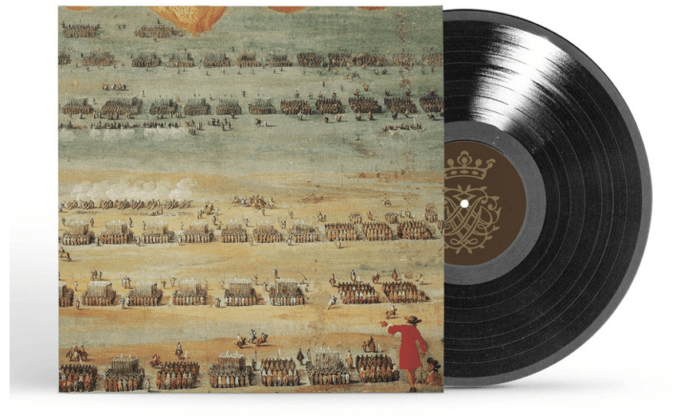
Cannon with one of the middle Ns shot out of it is that pun targeted by the album’s seemingly provocative title, which, like the track listings, is in French, the language used by Bach for his Brandenburgs (Six Concerts avec Plusieurs Instruments) but not for the Goldbergs. French was also the language of military theory even among the Germans—as in Les principes généraux de la guerre, the 1748 treatise by the most famous warrior king of the epoch, Frederick the Great, who was also a flute-playing admirer of Bach’s music. This allows the Artillerists a related pun on batterie—the French word both for the drums and for a unit of artillery pieces like those seen in the album’s cover image of a 17th-century battle scene.
The Goldberg canons range from the bravura to the brooding. The notes Bach put down on paper are heard on this album as if through the fog of war and din of battle; flanking maneuvers mix fury and fatigue; synths are caught in crossfire, drubbed by well-aimed percussion salvos and menaced by duck-and-cover cymbal crashes. This is live musical combat, recorded in a Nashville sitting room with daylight streaming through the sash window, blankets absorbing the spray of Sydnor’s armor-piercing Minimoog bullets and the blood-curdling snap of Saunier’s snare and bass drum bombs.
The exploding ordnance scrambles the original succession of the canons so that the tracks don’t proceed with Bachian discipline from narrow to wide formations, instead breaking ranks and discharging their duty in no particular order.
The skirmish starts with the canon at the octave, Sydnor pawing at Bach’s initial motive before cutting loose into a full delivery of the variation, with Saunier subjecting the contrapuntal lines to an increasingly heavy barrage from his batterie. The engagement ends indecisively, drifting distractedly from its home base, as if the commander turns towards his tent to consider his next move. The canon at the second follows with blaring abrasiveness, the drums throttling every sixteenth note, the cymbals crescendoing towards oblivion.
Interspersed among the Goldbergs are wonderfully warped riffs on each of the three movements of the Fifth Brandenburg Concerto for which MIDI technology is deployed to orchestrate and evocatively obfuscate. The magnificent Bachian wreckage in this No-Man’s-Land sounds like either a reverie or a prelude to war. But even here stray bullets ping off the ruins and moldering forms of the fallen. Sydnor picks up the first movement (track 4) in the midst of the poised transition to the infamously manic harpsichord cadenza, which begins with slow-motion strains—a synthed-up mélange of churchy bells and angelic harps. But these intimations of heaven and/or hell are ripped through by intermittent sniper fire and a single distant cannon’s report (no canon here, though the concerto’s third movement trots out a couple of them) that presages a return of hostilities. The cadenza then careens from ironic poise into catastrophic PTSD outburst before the opioid haze of the main theme blurs by—either rout or a bold declaration of victory.
The dedicatee of these concertos, the Margrave of Brandenburg, was himself a general as well as an avid hunter, and these concertos were meant as banqueting music. The hunt was another favorite—and very loud—pastime of German princes, often accompanied out in the field by their musicians, who went on to entertain at the evening’s banquet. Some court band members accidentally lost lips and even their lives in the slaughter. Given this historical context, the Artillerists’ analog blunderbussing through the Brandenburgs finds its mark.
J. S. Bach’s own title for the Goldbergs was the workaday Clavier-Übung—keyboard practice. The name that the work is now universally known by became attached to it a half-century after the composer’s death, when Bach’s first biographer, J. N. Forkel, claimed that the variations were commissioned by an insomniac Russian diplomat, Count Hermann Karl von Keyserling, whose private keyboardist, J. G. Goldberg, played Bach’s variations during the Count’s sleepless nights.
This origin story doesn’t jibe with historical fact, but there are still no reasons to doubt that, in the years after their publication in 1741, the variations were indeed heard by an aristocratic admirer of Bach’s music in flickering candlelight in the quiet of night, played by Keyserling’s even moodier harpsichordist who was one of Bach’s most brilliant, willful, and self-critical students. Goldberg is said to have burned most of his own manuscripts. Perhaps the sublime ingenuity and coruscating technical challenges of the variations that later took on his name lighted Goldberg’s destructive desire to set the candle’s flame to so many pages from his own pen.
The Romantic atmosphere of retreat and rumination that glazes the Goldbergs makes them all the more alluring a target of mischief for myth busters like Sydnor and Saunier—and before them the pianist provocateur, Uri Caine.
The Artillerists describe their interventions as an “absurdist take” on the Goldbergs, but the real absurdity might well be that Art has so long camouflaged its alliance with—indeed its dependence on—the ideologies of war. In his protracted hassles with town councils and other proto-democratic institutions, Bach sought covering fire from autocratic princes and kings. These were the same monarchs that had established standing armies and who organized their orchestras and other musical forces along kindred lines. Music both distracted from war and celebrated it. Even Bach’s title for his variations—Übung—can now, after the Artillerists’ 37-minute vinyl engagement, conjure the military exercises on the parade ground, especially when the asymmetric discipline of Saunier’s snare lashes the troops.
The frisson of fright carries a comic charge: in the Artillerists’ subversive operations, the humor is paradoxically both black and blinding—maybe deafening too. These incendiary audiocrats bunkered down in Nashville lob their bombs into Count Keyserling’s music room and delight in the explosions.
“It is the fashion to make war, and it will likely remain fashionable for quite a while longer,” wrote Frederick the Great to Duchess Louise Dorothea of Saxe-Gotha-Altenburg in the spring of 1760, a few weeks before the Prussian King laid siege to the city of Dresden, site of some of J. S. Bach’s greatest keyboard triumphs.
Keyserling’s diplomacy stoked the wars of the mid-18th century. Perhaps it was his conscience that kept him up at night and primed him to feed his nocturnal melancholy with a bit of Bach. Now in this age of Smart Warfare, Bach Artillerierenders impossible the full retreat to the guttering flames and nocturnal reflections once enjoyed, if fitfully, by the Count.
Sleep won’t ever come to Keyserling now that the guerrillas Saunier and Sydnor are inside the castle keep.